Ministry of Fisheries, Animal Husbandry & Dairying
WOAH PVS–PPP Targeted Support Workshop on “FMD-Free Zone Development in India” concludes with focus on strengthening State Action Plans and Public–Private Partnerships
Posted On:
18 SEP 2026 3:56PM by PIB Delhi
The Department of Animal Husbandry and Dairying (DAHD), Ministry of Fisheries, Animal Husbandry and Dairying, Government of India, in collaboration with the World Organisation for Animal Health (WOAH), organised a three-day PVS–PPP Targeted Support Workshop on “FMD-Free Zone Development in India” from 15–17 September 2026 at the National Agricultural Science Complex (NASC), New Delhi. The workshop brought together representatives from the DAHD, 12 State Animal Husbandry Departments, experts from WOAH, Paris, CDDL/RDDLs, NDDB, ICAR Research Institutions, industry, livestock value-chain stakeholders and technical experts to strengthen the pathway towards establishing FMD-free zones and compartments in India.
The workshop was aimed at supporting national and state stakeholders in refining and strengthening their FMD-free zone and compartment action plans through technical analysis, peer learning, public–private partnership (PPP) design and alignment with WOAH standards and official recognition requirements.
The Inaugural Session was graced by Shri. Naresh Pal Gangwar, Secretary, AHD and WOAH Delegate of India in presence of Dr Naveena B. Maheswarappa, Animal Husbandry Commissioner, DAHD, Dr Divakar Hemadri, ADG (Animal Health), ICAR, New Delhi and Ms. Barbara Alessandrini, Head, Capacity Building Department, WOAH, Paris.
Shri. Naresh Pal Gangwar, Secretary, AHD in his address highlighted India’s journey for FMD Control in India. He informed that, India has made substantial progress in FMD control under the Livestock Health and Disease Control Programme. Under the Government’s flagship FMD control programme, the country has invested in large-scale vaccination, animal identification, surveillance, laboratory strengthening and disease reporting. He mentioned about the Department’s objective under the Livestock Health and Disease Control Programme to control and ultimately obtain FMD freedom by 2030. Administration of more than 147.16 crore FMD vaccine doses till date, benefiting around 8.04 crore farmers and decline in FMD outbreaks from 132 in 2019 to 40 in 2025 and 20 till August 2026 and decline in NSP antibody positivity to 8.1% in 2025 were also highlighted.
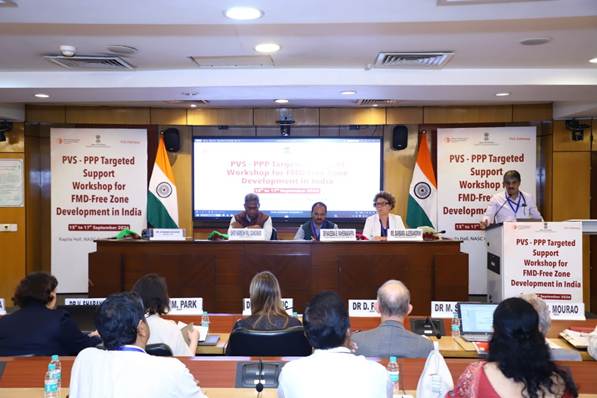
He also informed that this workshop is a continuation of the WOAH PVS-PPP Targeted Support which was held in India during 2025 and thanked WOAH for their continued partnership and technical support through the PVS–PPP Targeted Support programme. He further added that the Department has developed the guidelines for creation of FMD free compartments in India with extensive rounds of consultation with stakeholders. Further the Department for the first time has also come up with the Minimum Standards of Veterinary Infrastructure in India in 2025 and the Department is supporting the States under the Support to States for Capital Investment (SASCI) framework, to address infrastructure and system-readiness gaps identified by States. He also urged to have a discussion on the emerging threat of SAT Serotypes of FMD and highlighted India’s preparedness to deal with such exotic serotypes.
He emphasised that, India has demonstrated a sustained national FMD control and the next step is to prove and maintain freedom in defined populations. With WOAH's technical guidance and the combined efforts of States, Veterinary Services, laboratories, industry and exporters, we can build FMD-free zones and compartments that are scientifically credible, operationally sustainable, digitally traceable and capable of supporting greater confidence and trade.
On the first day WOAH experts provided an overview of the WOAH Performance of Veterinary Services (PVS) Pathway and the PVS–PPP approach, WOAH requirements for recognition of FMD-free zones, surveillance and post-vaccination monitoring, international experience from Brazil, and opportunities for public–private engagement.
A key component of the workshop was a series of practical group exercises involving public and private stakeholders from the nine priority States. The second day focused on co-designing solutions to address identified bottlenecks. Discussions covered vaccination systems and engagement with the vaccine industry, surveillance and diagnostic partnerships, animal identification and traceability, producer organisations and value-chain integration, as well as investment and financing models.
The final day focused on validation of State-level action plans. Representatives of the nine priority States presented their proposed action plans, followed by technical feedback from WOAH experts and other specialists. The presentations provided an opportunity to refine interventions related to surveillance, vaccination, laboratory preparedness, traceability, biosecurity, movement control, veterinary infrastructure and PPP engagement.
The workshop emphasised that PPP engagement should extend beyond financial participation and encompass the full animal-health value chain, including vaccine supply and delivery, diagnostics, animal identification and traceability, producer organisations, dairy and livestock value chains, veterinary service delivery and risk communication. The approach is intended to create stronger ownership, accountability and sustainability of FMD-free zone initiatives.
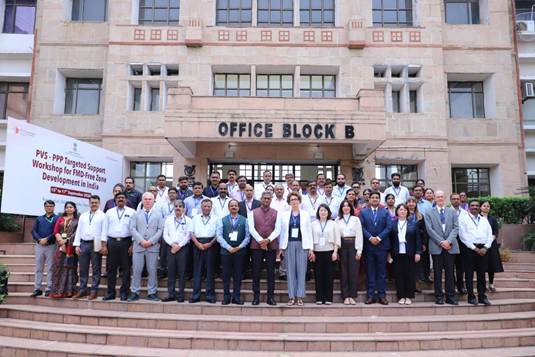
The three-day deliberations culminated in the refinement of State Action Plans and identification of priority technical interventions and opportunities for public–private partnership (PPP) in FMD-free zone and compartment development. In the concluding session, Dr. Naveena B. Maheswarappa, Animal Husbandry Commissioner, expressed appreciation for the valuable technical guidance provided by the WOAH team of experts and acknowledged the active participation and constructive contributions of the State Animal Husbandry Departments and other stakeholders.
Dr. Maheswarappa expressed confidence that the States would translate the outcomes of the workshop into clear, evidence-based and time-bound action plans for the progressive development of FMD-free zones and compartments, with strengthened collaboration and meaningful engagement of the private sector.
The initiative represents an important step towards India's national objective of achieving FMD-free status by 2030. The strengthened State Action Plans, supported by WOAH standards and appropriately designed public–private partnerships, are expected to provide a structured pathway for progressive development, maintenance and eventual recognition of FMD-free zones and compartments in India.
***
SM/
(Release ID: 2312013)
Visitor Counter : 178