Ministry of Science & Technology
Union Minister Dr Jitendra Singh Inaugurates Indigenous SPROUT Facility at BRIC-NIPGR to Accelerate Development of Climate-Resilient Crops
SPROUT will enable crop research under different environmental conditions, helping connect genomics and gene technologies with faster trait evaluation and crop improvement says Dr Jitendra Singh
India witnessing simultaneous advances in plant and human biotechnology as part of BioE3 policy and the biotechnology push of Modi Government: Dr Jitendra Singh
SpeedSeed technology can reduce chickpea generation cycle to around 40 days, considerably shortening breeding timelines: Dr. Jitendra Singh
Posted On:
15 SEP 2026 4:31PM by PIB Delhi
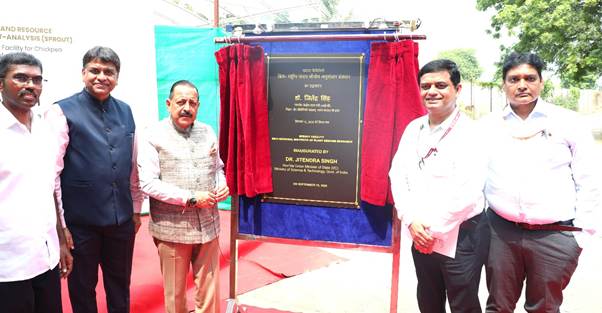
Union Minister of State (Independent Charge) for Science & Technology and Earth Sciences and MoS PMO, Dr. Jitendra Singh today inaugurated the "SpeedSeed Phenotyping and Resource Optimization for Unified Trait Analysis" (SPROUT) facility at BRIC-National Institute of Plant Genome Research (BRIC-NIPGR), New Delhi, describing it as an important indigenous capability for developing climate-resilient crops suited to different weather conditions.
The Minister said that in a country as geographically and agro-climatically diverse as India, the ability to study and evaluate crops under different environmental conditions is critical for strengthening agricultural resilience. The Minister said the initiative is part of the wider BioE3 policy and the biotechnology push of the Modi Government, under which simultaneous breakthroughs are taking place in plant biotechnology as well as human biotechnology. The BioE3 policy itself includes climate-resilient agriculture among its strategic thematic sectors.
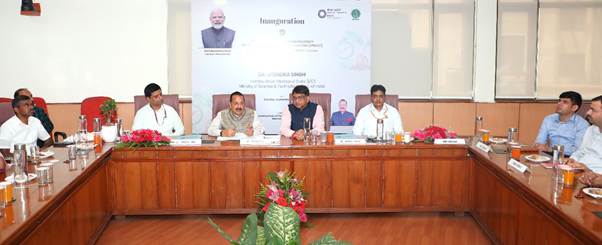
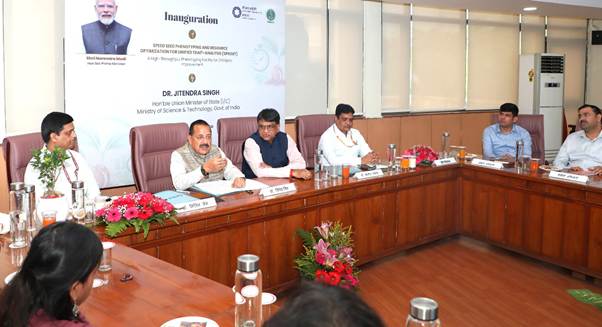
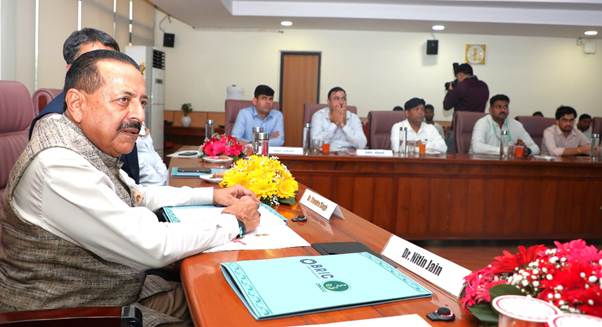
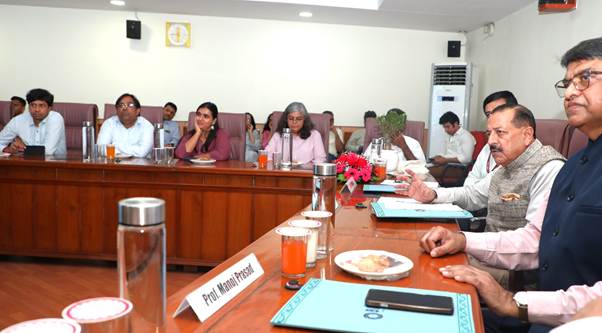
The event was attended by Prof. Manoj Prasad, Director, BRIC-NIPGR; Dr. Senthil K. Muthappa, BRIC-NIPGR; and Dr. Nitin Jain, Scientist-H, Department of Biotechnology (DBT). During the programme, Dr. Jitendra Singh inaugurated the SPROUT facility and planted a sapling under the “Ek Ped Maa Ke Naam” campaign. He also interacted with scientists and officials of BRIC-NIPGR.
SPROUT is a season-independent, controlled-environment facility designed for high-throughput phenotyping, precision stress screening and evaluation of germplasm, breeding populations, mutants, transgenic and genome-edited lines. With a major focus on chickpea, the facility will help connect advances in genomics and genome editing with precise trait evaluation and breeding. This will strengthen the ability to move more efficiently from gene discovery to trait validation and ultimately to crop improvement.
The facility comes at a time when climate change and changing weather patterns are creating an urgent need for faster agricultural solutions. Research supported in agriculture biotechnology has resulted in improved plant varieties and genotypes across economically important crops including rice, wheat, oilseeds, pulses, millets, fruits and vegetables, while work on plant microbiome interactions is opening possibilities for beneficial microorganisms to support sustainable crop productivity, soil health and nutrient availability.
Dr. Jitendra Singh said that modern biotechnology must increasingly be translated into technologies that can respond to real agricultural challenges and provide tangible benefits to farmers. He said that the scientific advances being made today, particularly in genomics, gene technologies, precision phenotyping and accelerated breeding, will become increasingly relevant in the years ahead.
NIPGR has also developed SpeedSeed, a separate technology for accelerated generation advancement. In chickpea, optimised protocols can reduce the generation cycle to approximately 40 days, considerably shortening conventional breeding and research timelines. The technology can be used within SPROUT or adapted to other suitable controlled-environment facilities. Together, SPROUT and SpeedSeed can accelerate the evaluation and advancement of promising crop traits and shorten the path from research to improved varieties.
Over the last twelve years, the Department of Biotechnology has played a transformative role in strengthening India’s agriculture biotechnology ecosystem, supporting innovation from laboratory research to farmers’ fields. Between 2014 and 2026, more than 300 projects were supported in agriculture biotechnology and allied areas. More than 50 improved varieties across rice, wheat, chickpea, mustard, vegetables and forestry species have been developed with enhanced tolerance to drought, floods, salinity, pests and diseases.
A major achievement has been the development of 17 climate-resilient rice varieties under a flagship genomics-assisted breeding programme. These varieties are now cultivated across nearly 15 lakh hectares, demonstrating the potential of advanced genomics and molecular breeding to translate scientific research into solutions with direct relevance to farmers and food security.
The Minister said that the biotechnology ecosystem is expanding beyond individual technologies and laboratories, with advances in plant biotechnology, human biotechnology, genomics and other emerging areas taking place simultaneously. He said that the country’s biotechnology journey is increasingly being driven by the convergence of advanced science, technology and applications that can address challenges relating to agriculture, health, sustainability and national development.
He also referred to the wider role of biotechnology in areas such as genetic technologies and recycling/circular approaches, stressing the need to align institutional capabilities and human-resource systems with the rapidly changing scientific landscape. The BioE3 framework similarly seeks to promote a sustainable and circular bioeconomy through convergence between biotechnology, engineering and digitalisation.
Dr. Jitendra Singh said that scientific achievements should not remain confined to laboratories or scientific institutions and called for a stronger culture of science communication and public outreach. He said that official visits to scientific institutions should not be limited to formal engagement or publicity, but should help those for whom the technologies are being developed understand what is being done and how it benefits them.
He suggested greater use of short films, workshops and professionally produced visual content to explain scientific technologies in an accessible manner. Such communication, he said, could show the challenges that existed before a technology was developed, explain how the scientific intervention addressed those challenges and demonstrate the relief or benefit that the technology has brought to farmers, industry and other users. Technical experts and professional communicators could work together to present these stories in a manner that has greater public and media impact.
The Minister also called for stronger interaction between scientific institutions and industry partners, farmers and other stakeholders. He said that regular institutional meetings and presentations should provide opportunities for people from outside the immediate scientific ecosystem to participate, so that scientists and stakeholders can understand each other’s work and identify opportunities for collaboration.
Referring to the experience of CSIR institutions, Dr. Jitendra Singh said that regular meetings can be used as platforms for scientific presentations and for bringing external stakeholders into discussions. He encouraged BRIC-NIPGR and other institutions to adopt similar practices and involve industry partners and other relevant stakeholders in institutional interactions so that the benefits of scientific research can reach beyond the scientific community.
He also stressed the importance of taking farmers into scientific institutions and allowing them to see the work being carried out there. Recalling his experience with CSIR institutions, the Minister said that farmers who had never previously visited such research establishments could develop misconceptions about the nature of the work being undertaken. Direct interaction and exposure, he said, can remove such apprehensions and help farmers understand how modern science and biotechnology are being developed for their benefit.
Dr. Jitendra Singh also referred to ongoing biotechnology initiatives involving experimental kits and scientific work in this emerging space, including the use of kits from a biotechnology laboratory in Delhi for experiments, and said that such developments should also find appropriate space in the wider communication of India’s biotechnology progress.
He said that institutions must continuously adapt their communication and human-resource practices to current scientific and technological trends, rather than relying only on conventional approaches. Scientific organisations, he added, need to become more vocal and visible in communicating their achievements so that society, industry and potential beneficiaries are aware of the work being undertaken.
The Minister said that the technologies being developed in biotechnology today are futuristic in nature and will become increasingly relevant in the years to come. He called for sustained efforts to communicate these advances in a manner that demonstrates what Indian science is doing for farmers, industry and society.
Facilities such as SPROUT, he said, demonstrate how modern biotechnology can contribute to the development of climate-resilient and productive crops, strengthen India’s agricultural capabilities and support the goal of a more self-reliant agriculture sector. He congratulated the scientists and technical teams of BRIC-NIPGR for developing the facility and said that such capabilities will contribute to India’s journey towards Viksit Bharat 2047.
*****
NKR/AK/MK
(Release ID: 2310460)
Visitor Counter : 232