Ministry of Social Justice & Empowerment
From Sanitation Worker to Self-Reliance: Shri Harish Chandra Parbat’s Journey through Mechanised Sanitation
Posted On:
13 SEP 2026 1:17PM by PIB Delhi
Access to mechanised sanitation equipment and financial assistance can help sanitation professionals strengthen their livelihoods and meet their family responsibilities. Shri Harish Chandra Parbat’s journey reflects how support for livelihood development can improve earning opportunities and enable the next generation to pursue higher education.
Shri Harish Chandra Parbat, a 46-year-old sanitation professional originally from Siwan district, Bihar, has strengthened his livelihood through assistance under the Swachhta Udyami Yojana (SUY).
Belonging to the OBC/Goswami community and educated up to the twelfth standard, he now operates a tractor-cum-suction machine for sanitation service activities under Ghaziabad Municipal Corporation in the Sahibabad Industrial Area.
In search of employment and a more secure future, Shri Parbat migrated to Delhi in 2015. He worked in sanitation-related activities and gradually gained practical experience in sewer and septic tank operations. From 2015 to 2020, he continued working in these services, but his earnings remained largely committed to everyday household needs.
His earlier monthly income of approximately ₹13,000–₹14,000 made it difficult to manage household expenditure, rental costs and his children’s educational needs. He also had the responsibility of financially supporting his mother, who resides in Siwan, Bihar. Limited resources left little scope for savings or investment in livelihood growth.
Despite these challenges, Shri Parbat remained determined to improve his family’s living standards. He believed that education could create a better future for his children and aspired to establish a stable livelihood that would enable them to pursue higher studies and build successful careers.
Financial assistance released on 26 November 2021 enabled him to procure a tractor-cum-suction machine. Against a total project cost of ₹9,75,400, he received a loan of ₹6,06,550 and an upfront capital subsidy of ₹3,68,850. This support helped him strengthen his sanitation service operations and improve his earning capacity.
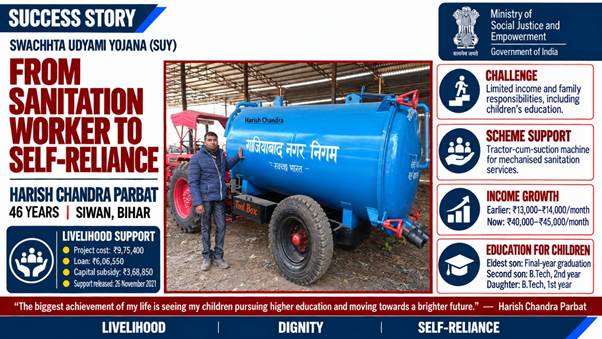
With access to mechanised equipment, Shri Parbat’s reported monthly earnings increased to approximately ₹40,000–₹45,000. The improvement enabled him to better meet his family responsibilities and invest in his children’s education. In 2022, he brought his wife and children to Delhi, allowing the family to live together and pursue improved educational opportunities.
Today, his eldest son is pursuing the final year of graduation, his second son is studying in the second year of B.Tech, and his daughter is pursuing the first year of B.Tech. All three children are studying in Delhi. His wife, a homemaker, manages household responsibilities.
Shri Parbat continues to meet monthly rent of approximately ₹12,000 and a loan instalment of ₹13,500, alongside educational and household expenses. He also sends approximately ₹3,000 each month to support his mother in Siwan. As on 27 May 2026, his remaining loan amount stood at ₹1,27,490. While these commitments limit his savings, his improved earnings have strengthened his ability to support his family and continue repaying the loan.
Reflecting on his progress, Shri Parbat said, “The biggest achievement of my life is seeing my children pursuing higher education and moving towards a brighter future. Today, I am gradually repaying my loan and moving ahead with confidence and dignity.”
Shri Harish Chandra Parbat’s journey demonstrates the role of livelihood assistance and mechanised sanitation equipment in supporting economic self-reliance. His progress has strengthened his family’s financial position and created opportunities for all three of his children to pursue higher education.
******
SS-78-TAR-KV-GA-RK
(Release ID: 2309685)
Visitor Counter : 82