Posted On:
10 SEP 2026 4:41PM by PIB Delhi
A new study that measured magnetic minerals accumulated in sediments below the Bakhira Lake in Sant Kabir Nagar over 25000 years helped track past changes in climate and how they have influenced rainfall, weathering, sediment transport and lake processes in northern India.
It can pave way for improved climate models to predict future monsoon behaviour and can help better water resource management in the Central Ganga Plain (CGP) of which the Bakhira Lake is a part.
The CGP is one of the most important regions influenced by the Indian Summer Monsoon and is critical in terms of agricultural practices.
Long-term, high-resolution palaeoclimate records from the CGP region are scarce. Most previous studies focused on biological proxies or covered only the Holocene period.
In order to respond to this gap, researchers of Birbal Sahni Institute of Palaeosciences (BSIP), an autonomous institute of the Department of Science and Technology (DST), investigated the potential of environmental magnetic properties preserved in the sediments of Bakhira Lake could provide a continuous and reliable archive of monsoon variability earlier than Holocene i.e. since the Last Glacial Maximum.
Bakhira Lake is located in the Ghaghara–Rapti alluvial system and represents a perennial oxbow/floodplain wetland formed through the migration and subsequent cut-off of the Rapti River. One of the largest wetlands in Uttar Pradesh, it was designated as a Ramsar Site in 2022. Its floodplain–lacustrine setting favours the accumulation and preservation of sediments derived from both the lake and surrounding catchment, making it sensitive to changes in monsoon-driven runoff, sediment transport and weathering. In addition, the Bakhira sediment sequence extends back to approximately 25 ka and is constrained by seven accelerator mass spectrometry (AMS) radiocarbon dates, providing a comparatively well-dated terrestrial archive for investigating Late Quaternary environmental and climatic variability in the CGP.
Environmental magnetic measurements from this lake could provide valuable proxies for reconstructing past climatic and environmental changes by recording variations in hydrology, erosion, sediment input and pedogenic processes. The availability of a well-preserved sediment sequence and complementary multiproxy datasets further encouraged this investigation.
Using environmental magnetic properties integrated with grain-size, geochemical and clay mineralogical records, Nazakat Ali, Sajid Ali, Biswajeet Thakur, Anupam Sharma reconstructed variations in the Indian Summer Monsoon (ISM) from the Last Glacial Maximum to the present.
The record identifies major climatic events, including the Last Glacial Maximum, Heinrich Stadial 1 (LGM; ~25.3–18.1 cal ka BP marked by cold and dry conditions with a weakened Indian Summer Monsoon -ISM), Bølling–Allerød (B/A; ~15.3–12.8 cal ka BP, a relatively warm and humid interval associated with enhanced ISM activity), Younger Dryas (YD; ~12.8–11.1 cal ka BP characterised by renewed cooling, drying and weakened monsoon conditions) Holocene Climatic Optimum (HCO; ~9.2–4 cal ka BP, when warmer and wetter conditions prevailed, accompanied by enhanced monsoon precipitation and pedogenic activity) and late Holocene droughts (~4–2 cal ka BP reflects a period of relatively dry conditions and reduced monsoon strength) and demonstrates how these events influenced rainfall, weathering, sediment transport and lake processes in northern India.
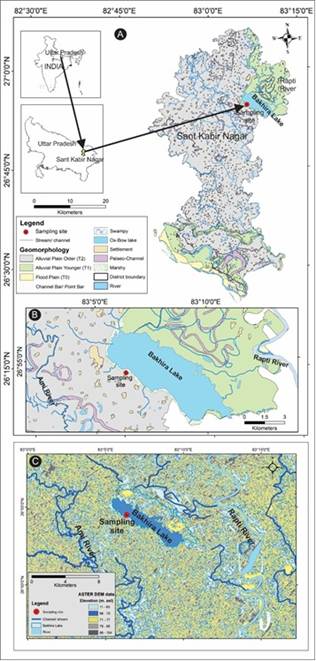
Fig. 1 Location and geomorphological setting of Bakhira Lake, showing the sampling site, surrounding drainage network, major geomorphic units, and regional elevation.
By combining seven AMS radiocarbon dates with multiple environmental magnetic parameters and integrating them with previously published sedimentological and geochemical datasets from the same core, this study provides a robust reconstruction of long-term Indian Summer Monsoon variability which key focus for changing climate scenario in present and our agricultural dominated system.
This research published in Palaeogeography, Palaeoclimatology, Palaeoecology improves our understanding of how the Indian Summer Monsoon has responded to natural climate change much before the instrumental record where direct evidence for climate change is relied upon proxy-based research. Such long-term records are essential for distinguishing natural climate variability from recent human-induced climate change.
The findings provide valuable baseline information for improving climate models, predicting future monsoon behaviour, and understanding the response of river and lake systems to changing rainfall patterns. The study also supports better planning for water-resource management, agriculture, flood and drought mitigation, and environmental conservation in the Ganga Plain, where millions of people depend directly on monsoon rainfall.
Publication link: https://doi.org/10.1016/j.palaeo.2026.114028
****
NKR/FT/AA