Posted On:
07 SEP 2026 3:36PM by PIB Delhi
Scientists have found a way to preserve entanglement for an extended period by applying a well-timed flip operation, demonstrating that when to act is as important as what operation to apply in quantum systems. The trick could help fragile quantum links inside future quantum computers survive longer — without changing the hardware at all.
Entanglement is a property that intertwines the state of one particle with another far-flung particle. Entanglement is a quintessential resource in quantum systems. However, entanglement can decay or weaken when it interacts with the environment.

Fig 1. A depiction of two entangled particles. An operation on one will affect the other in the same way even though they are in different environments.
Picture a pair of entangled particles, each of which can exist in two states — an excited state and a ground state. Left alone, each particle tends to decay from the excited to the ground state, much like an atom losing energy to its surroundings. As this happens, the entanglement between the pair weakens. Strikingly, entanglement can vanish at a finite time — well before the decay itself is complete. Physicists call this abrupt disappearance 'entanglement sudden death.’
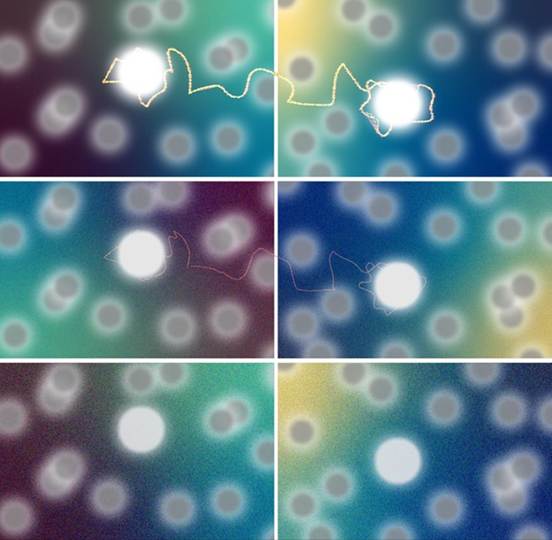
Fig 2. Entanglement can weaken or decay over time, due to noise in the environment, or just disappear suddenly.
A team consisting of scientists from Raman Research Institute (RRI), an autonomous institution of the Department of Science and Technology (DST), the University of Calgary and the Louisiana State University, took up the challenge to delay this death. The study was partly funded by DST’s flagship National Quantum Mission.
The group of researchers came upon a clever setup to delay sudden death. They first mimicked the two-level system in their optical setup. Light has a property called polarisation that tells the orientation in which the light waves are oscillating. Assume that the light or photons—the particles that make up light—exist in two different polarisation flavours. They assumed vertical polarisation to be the excited state, and horizontal polarisation to be the ground state. Using a waveplate, an optical device used to alter polarisation, they could control the polarisation from vertical to horizontal, effectively controlling the decay of the particles to the ground state.
Instead of allowing the excited state population’s natural decay to the ground state, they applied a well-timed operation that swapped the populations in the ground and excited states. The effect of this operation depended on when it was applied during the decay process. By choosing the timing, they delayed the decay of all particles to the ground state or delayed entanglement loss.
“To me, the heart of the result is that timing is not just an experimental detail; it can be a control resource,” said Urbasi Sinha, group leader of the Quantum Information and Computing (QuIC) lab, which led the study, and senior professor at RRI.
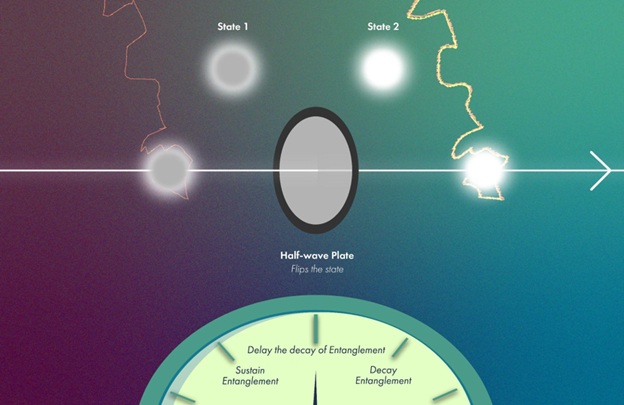
Fig 3. The placement of the operation can help control the decay of entanglement
A flip applied at the right moment doesn't just postpone the sudden death — it can prevent it from ever occurring. That is what the team calls avoidance.
“When you are applying, after how much of an evolution through the decay, you’re applying this single flip operation will determine if you avoid or delay or hasten the sudden death,” says Saumya Ranjan Behera, a quantum scientist in the QuIC lab at RRI and the new study’s lead author. The paper was published in American Physical Society’s Physical Review A in July.
In quantum computers, there’s a limit on how long quantum information can survive before it decays. The experiment shows that, in the presence of this kind of limitation, the timing of an operation can change the fate of entanglement.
In the QuIC lab, a classic example of theorists and experimentalists working in symphony, the experimental results of this study surprised the scientists. The experiment did not fall into either of the two standard textbook models of how quantum systems lose information to their environment.
Hence, for almost a year, the theorists explored different descriptions to understand the data. Eventually, they realised that the experiment was not ‘wrong’. It rather fell exactly on the curve that would join these two frameworks at the two ends. In essence, they found the ‘tuning parameter’ that would enable the experiment to slide between the two frameworks. So now there aren’t two separate setups for these two frameworks. This single setup can represent both the noise models and all variants in between, depending on the chosen tuning parameter.
Temporal steering of entanglement decay with single-shot control | Phys. Rev. A
Publication link: https://doi.org/1.1103/84n3-bcz8
*****
NKR/FT/AA