PIB Backgrounder
India’s GDP Performance
A Strong Start to 2026-27 with 7.8% Real GDP Growth
Posted On:
01 SEP 2026 2:42PM by PIB Delhi
|
India’s economy began 2026-27 on a strong note, with real GDP growth accelerating to 7.8% in Q1, riding on manufacturing and services, while real GVA rose 8.2%. Investments rose by 11.9%; household consumption grew 7.1% and exports grew by 12.0%. This momentum continued into July, with industrial production up 6.7%, while cumulative merchandise and services exports during April-July rose 13.16% year-on-year. Credit to industry and services grew 20.0% and 22.9%, respectively, in July.
|
India’s Macroeconomic Position
India entered 2026-27 amid persistent geopolitical tensions and uncertainty around global trade. Despite these external pressures ,real GDP grew by 7.8% in Q1 2026-27. The outcome marked the highest Q1 real GDP growth during the four-year period from 2023-24 to 2026-27. This has been supported by buoyant domestic demand and gains in manufacturing and services.
The International Monetary Fund (IMF) has also highlighted India’s role in the global economy. In July 2026, it described India as one of the world’s fastest-growing economies and a key engine of global growth.
India’s sovereign credit assessment further reflects this confidence. In August 2026, S&P Global Ratings affirmed India’s ‘BBB/A-2’ sovereign ratings with a Stable Outlook. This followed the upgrade of its long-term rating to ‘BBB’ in 2025, after an 18-year gap.
A Stronger Start to 2026-27
Growth Accelerates in the First Quarter
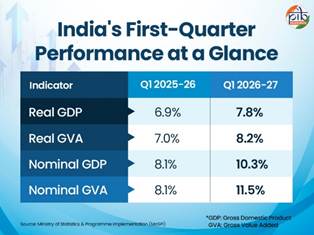
Economic growth strengthened in the first quarter (Q1) of 2026-27. This outcome has exceeded the Reserve Bank of India’s estimate of 7.0% for the quarter.
- Real GDP, or GDP at Constant Prices, is estimated at ₹81.36 lakh crore in Q1 FY 2026-27. It recorded 7.8% rise, compared with 6.9% in Q1 FY 2025-26.
- Nominal GDP, or GDP at Current Prices, is estimated at ₹88.27 lakh crore. It recorded 10.3% rise, compared with 8.1% last year.
|
Gross Domestic Product (GDP) is the value of final goods and services produced in the domestic economy in an accounting period.
|
- Real GVA is estimated at ₹73.82 lakh crore , recording 8.2% growth, compared with 7.0% last year.
- Nominal GVA is estimated at ₹80.53 lakh crore , recording 11.5% growth, compared with 8.1% last year.
|
Gross Value Added (GVA) measures the individual contribution of producers, industries or sectors to the economy.
|
Revised Estimates Strengthen the Growth Picture
Real GDP has been revised upwards for the previous three financial years. The revisions show that the first-quarter performance follows a stronger growth trajectory than previously estimated.
|
Table-1: Revised Real GDP Growth Estimates
|
|
Financial Year
|
Earlier Estimate
|
Revised Estimate
|
|
2023-24
|
7.2%
|
7.3%
|
|
2024-25
|
7.1%
|
7.2%
|
|
2025-26
|
7.7%
|
7.8%
|
|
Source: Ministry of Statistics & Programme Implementation (MoSPI)
|
|
Basis of the Revised Estimates
The annual revised estimates reflect the use of new price and production indices with base year 2022-23. This includes the Output Producer Price Index (PPI) and Banking Services Price Index (BkSPI). Updated administrative data from different sources were also incorporated.
To read more on National Account Statistics revisions, please refer to: Counting What Counts: Strengthening India’s National Accounts and Core Economic Statistics
|
Composition of Growth Drivers
Trends Across Key Expenditure Components
Economic activity in the first quarter was supported by a sharp rise in investment, firm household consumption and stronger exports.
|
Table-2: Key Expenditure Components of Real GDP
|
|
Component
|
Interpretation
|
Q1 2025-26
|
Q1 2026-27
|
|
Gross Fixed Capital Formation (GFCF)
|
Domestic funding of investment
|
5.8%
|
11.9%
|
|
Private Final Consumption Expenditure (PFCE)
|
Spending by households on goods and services
|
6.8%
|
7.1%
|
|
Exports
|
Goods and services supplied to the rest of the world
|
6.0%
|
12.0%
|
|
Source: Ministry of Statistics & Programme Implementation (MoSPI)
|
Growth Extends Across Major Sectors
The strength in expenditure was also reflected on the production side, with the tertiary and secondary sectors expanding at a faster pace.
- In terms of Real GVA, the tertiary sector grew by 10.0% in Q1 2026-27, up from 8.0% in Q1 2025-26. Within the sector, financial, real estate, IT and professional services recorded 12.1% growth.
- The secondary sector expanded by 8.6% in Q1 2026-27, compared with 6.1% in the corresponding quarter of the previous year.
- Manufacturing recorded 9.2% growth, supported by strong output across key segments. Several manufacturing categories also performed well during the quarter:
|
Table-3: Key Manufacturing Categories Record Notable Gains
(Year-on-year IIP growth (%))
|
|
Manufacturing category
|
Q1 2025-26
|
Q1 2026-27
|
|
Electrical Equipment
|
9.7
|
27.0
|
|
Other Transport Equipment
|
3.8
|
19.5
|
|
Computer, electronic and optical products
|
8.8
|
12.4
|
|
Machinery and equipment
|
6.6
|
9.1
|
|
Source: Ministry of Statistics & Programme Implementation (MoSPI)
|
-
- Under the IIP, capital goods production also increased by 15.2% in Q1 2026-27, compared with 8.8% a year earlier. Infrastructure/ construction goods also recorded higher growth of 7.2%, up from 6.1%.
Recent Indicators Signal Continued Momentum
Industrial Activity Remains Firm
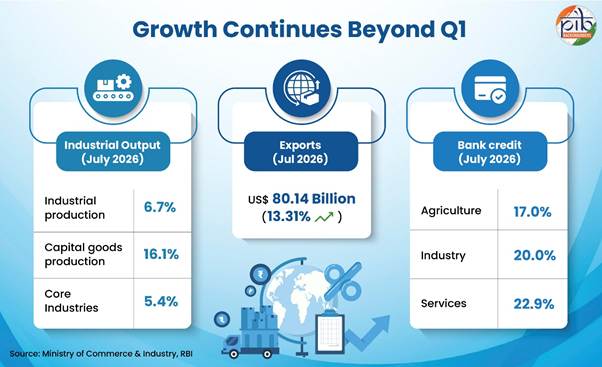
- Industrial production grew by 6.7% in July 2026, compared to 5.4% last year. It increased by 6.3% in April-July 2026-27 compared 4.0% last year same period.
- Capital goods production rose by 16.1% in July 2026 over July 2025. Intermediate goods increased by 10.0% and infrastructure and construction goods by 6.9%.
- The Index of Core Industries (ICI) recorded year-on-year growth of 5.4% in July 2026, compared with July 2025. During April-July 2026-27, the ICI grew by 4.3%, up from 1.5% in the corresponding period of the previous year.
Strong Export Performance
- India’s combined merchandise and services exports reached an estimated US$ 80.14 billion in July 2026, increasing by 13.31% over July 2025.
- During April-July 2026-27, cumulative exports were estimated at US$ 316.42 billion. This is 13.16% higher than the US$279.63 billion recorded during April-July 2025-26.
Credit Expands Across Major Sectors
Bank credit growth strengthened across major sectors in July 2026.
- Credit to agriculture and allied activities grew by 17.0% year-on-year, compared with 7.3% in July 2025.
- Credit to industry increased by 20.0%, up from 6.5% in July 2025.
- Credit to the services sector grew by 22.9%, compared with 10.2% in July 2025.
Recent Policy Measures Supporting Growth
Policy measures introduced during 2026 have complemented these economic trends, spanning manufacturing, energy security, trade and investment, and agriculture.
Manufacturing and Industry
- The Mobile Phone Manufacturing Scheme (July 2026) has an outlay of ₹62,500 crore through 2030-31. It aims to further expand production, deepen value addition and strengthen global competitiveness.
- Approved in July 2026, Semicon 2.0 has a budget outlay of ₹1,27,500 crore. It supports chip design and manufacturing, advanced packaging, research, materials, equipment and talent development.
- Approved in July 2026, the BHAVYA Rasayan Scheme has an outlay of ₹3,030 crore for a period of 5 years from FY 2026-27 to FY 2030-31. It will support the establishment of three dedicated chemical parks across the country.
- Emergency Credit Line Guarantee Scheme 5.0 (ECLGS 5.0) targets additional credit flow of ₹2.55 lakh crore in response to the West Asia situation. It provides 100% guarantee coverage for MSMEs and 90% for non-MSMEs.
- Passed by Parliament in August 2026, the MSME Development (Amendment) Bill, 2026 simplifies compliance and supports MSME development and competitiveness.
- Samudra Manthan, the National Offshore Exploration Scheme, has an outlay of ₹84,084 crore through FY 2030-31. The Scheme supports exploration to unlock India’s offshore energy potential.
- The Scheme for Promotion of Surface Coal/Lignite Gasification Projects was approved in May 2026 with an outlay of ₹37,500 crore. It supports the 100 MT coal gasification target by 2030 and aims to reduce import dependence.
- GOBARdhan, the National Circular Bioenergy Scheme, was approved in August 2026 with an outlay of ₹23,731 crore. The Scheme will be implemented from FY 2026-27 to FY 2035-36. It aims to increase compressed biogas production from agricultural, animal and municipal organic waste.
- Approved in July 2026, Pradhan Mantri Surya Sarovar Yojana (PM-SSY) has an outlay of ₹5,070 crore. It supports 5,000 MW of floating solar projects with co-located energy storage, with projects sanctioned during FY 2026-27 to FY 2030-31.
- The India-UK CETA and Agreement on Social Security entered into force on 15 July 2026. It provides zero-duty access for nearly 99% of India’s exports to the UK.
- The India-Israel Bilateral Investment Agreement (BIA) entered into force on 4 July 2026. It aims to strengthen bilateral economic ties and provides a more secure and predictable framework for investment.
- In June 2026, reforms were announced to expand Foreign Portfolio Investor (FPI) participation in Government Securities. Key measures include tax exemptions, wider coverage under the Fully Accessible Route and streamlined investment norms. The reforms are intended to attract long-term foreign capital and deepen India’s debt market.
- Launched in May 2026, the Bharat Maritime Insurance Pool (BMIP) carries a sovereign guarantee of ₹12,980 crore. It provides maritime risk cover while reducing dependence on foreign insurers amid global volatility.
Agriculture: Farm Income and Production Support
- The continuation of Pradhan Mantri Kisan Samman Nidhi (PM-KISAN) from FY 2026-27 to FY 2030-31 has been approved with an outlay of ₹3.15 lakh crore. The scheme provides eligible farmer families income support through the Direct Benefit Transfer (DBT) system.
- For Marketing Season 2026-27, the Government increased MSPs for 14 Kharif crops to ensure remunerative prices for farmers. The highest absolute increases were for sunflower seed, cotton, nigerseed and sesamum.
- Approved in May 2026, the Mission for Cotton Productivity (Kapas Kanti) has an outlay of ₹5,659.22 crore for 2026-27 to 2030-31. It links cotton farmers with modern research and technologies, reduces pest risks, and strengthens production systems and agricultural trade.
- The National Investment Policy for Urea-2026 (NIPU-2026) aims to promote new investment in gas-based urea manufacturing units. It supports higher domestic production and India’s goal of self-sufficiency in urea.
These measures build on a decade of policy initiatives including Make in India, Production Linked Incentive (PLI) schemes, PM-KISAN, the Export Promotion Mission and others.
Conclusion
India’s economic performance at the start of 2026-27 reflects broad-based momentum across key areas of the economy. Investment has accelerated, household consumption has remained firm, while manufacturing, services and exports have provided additional support.
More recent indicators show that this strength has carried beyond the first quarter. Continued government support through various policy measures has also helped maintain the pace of economic activity.
PIB Research
References
Ministry of Statistics & Programme Implementation:
https://www.pib.gov.in/PressReleaseDetail.aspx?PRID=2304949®=48&lang=1
https://www.pib.gov.in/PressReleaseDetail.aspx?PRID=2304948®=48&lang=1
https://www.mospi.gov.in/uploads/announcements/announcements_1772117257791_84ae898f-7be2-4b7d-a135-565e1a809513_FAQ_GDP_26022026_1902.pdf
https://www.mospi.gov.in/sites/default/files/publication_reports/national_accounta_0.pdf
https://www.pib.gov.in/PressReleaseDetail.aspx?PRID=2304222®=48&lang=1
https://www.pib.gov.in/FaqDetails.aspx?ModuleId=4&NoteId=157582&lang=1®=48
Ministry of Finance:
https://www.pib.gov.in/PressReleasePage.aspx?PRID=2280989&lang=1®=48
Ministry of Commerce & Industry:
https://www.pib.gov.in/PressReleaseIframePage.aspx?PRID=2301558&lang=2®=48
https://www.pib.gov.in/PressReleasePage.aspx?PRID=2298878&lang=1®=48
https://www.pib.gov.in/PressReleasePage.aspx?PRID=2285085&lang=1®=3
https://www.pib.gov.in/PressReleasePage.aspx?PRID=2294775&lang=1®=6
Ministry of Electronics & IT:
https://www.pib.gov.in/PressReleasePage.aspx?PRID=2284796&lang=2®=48
Ministry of Chemicals and Fertilizers:
https://www.pib.gov.in/PressReleasePage.aspx?PRID=2288866&lang=1®=3
https://www.pib.gov.in/PressReleasePage.aspx?PRID=2288824&lang=1®=48
Ministry of Petroleum & Natural Gas:
https://www.pib.gov.in/PressReleasePage.aspx?PRID=2295494&lang=1®=1
https://www.pib.gov.in/PressReleaseDetail.aspx?PRID=2301012®=48&lang=1
Ministry of New and Renewable Energy:
https://www.pib.gov.in/PressReleasePage.aspx?PRID=2292465&lang=1®=1
Ministry of Agriculture & Farmers Welfare:
https://www.pib.gov.in/PressReleasePage.aspx?PRID=2292460&lang=1®=6
https://www.pib.gov.in/PressReleasePage.aspx?PRID=2260618&lang=3®=3
https://www.pib.gov.in/PressReleasePage.aspx?PRID=2258187®=48&lang=2
Union Cabinet:
https://www.pib.gov.in/PressReleasePage.aspx?PRID=2284789&lang=1®=20
https://www.pib.gov.in/PressReleasePage.aspx?PRID=2258114&lang=1®=3
https://www.pib.gov.in/PressReleasePage.aspx?PRID=2292445&lang=1®=48
https://www.pib.gov.in/PressReleasePage.aspx?PRID=2260621&lang=1®=3
https://www.pib.gov.in/PressReleasePage.aspx?PRID=2253242&lang=1®=3
https://www.pib.gov.in/PressReleasePage.aspx?PRID=2250032&lang=1®=20
Cabinet Committee on Economic Affairs (CCEA):
https://www.pib.gov.in/PressReleasePage.aspx?PRID=2284800&lang=1®=3
Reserve Bank of India (RBI):
https://rbidocs.rbi.org.in/rdocs/Bulletin/PDFs/0BULL25082026F2C1FCCDD5CBB4F6EAE15BCBB541FC331.PDF
https://www.rbi.org.in/Scripts/BS_PressReleaseDisplay.aspx?prid=63287
https://www.rbi.org.in/scripts/BS_PressReleaseDisplay.aspx?prid=63478
International Monetary Fund (IMF):
https://www.imf.org/en/news/articles/2026/07/09/tr-07092026-imf-press-briefing-transcript-july-09-2026
United Nations (UN):
https://unstats.un.org/unsd/nationalaccount/glossresults.asp?gID=232&
PIB Archives:
https://www.pib.gov.in/PressReleasePage.aspx?PRID=2297792&lang=1®=3
https://www.pib.gov.in/FactsheetDetails.aspx?Id=150624&lang=1®=48
Others:
https://www.spglobal.com/ratings/en/regulatory/article/-/view/type/HTML/id/3618793
India’s GDP Performance
******
PIB Research
(Release ID: 2305422)
Visitor Counter : 12269