PIB Backgrounder
Manufacturing Momentum:Building a Self-Reliant India
Posted On:
14 AUG 2026 7:51PM by PIB Delhi
Introduction
As India celebrates its 80th Independence Day, the nation’s manufacturing sector stands as a pillar of self-reliance and progress. Over the past 12 years, bold reforms under the Make in India vision have reshaped industries, positioning the country as a global hub. Defence equipment, textiles, pharmaceuticals, medical devices, and heavy machinery are now produced at world-class standards, serving both domestic and international markets. To further accelerate this momentum, the Government has introduced several initiatives like the Production Linked Incentive (PLI) scheme, PM GatiShakti, the National Logistics Policy, BHAVYA, and programmes for the electronics and MSME sectors.
Strengthening India’s Manufacturing Ecosystem
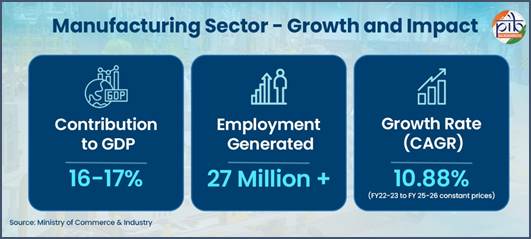
The manufacturing sector now contributes about 16–17 percent of GDP and employs over 27 million workers. The compounded annual growth rate (CAGR) of Manufacturing GVA at constant prices (2022-23 base) as per the revised series during 2022-23 to 2025-26 is 10.88%. Merchandise exports in July 2026 reached USD 44.24 billion, compared to USD 36.98 billion a year earlier, while manufacturing output grew 7.8 percent in June 2026. These indicators show manufacturing as a central driver of India’s economic growth.
India’s Defence Transformation: From Self-Reliance to Global Exports
India’s defence industry has undergone a remarkable transformation in the past decade. Focused policies, targeted investments, and a strong push for self-reliance have turned the country into a significant producer and exporter of defence equipment.
Key Facts:
- The value of indigenous defence production reached a record ₹1.78 lakh crore in FY 2025–26. This marked 15.6% growth from ₹1,54,071 crore in the previous fiscal and ₹46,429 crore in 2014–15.
- Defence exports surged from ₹686 crore in 2013–14 to ₹38,424 crore in 2025–26.
- Indian defence products are now exported to 80+ countries, showing over 5,500% growth in the last twelve years.
- Defence PSUs and other PSUs contributed around 76% of total production in FY 2025–26.
The private sector’s share rose to 24%, reflecting greater industry participation.
- Till May 2026, 10 Positive Indigenisation lists, five each of DMA & DDP, covering 5,521 items, were notified, resulting in increased Aatmanirbharta in defence production.
- Srijan Defence Equipment Empowerment Platform (DEEP) is a digital repository promoting indigenous defence sourcing. As of May 2026, it listed over 41,000 vendors and 2.7 lakh products, strengthening domestic supply chains.
India’s Electronics Boost
India has rapidly evolved into a major centre for electronics production, achieving exceptional growth in both output and exports. Successive policies like the National Policy on Electronics, SPECS, EMC 2.0, and PLI have reshaped electronics manufacturing. Schemes such as Electronics Components Manufacturing Scheme (ECMS) further strengthened India’s Electronics System Design and Manufacturing (ESDM) ecosystem, driving growth and competitiveness. Electronics production rose from ₹11.32 lakh crore in FY 2024–25 to ₹13.11 lakh crore in FY 2025–26, a 15.8% year-on-year increase.
|
Indicator
|
2014–15
|
2025–26
|
Growth
|
|
Production of electronics goods
|
~Rs 1.9 lakh crore
|
~Rs 13.11 lakh crore
|
7 times
|
|
Exports of electronics goods
|
~Rs 38,000 crore
|
~Rs 4.24 lakh crore
|
11 times
|
|
Mobile phone production
|
~Rs 18,000 crore
|
~Rs 6.27 lakh crore
|
33 times
|
|
Mobile phone exports
|
~Rs 1,500 crore
|
~Rs 2.59 lakh crore
|
165 times
|
Semicon Manufacturing
India's emergence as a semiconductor destination has been built on sustained reforms across the electronics sector. The Semicon India Programme (Semicon 1.0) was approved in December 2021 with an outlay of ₹76,000 crore. It was launched to build a domestic semiconductor and display manufacturing ecosystem. Building on it, Semicon 2.0 has been approved in July, 2026 with a total budget outlay of ₹1,27,500 crore.
Progress Under Semicon India Programme 1.0
As of July 2026, twelve manufacturing units have been approved with investments exceeding ₹1.64 lakh crore. These include one silicon fab, one silicon carbide fab, an integrated Gallium Nitride Micro LED display fab, and nine packaging units. Together, they are expected to meet chip requirements across consumer appliances, industrial electronics, automobiles, power electronics, telecommunications, and aerospace.
Out of the twelve approved proposals, three companies, Micron, Kaynes, and CG Semi have already started commercial production. One more company is expected to begin operations in 2026, further strengthening India’s semiconductor manufacturing base.
India’s Mobile Manufacturing Rise
India’s mobile manufacturing sector has grown rapidly, strengthening domestic production, exports and value addition.
- 99.2% of mobile phones used in India are now made domestically.
- India is the world’s second-largest mobile phone manufacturer by volume.
- India has shifted from a net importer to a net exporter of mobile phones since 2014.
- PLI scheme for Large Scale Electronic Manufacturing (LSEM) has attracted around ₹96,000 crore in investments across the mobile manufacturing ecosystem.
- Domestic value addition reached 23% in FY 2023–24, alongside strong growth in production and exports.
- Smartphones became India’s top individual exported commodity in FY 2025–26, surpassing petroleum, gems and jewellery.
Mobile Phone Manufacturing Scheme:
This scheme was approved on July 15, 2026, with a ₹62,500 crore budget. It focusses on boosting production, domestic value addition, supply chain resilience and global competitiveness. The five-year scheme will run from FY 2026–27 to FY 2030–31. Incentives range from 2.25% to 5%, with additional support for local sourcing, Indian brands, design and R&D.
India’s Pharma Edge: Scaling Manufacturing and Exports
India ranks 3rd in volume and 11th in value in the global pharmaceutical industry. It plays a crucial role in ensuring affordable healthcare worldwide by supplying 20% of the world’s generic medicines and a large share of vaccines. Steady growth in production, exports, and domestic innovation has reinforced its position as a trusted global supplier.
Key Facts:
- In 2024-25, the sector’s annual turnover reached Rs. 4.72 lakh crore.
- Three PLI schemes under the sector have a total budgetary outlay of ₹25,360 crore and have attracted over ₹51,997 crore in investments.
- The schemes have achieved ₹3.88 lakh crore in cumulative sales, including exports exceeding ₹2.43 lakh crore.
- Manufacturing capacity has been created for 218 APIs/KSMs/drug intermediates and 57 medical devices, including CT, MRI, ultrasound and critical implants.
- Medical device exports increased from ₹26,915 crore in 2019–20 to ₹42,360 crore in 2024–25. Domestic manufacturing rose from ₹28,000 crore to ₹41,500 crore during the same period.
- Scheme for promotion of Bulk Drug Parks: The scheme was approved in 2020 to establish three Bulk Drug Parks with world-class common infrastructure to reduce the cost of manufacturing of bulk drugs. Three parks were approved in Andhra Pradesh, Gujarat and Himachal Pradesh in FY 2022–23.
- Biopharma SHAKTI (Strategy for Healthcare Advancement through Knowledge, Technology and Innovation) Scheme: The scheme was announced in Union Budget 2026-27, with an outlay of ₹10,000 crores over the next 5 years.
Textiles& Apparel on the Rise: Building Global Competitiveness
India’s textile and apparel industry is one of its most important manufacturing sectors. It is the second-largest employer after agriculture, providing livelihoods to over 45 million people and supporting MSME-led industrial development.
- India has several natural and structural advantages in the sector, such as a strong raw material base, manufacturing capabilities for the complete value chain, and a sizeable domestic market. Additionally, the country is among the world’s largest cotton producers and the largest exporter of cotton yarn.
- Textiles and apparel contribute ~2% to national GDP, 11% to manufacturing GVA, and 9% of merchandise exports.
- In FY2025, India exported textile products worth USD 37.7 billion. It accounted for 4.1% of global textile and apparel exports, making it the sixth-largest textile exporter globally.
- Government initiatives such as the PLI Scheme for Textiles, PM MITRA Parks, the National Technical Textiles Mission, Textiles Export Promotion Mission, National Fibre Mission and the recently announced Mission for Cotton Productivity are likely to strengthen manufacturing capabilities further and improve sector competitiveness.
India’s Maritime Push: Making Ships and Containers
Several initiatives in the maritime sector have been introduced to strengthen domestic manufacturing and enhance India’s competitiveness globally.
In September, 2025, a comprehensive package of ₹69,725 crore was announced to strengthen domestic shipbuilding capacity, maritime financing and skilling. It has the following three components:
Shipbuilding Development Scheme (SbDS)
- This scheme has an outlay of ₹19,989 crore and aims to increase India’s annual shipbuilding capacity to 4.5 million Gross Tonnage (GT).
- Greenfield shipbuilding clusters will receive 100% capital support for common maritime and internal infrastructure through a 50:50 Centre–State Special Purpose Vehicle.
- Existing shipyards will receive 25% capital assistance for brownfield expansion and upgradation of critical infrastructure, including dry docks, ship lifts, fabrication facilities and automation systems.
- Greenfield shipbuilding clusters are proposed in Andhra Pradesh, Gujarat and Tamil Nadu. Three brownfield expansion projects have also received in-principle approval.
Maritime Development Fund
- The Maritime Development Fund has a corpus of ₹25,000 crore to support long‑term financing in the maritime sector. It includes a ₹20,000 crore Maritime Investment Fund with 49 percent Government equity participation. Also, it has a ₹5,000 crore Interest Incentivization Fund to reduce borrowing costs for shipyards.
Shipbuilding Financial Assistance Scheme (SBFAS)
- ₹24,736 crore has been allocated under the SBFAS to address cost disadvantages and strengthen financing, capacity, and infrastructure. Its guidelines were issued on 26 December 2025.
Container Manufacturing Assistance Scheme (CMAS)
CMAS was announced in the Union Budget 2026-27 to expand domestic container manufacturing capacity and strengthen India’s position in global container supply chains.
- ₹10,000 crore has been allocated under CMAS over five years.
- CMAS targets annual domestic capacity of up to 7.5 lakh TEUs. This is around 10 times the existing capacity.
- In July 2026, India rolled out its first domestically manufactured EXIM shipping container for A.P. Moller–Maersk. The container was unveiled at the Maersk–CONCOR Inland Container Depot in Dadri, Uttar Pradesh.
Automobiles: Manufacturing Strength
India has a strong automobile industry, supported by extensive manufacturing capabilities and a large auto-component ecosystem. It is the world’s largest market for two-wheelers and three-wheelers, and the third-largest for passenger and commercial vehicles globally. The sector is also advancing electric mobility, supported by rising EV adoption and government initiatives.
- The sector provides direct and indirect employment to over 30 million people across India.
- Vehicle production increased from 22.65 million units in FY21 to 31.03 million units in FY25. Overall production grew by nearly 33% between FY15 and FY25.
- PLI Scheme for Automobile & Auto Components Industry: The scheme was approved in September 2021 with an outlay of ₹25,938 crore. It promotes high-value Advanced Automotive Technology vehicles and products. It attracted ₹44,326 crore in investment by March 2026. It also generated 67,820 jobs during the same period.
- PM E-DRIVE Scheme: Launched in September 2024, the scheme has an outlay of ₹10,900 crore to support electric mobility. It provides incentives for around 28.30 lakh EVs, including e-2W, e-3W, e-trucks, e-buses, and e-ambulances. ₹4,391 crore has been allocated for 14,028 e-buses, out of which 14,000 e-buses have already been deployed. ₹2,000 crore has also been allocated for EV public charging stations across India.
India’s Solar PV Manufacturing: Rapid Growth and Expansion
India’s solar PV manufacturing sector has expanded rapidly, strengthening domestic production of solar cells and modules. The domestic PV market is valued at around ₹32,400 crore and is expected to grow strongly through 2030.
- The domestic PV market is expected to grow at a 17–20% CAGR between FY23 and FY30.
- Approved List of Models and Manufacturers (ALMM) listed solar module capacity reached 100 GW in August 2025. This increased sharply from nearly 2.3 GW in 2014.
- Solar cell manufacturing capacity reached 25 GW in March 2025. This Capacity increased from less than 1.2 GW in 2014.
- The government introduced the PLI scheme for high-efficiency solar PV module manufacturing.
The scheme has two tranches with total funding of ₹24,000 crore and awarded 48 GW integrated PV capacity.
- PV exports in FY25 were eight times higher than in FY18. Higher cell-to-module capacity under the PLI scheme supported this growth.
The Road Ahead
India's manufacturing sector today reflects steady progress, deepening capability and growing confidence across industry. Sustained policy support and rising private participation continue to strengthen this foundation year after year. As new capacities mature, the sector is well placed to expand its global role. The coming years promise wider opportunity, greater value creation and a stronger self-reliant economy.
References:
Ministry of Commerce & Industry:
https://www.pib.gov.in/PressReleasePage.aspx?PRID=2230621®=3&lang=1
Ministry of Statistics & Programme Implementation:
https://www.pib.gov.in/PressReleasePage.aspx?PRID=2298236®=48&lang=2
Ministry of Electronics & IT:
https://www.pib.gov.in/PressReleasePage.aspx?PRID=2291171®=48&lang=2
Union Cabinet:
https://www.pib.gov.in/PressReleasePage.aspx?PRID=2284789®=48&lang=1
Ministry of Chemicals and Fertilizers:Department of Pharmaceuticals:
https://www.pib.gov.in/PressReleasePage.aspx?PRID=2244474®=3&lang=1
https://www.pib.gov.in/PressReleasePage.aspx?PRID=2286949®=48&lang=1
Ministry of Ports, Shipping and Waterways:
https://www.pib.gov.in/PressReleasePage.aspx?PRID=2294248®=48&lang=1
https://www.pib.gov.in/PressReleasePage.aspx?PRID=2288924®=48&lang=2
https://www.pib.gov.in/PressReleasePage.aspx?PRID=2209139®=3&lang=2
Ministry of Textiles:
https://www.pib.gov.in/PressReleasePage.aspx?PRID=2286960®=48&lang=2
Ministry of Statistics & Programme Implementation:
https://www.pib.gov.in/PressReleasePage.aspx?PRID=2290419®=48&lang=2
https://www.pib.gov.in/PressReleasePage.aspx?PRID=2298236®=48&lang=2
Ministry of Heavy Industries:
https://www.pib.gov.in/PressReleasePage.aspx?PRID=2298052®=48&lang=2
NITI Aayog:
https://www.pib.gov.in/PressReleasePage.aspx?PRID=2298965®=48&lang=1
Press Information Bureau:
https://www.pib.gov.in/PressReleasePage.aspx?PRID=2278107®=48&lang=2
https://www.pib.gov.in/PressReleasePage.aspx?PRID=2234442®=3&lang=2
https://www.pib.gov.in/PressReleasePage.aspx?PRID=2273854®=48&lang=2
Click to see pdf
***
PIB Research
(Release ID: 2299573)
Visitor Counter : 1708