Ministry of Science & Technology
A novel blueprint for efficiently connecting quantum networks
Posted On:
06 AUG 2026 4:09PM by PIB Delhi
A new study has introduced a protocol that could provide a grounded and predictable framework for designing the quantum communication architectures of the future.
Building a quantum network requires establishing maximal entanglement between distant locations (stations) for better security and efficiency. However, it is experimentally challenging to achieve maximally entangled states, over which quantum information can be transferred more effectively. This is because real-world noise constantly weakens these links. Scientists combine quantum mechanics with basic principles of statistical physics — specifically percolation theory — to obtain stronger connections from within a network of predominantly weak connections. Existing theoretical methods often achieved this by systematically disconnecting intermediate stations to establish a link.
This poses a challenge, as the systematic disconnection of intermediate stations physically consumes valuable network resources and destroys the underlying network topology (study of how shapes and spaces are put together).
A team of scientists from the Bose Institute, an autonomous institute of the Department of Science and Technology, has provided the theoretical foundation of quantum entanglement percolation that could reduce the requirements and enhance the efficiency for connecting a quantum network.
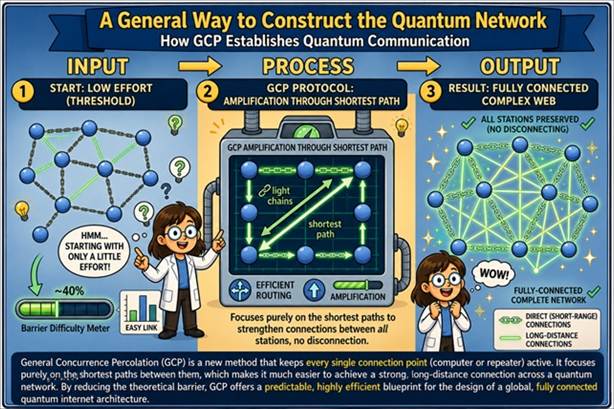
Fig: The operational flow of the GCP framework, which utilises localised geometric routing to optimise existing low-entanglement links. Thus GCP avoids undesirable outcomes arising from existing protocols like the isolation and deletion of nodes, and renders a robust and sustainable quantum network associated with higher maximal entanglement.
The study by authors, Dr. Deep Nath and Prof. Soumen Roy from Bose Institute, Kolkata published in the journal Physical Review A introduces a new protocol, General Concurrence Percolation (GCP), that takes a different geometric approach.
Instead of disconnecting stations, their protocol amplifies entanglement, strictly along the shortest paths. This transforms a sparse physical grid into a highly dense network. They demonstrate that by implementing the protocol of general concurrence percolation (GCP), long-distance quantum communication can be established using a lower threshold of initial entanglement, than previously known.
Through computer simulations the researchers have confirmed that this routing method successfully lowers the minimum threshold of entanglement needed to connect the entire network. The authors have demonstrated that GCP adheres to the percolation universality class, which is well-known in statistical physics. This finding strengthens the theoretical foundation of quantum entanglement percolation.
Publication link: https://doi.org/10.1103/2sf7-srwz
***
NKR/FT
(Release ID: 2295481)
Visitor Counter : 1052