Posted On:
24 JUL 2026 2:50PM by PIB Delhi
New nanofluid electrolyte developed by scientists which can enhance efficiency of the cathode of electrically rechargeable Zinc-air batteries offers potential for better, safer, cheaper, next generation green batteries.
The electrolyte which is stable over three months, is directly applicable to the zinc-air battery industry and relevant to grid-scale storage and can support electric mobility in India.
Conventionally, costly corrosion inhibitors are added to suppress zinc corrosion, but these often-hinder oxygen reaction kinetics.
This challenge was solved by scientists from SASTRA Deemed University, Thanjavur, dispersed small amounts of inexpensive silica and zinc oxide nanoparticles into the standard electrolyte, creating "nanofluid electrolyte". This work supported by Department of Science and Technology (DST) under the Nano and Advanced Materials Division suppressed the hydrogen reaction while simultaneously inhibiting corrosion and enhancing oxygen reaction performance at the cathode, solving both electrode problems with one low-cost intervention.
The technology protected by a granted Indian patent (IN570691), is ready for usage.
As the world race toward cleaner energy storage, aqueous batteries are gaining attention as a safe, low-cost, environmentally friendly alternative to lithium-ion systems. Among them, the electrically rechargeable zinc-air battery (ZAB) stands out for its high theoretical energy density, low-cost, and water-based chemistry.
The team led by Dr. S. Devaraj at SASTRA Deemed University, initiated efforts to resolve the two stubborn problems have held this green technology back -- unwanted hydrogen gas evolution at the zinc anode wastes charge and corrodes the metal, while oxygen reactions at the air-cathode remain sluggish without expensive platinum or ruthenium catalysts.
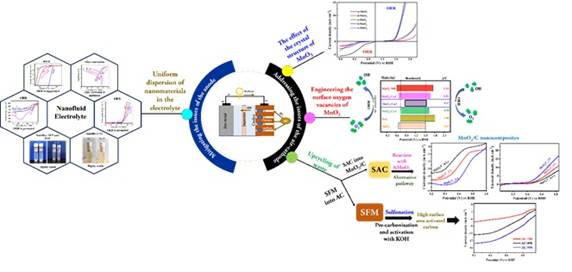
Fig: Workflow of various strategies adopted to improve the kinetics of oxygen reactions at cathode and reduce hydrogen evolution reaction and zinc corrosion at the anode.
Apart from engineering the nanofluid electrolyte to suppress parasitic hydrogen evolution and zinc corrosion simultaneously they developed earth-abundant bifunctional catalysts to drive both oxygen reduction (ORR) and oxygen evolution (OER) efficiently and explored waste-derived materials as viable electrode candidates.
Their research identified α-MnO2 as the top catalyst performer, owing to its open tunnel-like architecture. Strategic copper doping pushed performance beyond commercial benchmarks, outperforming both Pt- and Ru-based standards at a remarkably low dopant loading of just 2 wt%.
They recovered spent activated carbon from exhausted household water filters and hydrothermally converted it into MnO2/C nanocomposites developing both efficient bifunctional electrocatalysts and high-performing supercapacitor electrodes. This process has been patented (Application No. 202441032753).
Separately, post-pandemic surgical face masks were chemically upcycled into activated carbon with a record-high surface area, rivalling platinum in oxygen reduction activity.
The approaches developed have prospects beyond this technology. The waste-derived carbon can be tuned for multiple applications beyond zinc-air batteries, and the upcycling approach is adaptable to virtually any waste carbon source. Similarly, the nanofluid electrolyte concept can potentially extend to other aqueous battery systems, offering a generalisable strategy for safer, cheaper, next-generation green batteries.
For more details contact Dr. S. Devaraj (devaraj@scbt.sastra.edu)
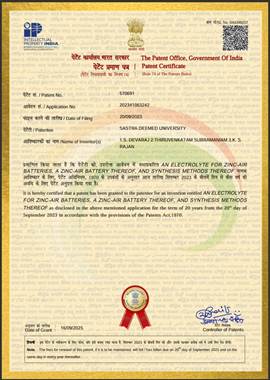
Copy of patent certificate
*****
NKR/FT