Ministry of Science & Technology
Ultrafast organic anodes designed for next-generation rechargeable batteries
Posted On:
17 JUL 2026 3:06PM by PIB Delhi
Researchers have designed a new porous organic anode material for more efficient lithium-ion batteries with improved energy storage capacity. As demand for energy storage for electric vehicles, smartphones, laptops, and renewable energy continues to grow, there is an increasing need for batteries that can be charged quickly without compromising lifespan.
To address this challenge, the researchers from Indian Association for the Cultivation of Science (IACS) and S. N. Bose National Centre for Basic Sciences (SNBNCBS), both institutes of the Department of Science and Technology (DST), have developed a new porous organic material (covalent organic framework) that enables lithium ions—the tiny charged particles that store energy in batteries—to move much more easily.
A collaborative research team led by Dr. Urmimala Maitra from the Indian Association for the Cultivation of Science (IACS) and Dr. Pradip Pachfule from the S. N. Bose National Centre for Basic Sciences (SNBNCBS) has developed a new covalent organic framework (COF) material that could help make future rechargeable batteries charge much faster while remaining durable and reliable.
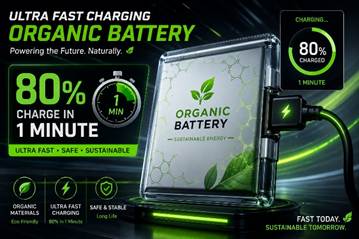
Fig 1. Applications of fast-charging, safe, and organic battery prepared using a covalent organic framework (COF) for energy storage.
The newly developed material enabled a battery to reach 80% charge in just over one minute while maintaining excellent performance over many charging and discharging cycles. The researchers also found that the same material can store sodium ions, opening the door to the development of affordable sodium-ion batteries in the future. The successful operation of the material in a practical battery device further demonstrates its potential for real-world applications. This breakthrough highlights how thoughtful material design can help develop safer, faster-charging, and longer-lasting batteries.
This collaborative work highlights how rational molecular design of covalent organic frameworks can simultaneously optimise ion transport, charge storage, and structural stability, providing an effective strategy for developing low-cost, fast-charging, and durable organic battery electrodes. The study exemplifies the strength of interdisciplinary collaboration between IACS and SNBNCBS in addressing critical challenges in sustainable energy-storage technologies.
Publication Link: https://doi.org/10.1002/adma.73960
***
NKR/FT
(Release ID: 2285704)
Visitor Counter : 1906