PIB Backgrounder
Modified UDAN: Strengthening India’s Regional Aviation Network
Posted On:
17 JUL 2026 1:55PM by PIB Delhi
|
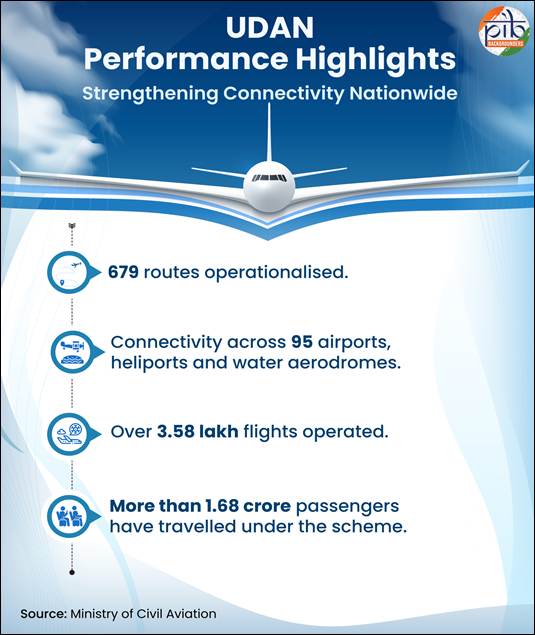
Launched to expand regional air connectivity, the UDAN scheme has widened access to air travel across India. Over nine years, the scheme has operationalised 679 routes across 95 airports, heliports and water aerodromes. More than 3.58 lakh flights have served over 1.68 crore passengers under the scheme. Modified UDAN is being implemented from FY 2026–27 to FY 2035–36 with an outlay of ₹28,840 crore. The scheme also envisions 100 new airports and 200 modern helipads to strengthen last-mile connectivity.
|
Bridging Distances Through Regional Connectivity
Connectivity has long been the backbone of economic progress, linking production to markets and people to opportunity. The ability to move quickly and reliably has become essential to sustaining growth. In this evolving landscape, aviation has emerged as a powerful pillar of speed, access and reach. For generations, however, this connectivity did not reach everyone equally. Air travel in India was largely concentrated in a handful of major cities. Many smaller towns lacked regular air services. This gap highlighted the growing need to extend the benefits of air connectivity beyond metropolitan centres. More regions needed to be integrated into the national aviation map.
Recognising this need for inclusive and widespread connectivity, the Regional Connectivity Scheme (RCS) – UDAN (Ude Desh ka Aam Nagrik) was launched in October 2016. The scheme marks a major step towards making air travel more affordable and accessible to citizens. It also expands connectivity to underserved and unserved regions. India now ranks as the third-largest domestic aviation market globally. Over the past decade, India’s civil aviation sector has grown significantly. The number of operational airports increased from 74 in 2014 to 165 as of 15th July 2026. The UDAN scheme plays a key role by operationalising new routes and strengthening the regional aviation ecosystem. It has created momentum for a more balanced aviation network across the country.
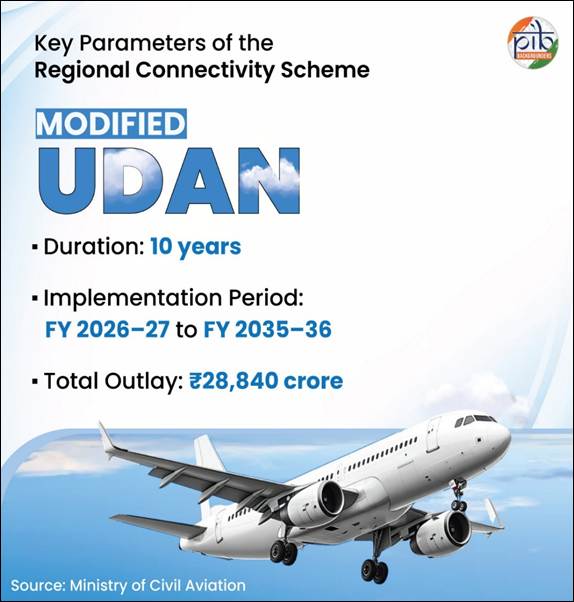
Building on this, the Modified UDAN Scheme, launched on 4th July 2026, marks another transformation in India’s aviation journey. The scheme is being implemented over a period of 10 years, from FY 2026–27 to FY 2035–36, with a total outlay of ₹28,840 crore. This new phase places greater emphasis on expanding airport infrastructure, improving operational support, and creating a viable ecosystem for airline operators serving smaller markets. It seeks to consolidate earlier gains and address emerging demands.
|
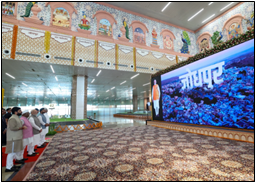
The recently inaugurated New Terminal Building at Jodhpur Airport further reaffirms the commitment to developing world-class aviation infrastructure. The 23,342-square-metre terminal accommodates 1,500 peak-hour passengers and 20 lakh passengers annually. It features 20 check-in counters, advanced security screening systems, modern baggage handling facilities and six aerobridges, ensuring a seamless passenger experience.
|
The Next Phase: Modified UDAN
Expanding connectivity requires more than new routes. It also needs stronger infrastructure and reliable operational systems. Airline operators in smaller markets require adequate support mechanisms. Several regions face difficult geographical conditions. In such areas, helipads and specialised aircraft improve access to essential services. The Regional Connectivity Scheme– Modified UDAN has therefore been designed as a strengthened and forward-looking framework to address these requirements.
Components of the Modified UDAN Scheme
The Modified UDAN Scheme brings together a set of targeted components aimed at long-term growth and viability.
Development of Aerodromes
The development of aerodromes is a central pillar of the Modified UDAN Scheme. Under this component, 100 airports will be developed from existing unserved airstrips to expand aviation infrastructure across the country. The initiative seeks to integrate smaller towns and remote regions more effectively into the national transportation network. It enables faster movement of passengers and goods while supporting regional economic development. A total outlay of ₹12,159 crore has been proposed for the development of these aerodromes over the next eight years.
Operation and Maintenance Support
The sustainability of smaller aerodromes depends on continued operations. The Modified UDAN Scheme, therefore, provides structured Operation and Maintenance support. Many RCS-only aerodromes face high recurring costs alongside limited revenue streams during their initial years of operation. Operational support is therefore critical for reliable services. To address this challenge, the scheme proposes to provide O&M support for a period of three years. This is capped at ₹3.06 crore per annum per airport and ₹0.90 crore per annum per heliport or water aerodrome. This component is estimated at ₹2,577 crore and is expected to support approximately 441 aerodromes across the country.
Development of Modern Helipads
In several parts of the country, conventional airport infrastructure may not always be feasible due to geographical constraints. In such areas, helicopter connectivity plays a vital role in ensuring timely access to essential services and improving last-mile connectivity. The Modified UDAN Scheme proposes the development of 200 modern helipads focused on priority regions where connectivity gaps remain significant. These facilities are expected to improve access to healthcare, support emergency response operations, and facilitate administrative and economic activities. Each helipad has an estimated cost of ₹15 crore. The total projected outlay for this component is ₹3,661 crore over eight years.
Viability Gap Funding for Airlines
To support airline operators and encourage sustained route development in smaller markets, the scheme continues the provision of Viability Gap Funding (VGF). Regional routes often require financial support in the early stages due to lower passenger volumes and higher operational costs. VGF helps ensure that services remain viable while demand gradually develops. Under the Modified UDAN framework, a total of ₹10,043 crore has been proposed towards VGF over a ten-year period. Airlines will receive funding support for up to five years. A tapered funding mechanism will begin from the third year, while exclusivity on routes will remain limited to three years. This structure is intended to balance market development with the gradual transition towards commercial sustainability.
Atmanirbhar Bharat and Indigenous Aviation Capacity
The Modified UDAN Scheme also incorporates a strong focus on strengthening indigenous aviation capacity under the Atmanirbhar Bharat initiative. One of the operational challenges has been the limited availability of small fixed-wing aircraft and helicopters suited for operations in remote and difficult terrain. The scheme proposes two HAL Dhruv helicopters for Pawan Hans and two HAL Dornier aircraft for Alliance Air. These aircraft are designed to operate effectively in challenging conditions while supporting domestic manufacturing capability.
UDAN: Building a Strong Foundation
Over nine years of implementation, the UDAN scheme has delivered significant outcomes.
Operational Achievements
As of 15th July 2026, 679 routes connect 95 airports, heliports and water aerodromes nationwide. More than 3.58 lakh flights have operated under the scheme since its launch, benefitting over 1.68 crore passengers. These achievements highlight UDAN’s contribution to mobility, economic activity and balanced development.
Impact on Connectivity and Services
The impact of UDAN has been visible across multiple regions. Its benefits are especially important in remote, hilly and island areas like Tezpur, Passighat, Diu, Pithoragarh, Rourkela among various others. The scheme has improved access to transportation services and strengthened links between smaller towns and major urban centres. In addition, UDAN has supported the development of tourism and improved access to healthcare and emergency services in several areas. Passenger facilitation remains a key priority. Several initiatives have been introduced to improve passenger comfort and ease of travel. UDAN Yatri Cafés provide affordable food options at airports across the country. Flybrary for free access to books and free Wi-Fi services, further enhance the travel experience.
|
A Journey Made Easier: How UDAN is Changing Everyday Travel
UDAN has significantly reduced travel time between cities. One such example is the air route connecting Vijayawada and Kadapa. What was once a long and time-consuming journey can now be completed in about an hour by air. This demonstrates the tangible benefits of improved regional connectivity. Sharing his experience, Nagendra Bharti from Andhra Pradesh noted that the journey between Vijayawada and Kadapa earlier took 8 to 10 hours by road, but has now become much easier and significantly shorter by air. Similarly, Sayyed Iliyaz Ahmed from Vidyanagar observed that a journey that once took around six hours can now be completed in just one hour at a reasonable cost. This reflects the broader success of the UDAN scheme in connecting regions, reducing travel barriers, and improving mobility for citizens. By bringing distant locations within quick reach, UDAN continues to enhance everyday convenience for communities across the country.
|
Funding Mechanism and Institutional Support
Geographically large countries such as the US, Canada, Brazil and Australia often rely on public funding to sustain regional air connectivity. India introduced a first-of-its-kind model — the RCS levy mechanism under the UDAN scheme, which enables funding from within the sector. This is done by levying a small fee on selected categories of domestic flights. Government participation has improved coordination and airport-level ownership. Non-monetary concessions have helped reduce operational costs across the aviation ecosystem.
UDAN to Modified UDAN: Expanding India’s Aviation Vision
The journey from UDAN to Modified UDAN reflects India’s sustained commitment to building an inclusive and resilient aviation network. It connects regions, supports economic activity and improves everyday mobility for citizens. Over nine years, UDAN has transformed regional aviation across India. Hundreds of routes now connect previously underserved locations. Air travel has become accessible to millions. The approval of Modified UDAN reinforces the resolve to build a civil aviation ecosystem that is modern, inclusive and sustainable. It ensures that the promise of affordable and accessible air travel reaches every part of the country.
Ministry of Civil Aviation
https://www.civilaviation.gov.in/sites/default/files/migration/Udaan_Eng.pdf
https://www.pib.gov.in/PressReleasePage.aspx?PRID=2245099®=3&lang=1
https://www.pib.gov.in/PressReleasePage.aspx?PRID=2245471®=3&lang=1
https://www.pib.gov.in/PressReleasePage.aspx?PRID=2241546®=3&lang=1
https://www.pib.gov.in/PressReleasePage.aspx?PRID=2181310®=3&lang=2
https://www.pib.gov.in/PressReleasePage.aspx?PRID=2241546®=3&lang=1
https://www.pib.gov.in/PressReleasePage.aspx?PRID=2236062®=3&lang=1
https://www.civilaviation.gov.in/sites/default/files/migration/UDAN-Manual.pdf
https://www.pib.gov.in/PressReleasePage.aspx?PRID=2281051®=3&lang=1
https://www.pib.gov.in/PressReleaseDetail.aspx?PRID=2285420®=3&lang=1
Prime Minister’s Office
https://www.pmindia.gov.in/en/news_updates/cabinet-approves-regional-connectivity-scheme-modified-udan-with-a-total-outlay-of-rs-28840-crore/
Airports Authority of India
https://www.aai.aero/en/rcs-udan
Click to See in PDF
***
PIB Research
(Release ID: 2285671)
Visitor Counter : 4201