Ministry of Science & Technology
Plant of yielding the fragrant kewra is older than human civilization & predates Himalaya formation
Posted On:
15 JUL 2026 4:09PM by PIB Delhi
Fossil leaves recovered from a coalfield in the North East state of Assam have revealed that Kevda plant well known for the fragrant kewra essence, used in sweets, traditional medicine and also in temples has survived in the Indian subcontinent for at least 24 million years and is a living survivor from India's ancient tropical forests.
The study helps in understanding the role of India as a refuge for ancient plant lineages, the evolution of biodiversity during periods of climate change as well as comprehending future ecosystem responses.
Scientists, through regular investigations of the rich fossil flora of northeast India, chanced upon fossil leaves showing remarkable similarities to modern Kevda-- the fossil records of which are extremely rare worldwide.
This led the scientists from Birbal Sahni Institute of Palaeosciences, (BSIP) Lucknow, an autonomous institute of the Department of Science and Technology (DST) to trace the evolutionary history of this culturally important plant.
Harshita Bhatia and Gaurav Srivastava collected the four well-preserved fossil leaves recovered from the Tikak Parbat Formation of the Makum Coalfield, Assam, dating to about 24 million years ago, and studied them using detailed morphological and microscopic analyses.
The fossils closely resembled modern Kevda leaves. They have preserved distinctive features that are still seen in modern Kevda plants, including long sword-shaped leaves, parallel veins, and characteristic marginal prickles.
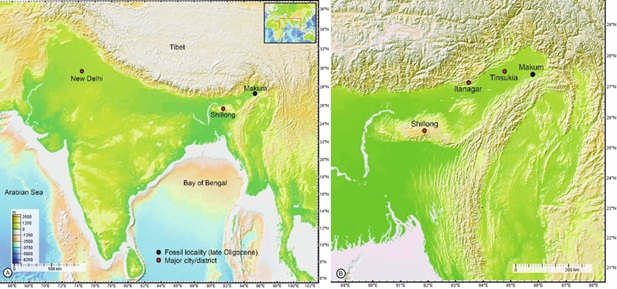
Fig 1. Map showing the fossil locality (Makum Coalfield, Assam) from where the fossil leaves were collected belonging to 24 Million years in age.
They compared them with modern Kevda species preserved in herbaria and botanical databases, as well as previously reported fossil records from different parts of the world.
Detailed comparisons with modern species and fossil records from around the world confirmed their affinity with the Kevda family (Pandanaceae). This shows that this ancient plant lineage was already established in India millions of years before humans appeared on Earth.
Geological, palaeobotanical, and palaeoclimatic evidence were integrated to reconstruct the evolutionary history and ancient environment of these plants.
Today, Pandanus is mainly restricted to tropical and subtropical regions. However, fossil evidence from Europe and North America, dating back 85–66 million years, indicates that its ancestors once had a much wider distribution across the Northern Hemisphere. As global climates cooled after about 34 million years ago, these plants gradually disappeared from many regions and became restricted to the tropics.
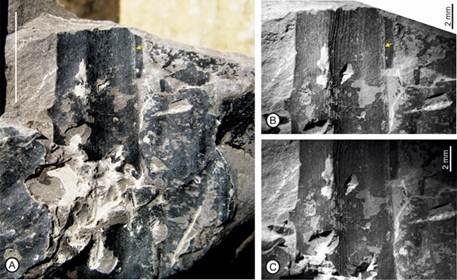
Fig 2: Fossil leaf of Pandanus showing marginal prickles (black arrows), M-shaped transverse section and mid-vein (yellow arrows), characteristics of the Pandanaceae family. Scale bar: 1cm unless specified.
The fossils from Assam show that India served as an important refuge where this ancient lineage survived while it disappeared from many other parts of the world.
The discovery published in the journal Geobios, fills an important gap in the evolutionary history of the family by linking older fossil records from Europe and North America (85–66 million years ago) with younger records from tropical Asia and Australia. The study also highlights India's role as an important refuge for ancient tropical plant lineages during periods of global climate change, revealing that Kevda has a deep evolutionary history in the Indian subcontinent rather than being a recent component of Indian vegetation.
The findings improve our understanding of the evolution of tropical plants, the development of Indian biodiversity and the history of how plants responded to past environmental changes.
Publication link: https://doi.org/10.1016/j.geobios.2026.05.001.
*****
NKR/FT
(Release ID: 2284832)
Visitor Counter : 1630