PIB Backgrounder
Guardians of India's Maritime Frontiers
Three Indigenous Naval Classes for Combat, Survey and Coastal Defence
Posted On:
13 JUL 2026 11:25AM by PIB Delhi
|
India's maritime strength depends on a balanced fleet protecting national interests across the full spectrum of naval operations. The Nilgiri, Sandhayak and Arnala classes represent three vital pillars of this capability. Recently commissioned INS Dunagiri, INS Sanshodhak and INS Agray demonstrate the steady expansion of these indigenous warship classes. INS Mahendragiri further strengthens this capability. Built with high indigenous content, these platforms embody Aatmanirbhar Bharat and strengthen India's defence manufacturing ecosystem. Together, they enhance maritime security, support the Blue Economy and reinforce India's position as a leading maritime power.
|
India's Layered Naval Capability
The Indian Navy is a primary security provider in the Indian Ocean Region. It safeguards a coastline of about 11,098 kilometres, an Exclusive Economic Zone of nearly 2.4 million square kilometres, and sea lanes carrying close to 90 per cent of India's trade by volume. Achieving this requires a balanced fleet, with each class of warship contributing to a distinct layer of maritime security. In India, four new-generation indigenous naval platforms inducted in just one month now bring this layered approach to life.
The ability to deter and fight on the ocean surface sits at the front of this structure. The latest in this segment are Nilgiri-class stealth frigates which are built under Project 17A for high-intensity operations. Their reduced radar, thermal and acoustic signatures improve survivability in combat.
Maritime power also depends on a deep understanding of the seas. The Sandhayak-class Survey Vessel (Large) ships strengthen India's hydrographic capability. They map the seabed, gather ocean data and produce accurate nautical charts for safe navigation. This work supports naval operations, maritime trade and the Blue Economy, and it reinforces India's standing as a trusted hydrographic partner across the Indian Ocean Region.
Closer to the coastline, anti-submarine warfare forms the next layer of defence. The Arnala-class Anti-Submarine Warfare Shallow Water Crafts are designed to detect and neutralise submarines in littoral waters. Alongside their core roles, all three classes can take on humanitarian assistance, disaster relief and search and rescue missions.
Together they mark the success of India's indigenous shipbuilding programmes. Their move into serial production strengthens maritime security, advances Aatmanirbhar Bharat and shows India's growing ability to design and build its own warships.
|
Did You Know?
On 21 June 2026, three indigenously designed and built platforms were commissioned together at Kolkata: INS Dunagiri, a Nilgiri-class stealth frigate; INS Sanshodhak, a Sandhayak-class survey vessel (large); and INS Agray, an Arnala-class anti-submarine warfare shallow water craft. All three ships were designed by Navy's own Warship Design Bureau and manufactured by the Garden Reach Shipbuilders and Engineers Limited (GRSE), Kolkata, a defence public sector undertaking.
On 11 July 2026, the sixth indigenously designed and built Nilgiri-class stealth frigate INS Mahendragiri was commissioned at Visakhapatnam
|
Stealth Frigates: The Cutting Edge of Surface Power
Stealth frigates form the backbone of the Indian Navy's surface combat capability. They protect aircraft carriers, secure vital sea lanes and project power across distant waters. Designed for modern naval warfare, they integrate advanced weapons, sensors, and aviation facilities while optimizing radar, infrared (thermal), and acoustic signatures for enhanced stealth. This makes them difficult to detect while enabling both offensive and defensive operations.
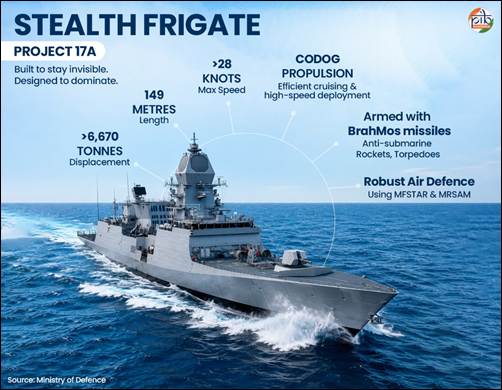
Building on this capability, Project 17A represents the latest generation of indigenous stealth frigates. The Nilgiri-class comprises INS Nilgiri, INS Himgiri, INS Taragiri, INS Udaygiri, INS Dunagiri, INS Mahendragiri and the under construction Vindhyagiri. Mazagon Dock Shipbuilders Limited, Mumbai, built four ships, while Garden Reach Shipbuilders and Engineers Limited, Kolkata, is building three. The latest additions to the class, INS Dunagiri, was commissioned recently as its fifth ship and INS Mahendragiri, the vessel of the class, was commissioned on 11 July 2026 at Visakhapatnam. These warships strengthen India's maritime security and reinforce its presence across the Indian Ocean.
|
Did You Know?
Project 17A is the Indian Navy’s advanced stealth frigate programme to build seven next-generation guided-missile warships. These frigates are designed for multi-mission operations, including anti-air, anti-surface, and anti-submarine warfare. Project 17A reflects India’s growing strength in self-reliant warship design and construction.
|
Key specifications of Project 17A Nilgiri-class Stealth Frigates
- Size: Around 149 metres long, displacing about 6,670 tonnes. Displacement is the weight of water a ship pushes aside.
- Propulsion: A Combined Diesel or Gas (CODOG) system, that is Combined Diesel or Gas, pairing diesel engines with gas turbines for range and speed.
- Speed: Maximum speed of 28 knots. A knot is about 1.85 kilometres per hour.
- Strike power: Supersonic surface-to-surface missiles that hit distant ships and shore targets.
- Air defence: These frigates feature advanced weaponry including Brahmos missiles, Medium-range air-defence missiles and close-in guns that stop aircraft and incoming missiles.
- Sensors and air wing: Advanced radar, a hull-mounted sonar and helicopters. Sonar uses sound pulses to find submarines underwater.
|
Did You Know?
Apart from Project 17A frigates, Indian Navy also has two more classes of stealth vessels, namely: Talwar-class and the Shivalik-class. The Talwar class (Project 1135.6/11356) was designed and built in Russia, from a time when the Navy still bought its frontline warships abroad. That changed with the Shivalik class (Project 17), India's first indigenously designed stealth frigate, created by the Navy's own Warship Design Bureau and built at Mazagon Dock, Mumbai. Project 17A (Nilgiri class) takes this legacy forward with better sensors, weapons and much higher indigenous content, marking the Navy's shift from a Buyer's Navy to a Builder's Navy under the Aatmanirbhar Bharat vision.
|
|
How Stealth Actually Works?
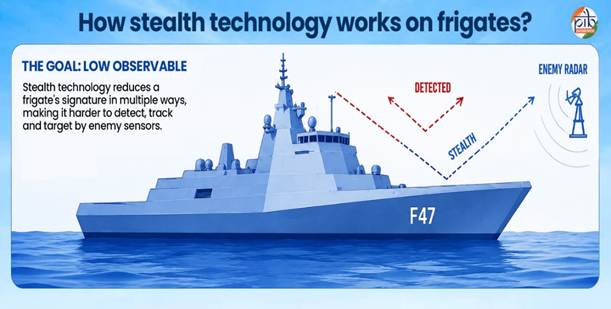
Stealth technology makes a warship harder for the enemy to detect. It does not make the ship invisible rather it simply makes the ship appear much smaller and quieter than it really is. Warships achieve this in a few key ways. Their angled surfaces deflect enemy radar waves away, while special coatings absorb radar signals instead of reflecting them.
|
Survey Vessels: Charting Seas for Security and Prosperity
Survey vessels strengthen the Indian Navy's hydrographic capability by mapping the seabed and coastal waters. Accurate nautical charts ensure safe navigation for warships and merchant vessels. They also support the Blue Economy through the sustainable use of ocean resources. These ships regularly undertake humanitarian assistance, disaster relief and search and rescue missions.
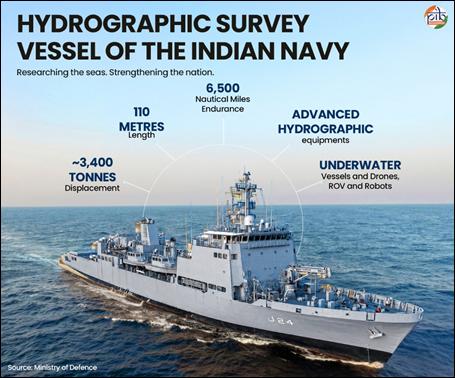
To sustain this vital capability, the Indian Navy is inducting the indigenous Sandhayak-class survey vessels. The class comprises INS Sandhayak, INS Nirdeshak, INS Ikshak and INS Sanshodhak. Built by Garden Reach Shipbuilders and Engineers Limited, Kolkata. INS Sanshodhak was recently commissioned as the fourth and final ship of the class. They strengthen India's maritime domain awareness and reinforce its leadership in hydrographic cooperation across the Indian Ocean Region.
Key specifications of Sandhayak-class survey vessels
- Size: Around 110 metres long, displacing about 3,400 tonnes.
- Speed and range: Capable of a top speed of over 18 knots and an operational range of 6,500 nautical miles. The vessel can undertake long-distance missions across the Indian Ocean and beyond.
- Complement: These ships have a crew of about 178 personnel.
- Survey suite: Multi-beam echo sounders, side-scan sonar and autonomous underwater vehicles that map the seabed in detail.
- Secondary roles: It can operate helicopters and serve as a hospital ship in an emergency.
- India's hydrographers have surveyed 89,000 square kilometres and produced 96 charts in five years (2019-24), aiding many friendly nations.
|
Did You Know?
The 21st of June is celebrated worldwide as World Hydrography Day. INS Sanshodhak, India's newest survey ship, was commissioned on that very day.
|
Shallow-Water Sub-Hunters: Guarding the Littorals
Anti-Submarine Warfare Shallow Water Craft strengthen the Indian Navy's coastal defence capability. They detect and neutralise submarines operating in shallow waters near the coast. Larger warships cannot manoeuvre effectively in these areas, making these agile vessels essential. They also support humanitarian assistance, disaster relief and search and rescue missions.
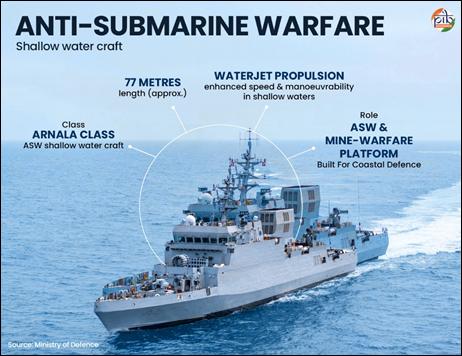
To reinforce this crucial layer of maritime security, the Indian Navy is inducting the indigenous Arnala-class craft. The eight-ship class comprises Arnala, Androth, Anjadip, Amini, Abhay, Agray, Akshay and Ajay. Built by Garden Reach Shipbuilders and Engineers Limited in partnership with L&T Shipbuilding, these vessels replace the ageing Abhay-class corvettes. INS Agray was recently commissioned as the fourth ship of the class. A parallel Mahe-class is under construction at Cochin Shipyard, raising the planned strength to 16 Anti-Submarine Warfare Shallow Water Craft. They will secure India's littoral waters and allow larger warships to focus on open ocean operations.
Key specifications of Arnala-class crafts
- Size: Around 77.6 metres long, displacing about 900 tonnes.
- Propulsion: Waterjets that drive the craft with a jet of water instead of a propeller, giving agility in shallow waters.
- Speed: A top speed of about 25 knots.
- Weapons: Lightweight torpedoes and anti-submarine rockets to strike submarines below the surface.
- Sensors: Shallow-water sonar and a combat management system that links sensors to weapons.
|
Did You Know?
INS Arnala is the largest waterjet-propelled warship yet inducted by the Indian Navy.
|
Strategic Value Beyond Combat
The Nilgiri, Sandhayak and Arnala classes deliver far more than frontline naval capability. They strengthen national security, advance self-reliance and support India's maritime ambitions. Their impact extends across defence manufacturing, employment, maritime diplomacy, the Blue Economy and defence exports. The table below highlights how these indigenous-warship classes contribute to India's broader national goals.
|
Goal
|
How These Vessels Deliver
|
|
Aatmanirbharta (Indigenisation)
|
All three classes are designed by the Navy's Warship Design Bureau (Nilgiri and Sandhayak Class) and Indian Shipyards (Arnala and Mahe class), and built in Indian yards. Indigenous content is 75 percent for the Project 17A frigates and over 80 percent for the Sandhayak survey vessels. Across the Navy, 64 of 66 ships and submarines on order are being built in India.
|
|
Jobs Creation
|
Building these classes in series sustains shipyards and a wide vendor base. The Project 17A frigate line engaged over 200 MSMEs and about 4,000 direct jobs. It created over 10,000 indirect jobs, and the Arnala-class adds a GRSE and L&T Kattupalli partnership.
|
|
Maritime Security (Preferred Security Partner)
|
The classes give layered strength: frigates for sea control, survey ships for safe passage, ASW craft for the littorals. As the region's first responder, the Navy counters piracy at choke points like the Gulf of Aden. It safeguards freedom of navigation and trade for all.
|
|
Blue Economy
|
Survey-class charts open ports, channels and the Exclusive Economic Zone. This supports fishing, offshore energy and safe shipping, guarded by the frigate and ASW classes. India's blue economy contributes about 4 percent of GDP.
|
|
Maritime Export of Warships
|
India is shifting from importer to exporter of naval platforms. GRSE, builder of the survey and ASW classes, is executing overseas orders. National defence exports hit a record Rs 23,622 crore in 2024-25, up about 12 percent over the defence exports figures of FY 2023-24, which were Rs 21,083 crore.
|
|
SAGAR and MAHASAGAR Vision
|
The Sandhayak-class survey ships chart the oceans for safe navigation. They protect India's maritime interests and those of friendly nations. This advances the SAGAR (2015) and MAHASAGAR (2025) visions, with warships deploying to partner countries.
|
|
Did You Know?
India launched SAGAR (Security and Growth for All in the Region) in 2015 to secure its immediate Indian Ocean neighbourhood. It later evolved and expanded its reach globally by launching MAHASAGAR (Mutual and Holistic Advancement for Security and Growth Across Regions) in 2025 to build partnerships across the broader Global South. Both doctrines work to improve regional security, grow the ocean economy, and respond to disasters.
|
Securing India's Maritime Future
The Nilgiri, Sandhayak and Arnala classes reflect the steady evolution of India's naval capability. Together, they strengthen surface combat, hydrography and coastal anti-submarine warfare. Each class is designed by the Indian Navy's Warship Design Bureau and built in Indian shipyards. They demonstrate India's growing expertise in designing and building complex frontline warships. Their expanding production also deepens self-reliance in defence manufacturing.
Their contribution extends well beyond naval operations. They sustain Indian shipyards, support hundreds of MSMEs and generate thousands of skilled jobs. They also advance the SAGAR and MAHASAGAR visions through stronger maritime security and regional cooperation. As India's maritime interests expand, these indigenous warship classes will safeguard national interests and reinforce India's position across the Indian Ocean Region.
References
Prime Minister's Office
Ministry of Defence
Ministry of External Affairs
Ministry of Fisheries, Animal Husbandry & Dairying
Click to See PDF
***
PIB Research
(Release ID: 2283989)
Visitor Counter : 4693