PIB Backgrounder
Ethanol Blended Petrol Programme
Frequently Asked Questions
Posted On:
10 JUL 2026 5:51PM by PIB Delhi
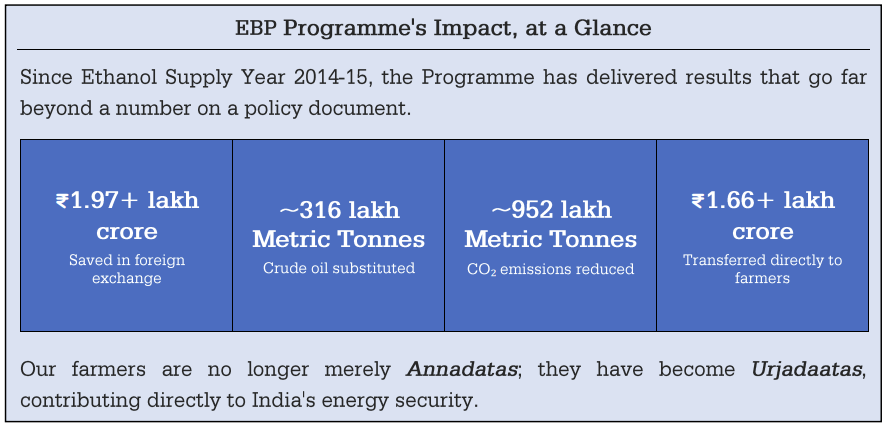
The Ethanol Blended Petrol (EBP) Programme is one of India's key energy initiatives. It aims at improving energy security, supporting farmers, and reducing environmental impact through greater use of domestically produced renewable fuel.
The Ministry of Petroleum and Natural Gas issued a detailed clarification on the programme through a press release on June 23, 2026, addressing various concerns. Automobile manufacturers also issued their own clarifications during a press conference held on July 4, 2026.
Despite clarifications, certain concerns have continued to be raised regarding the EBP Programme. The following Frequently Asked Questions provide factual, evidence-based responses to these concerns.
Was the Ethanol Policy Rushed?
Q1. Is ethanol a new fuel that India invented or rushed into?
No. Ethanol is not a new fuel. Henry Ford designed the Model T to run on ethanol more than a century ago. Countries like Brazil and the United States have blended ethanol into petrol for decades.
India's own ethanol story also began long before the present government. This has been a journey spanning over two decades. Here is the timeline:
-
- 2001: A pilot ethanol blending programme was launched.
- 2004: The programme was formally announced.
- 2006: E5, or 5 percent blending, rolled out across several states.
- January 2013: The policy framework was notified in the Gazette of India with a target of achieving 5% ethanol blending across 10 States and Union Territories.
- Despite this, blending stayed stuck at around 1.5 percent until 2014, because India simply could not produce enough ethanol from sugarcane alone.
- May 2018: The National Policy on Biofuels widened the raw material base beyond sugarcane, to maize and surplus grain, and turned ethanol production into a genuine whole of government mission.
- June 2021: NITI Aayog released a detailed roadmap after consulting automakers, oil companies and farm experts.
- August 2021: IOCL, BPCL and HPCL invited private investment to set up Dedicated Ethanol Plants, backed by guaranteed purchase agreements and bank financing.
Q2. How did India move to 20 percent blending so quickly?
In 2021, India required around 500 to 600 crore litres of ethanol annually to achieve 10 percent blending. As fresh investments expanded production capacity, annual ethanol availability approached 1,200 crore litres. With adequate supply in place, advancing to 20 percent blending became a logical and responsible next step. The rise in blending tells its own story of steady, calibrated progress, not a sudden leap:
|
Ethanol Supply Year
|
Blending Achieved
|
|
2020-21
|
~8.1%
|
|
2021-22
|
10.0%
|
|
2022-23
|
12.1%
|
|
2023-24
|
14.6%
|
|
2024-25
|
19.2%
|
|
2025-26 (Nov to June)
|
20%
|
Brazil built the world's first large ethanol ecosystem from scratch, which naturally took decades. India had the advantage of learning from that experience. What looks like speed was actually two decades of groundwork, followed by disciplined execution.
Vehicle Compatibility and Consumer Choice
Q3. Why can't I simply choose between pure petrol, E10 and E20 at the pump, like I choose premium fuel?
India runs over one lakh retail outlets through a vast network of refineries, terminals and pipelines. Stocking three separate base fuels nationwide would multiply costs and complicate quality control at every single outlet.
Premium petrol is not a fair comparison. It is a small, additive enhanced product sold at a premium in limited quantities, not a separate nationwide base fuel.
There is also the question of what already exists. Public sector banks have financed close to Rs 1 lakh crore a year in ethanol plants, storage and logistics. Reverting to E10 now would strand this investment and hurt the farmers and entrepreneurs who built it in good faith.
Q4. Was the automobile industry actually consulted before E20 was rolled out?
Yes, from the very start of the transition, not after it. E10 compatibility was discussed with manufacturers as early as 2020-21, and India met its E10 target in June 2022, five months ahead of schedule.
For E20, the process was even more thorough. Engine calibration, fuel systems, rubber components, emissions and fuel efficiency were all examined over several rounds of testing before the fuel reached any petrol pump. Manufacturers would not have honoured warranties on E20 if they were not convinced of its safety.
Q5. Will E20 reduce my vehicle's mileage or hurt its performance?
Some vehicles may experience a 3 to 5 percent reduction in fuel economy. However, real world mileage depends more on driving habits, tyre pressure, servicing, and air conditioner use than fuel type. Mileage is only one part of the picture.
Beyond fuel economy, E20 delivers several performance and environmental advantages:
- A Research Octane Number of about 108.5, compared to 84.4 for petrol.
- Raises the effective octane rating of Indian petrol to around 95, improving combustion in modern engines.
- Vehicles calibrated for E20 deliver smoother acceleration.
- E20 offers superior anti-knock characteristics.
- E20 also enables cleaner engine operation with significantly lower particulate emissions.
- E20 can reduce lifecycle carbon emissions by nearly 40 percent.
Q6. My vehicle manual says 'E10 compatible'. Does that mean E20 is unsafe for my car?
No. A vehicle manual reflects the fuel standard that existed when the vehicle was certified. It does not mean the vehicle becomes unsafe the moment fuel standards move forward, after extensive testing and regulatory approval.
Before E20 was rolled out, the government set up expert committees involving ARAI, SIAM, automobile manufacturers and oil companies. The 2021 NITI Aayog roadmap specifically addressed the shift from E10 to E20 and gave manufacturers years of advance notice.
Q7. Will E20 damage rubber parts, fuel lines or engines in older vehicles?
E15-plus blends have already been running across India for over three and a half years. E20 went through extensive lab testing and field validation covering engine durability, corrosion resistance and drivability before it reached the market.
The strongest evidence comes from the real world. Maruti Suzuki serviced 2.84 crore cars in FY 2025-26, of which 1.5 crore were older vehicles never certified for E20. No E20 related damage was found. If E20 genuinely damaged rubber hoses, fuel lines or engines, this would have shown up as a wave of warranty claims and complaints. That wave never happened.
Additionally, India's ethanol supply chain is also tightly regulated. Ethanol and blended petrol must meet strict BIS specifications, checked at every stage from distillery to depot to retail pump. Chief Secretaries of all states have been asked to enforce zero tolerance against adulteration.
Pricing and Value for Money
Q8. Ethanol should be a cheaper fuel. So why isn't E20 priced lower than pure petrol?
The Government ensures that farmers receive a fair price for the ethanol supplied under the programme. For example, maize based ethanol is procured at around Rs 71.86 per litre, even before GST, transport, and storage costs are added.
When global crude oil prices are around USD 70 per barrel, producing E20 can cost as much as, or even more than, pure petrol. Ethanol becomes the cheaper option only when crude prices rise sharply, typically to USD 120 to 130 per barrel or higher.
Even when E20 is priced similarly to pure petrol, consumers still benefit. Nearly 20 percent of every litre of petrol sold in India is now domestically produced ethanol. Unlike crude oil, ethanol prices are not affected by Brent crude fluctuations, wars, or global shipping disruptions.
This means that one fifth of every fuel tank is sourced from a stable domestic supply, helping reduce India's exposure to global oil price shocks while strengthening energy security.
Q9. Has ethanol blending helped keep petrol prices in India more stable than in other countries?
Yes. The results are visible in how Indian fuel prices have moved compared to the rest of the world.
|
Country
|
Petrol, June 2022
|
Petrol, June 2026
|
Rise
|
|
Pakistan
|
92.64
|
129.48
|
39.77%
|
|
Bangladesh
|
76.97
|
109.82
|
42.69%
|
|
Sri Lanka
|
90.43
|
123.59
|
36.66%
|
|
Nepal
|
113.99
|
137.19
|
20.35%
|
|
France
|
174.18
|
205.08
|
17.74%
|
|
Germany
|
163.18
|
194.26
|
19.05%
|
|
Italy
|
166.85
|
197.52
|
18.39%
|
|
India (Delhi)
|
96.72
|
102.12
|
5.58%
|
Prices in Rs per litre.
Every litre of ethanol blended into petrol means four things. Less crude imported. Less foreign exchange spent. More income for Indian farmers and a more stable pump price for the citizen.
Ethanol Blending Is a Global Practice
India is far from alone in adopting ethanol blending. It is now a globally accepted practice. Several major economies have built ethanol firmly into their fuel strategy.
- United States: E10 is the standard ethanol blended fuel nationwide. E15 is expanding rapidly, backed by the US government. Millions of vehicles are already flex fuel capable. These can run on blends as high as E85.
- Brazil: Brazil remains the global leader in ethanol use. It currently mandates E27 as its standard petrol blend. This is being raised further to around 35 percent. Over 80 percent of new cars sold are flex fuel vehicles. These run on E27, E30, or pure hydrous ethanol.
- Japan: Japan has brought ethanol into its fuel mix too. This was done through a phased E10 rollout.
Countries including Canada, Thailand, and several European nations have also adopted ethanol blending as part of their clean fuel strategies.
A Proven Path to Energy Security
India's ethanol journey spans more than two decades. It began with pilot projects in 2001 and evolved through policy reforms, industry collaboration, and sustained investments. Achieving 20 percent blending in 2025-26 is the outcome of careful planning and steady execution, not a sudden decision.
Every stage of the E20 rollout involved automobile manufacturers, testing agencies, fuel retailers, and farmers. Claims of engine or component damage have been assessed against service data from crores of vehicles maintained by Maruti Suzuki and Hero MotoCorp. The evidence has not supported these claims.
The Ethanol Blended Petrol Programme has strengthened India's energy security, reduced crude oil imports, lowered emissions, and increased farmers' incomes. E20 is a safe, cleaner, and thoroughly tested fuel, backed by scientific evaluation, phased implementation, and collaboration across industry and research institutions. It represents a major step towards an Atmanirbhar, sustainable, and energy secure India.
References:
Click to See PDF
***
PIB Research
(Release ID: 2283376)
Visitor Counter : 10538