Ministry of Science & Technology
Unravelling the secrets of near-earth space critical for satellite operations
Posted On:
08 JUL 2026 3:30PM by PIB Delhi
In a significant effort to accurately model the near-earth space researchers have developed a novel approach to reconstruct the topside ionosphere over the Indian region for the first time by integrating ground and space-based observations. This approach would be critical for satellite operations, communication systems, and navigation services.
The ionosphere is a complex, ionized part of Earth’s upper atmosphere that plays a vital role in atmospheric and ionospheric electrodynamical processes. The day-to-day variation in the electron density significantly influences the radio wave propagation in various frequency bands, particularly in the high-frequency (HF) band, where multi-hop reflected signals can enable long-distance radio communication through skywave propagation. It also affects satellite-based navigation systems such as GPS or Indian NAVIC system by altering signal transmission.
Understanding how the electron density varies with height in the ionosphere is therefore essential for reliable communication and navigation, especially in the equatorial regions where ionospheric dynamics are highly complex. Accurate electron density information up to ~1000 km is essential for continuous monitoring of the ionosphere, as most low Earth orbit (LEO) satellites operate within this altitude range.
In most earlier studies and conventional models, a constant topside scale height is assumed for simplicity due to the lack of reliable information on its variation, particularly over the Indian region. This limitation often leads to inaccuracies in representing the true topside ionosphere.
Addressing this limitation, a new method developed by the Indian Institute of Geomagnetism (IIG), an autonomous institute of the Department of Science and Technology (DST), the altitudinal variation of scale height, a crucial parameter for topside ionospheric modelling, derived from COSMIC radio occultation measurements have been combined with bottomside ionosonde observations to obtain a more realistic representation of the topside electron density profile (EDP).
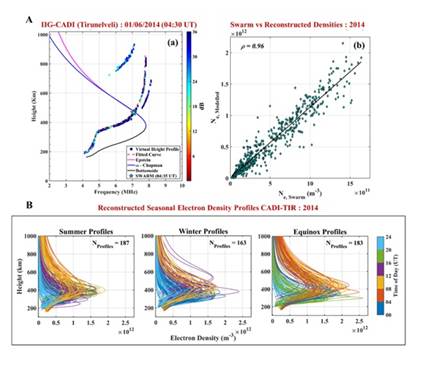
Figure A(a): A typical ionogram (frequency vs virtual height plot) and the corresponding reconstructed vertical electron density profiles over Tirunelveli. The plot shows virtual height profile (cyan), fitted curve (red dashed line), the real height bottomside profile (black solid line), and two topside reconstructed profiles: α-Chapman (blue solid line), and Epstein (Pink solid line). The Swarm in-situ electron density is marked by a star for validation.
Figure A(b): Correlation analysis between measured and reconstructed densities for 2014 validating the robustness of proposed topside reconstruction approach.
Figure B: Seasonal electron density profiles reconstructed over Tirunelveli for 2014 distributed according to time zones.
The improved reconstruction of the topside ionosphere provided by this method supports better understanding of topside ionosphere and provides more accurate region-specific estimates of the topside scale height gradient.
This approach is particularly important over the geomagnetic equator, where ionospheric dynamics are highly complex due to the geometry of Earth’s magnetic field.
This study by K Siba Kiran Guru, S Sripathi, R K Barad, marks an important milestone toward improving the characterization of the topside ionosphere over the Indian region by effectively combining ground and space-based observations. The proposed approach enhances the accuracy of regional ionospheric modelling under varying space weather conditions. The study AGU Radio Science journal can be extended to other regions as well. Such advancements are crucial for improving space weather prediction capabilities and ensuring the reliability of communication and navigation systems.
Publication link: https://doi.org/10.1029/2025RS008356
*****
NKR/FT/NM
(Release ID: 2282424)
Visitor Counter : 1907