NITI Aayog
NITI Aayog launches Eighth Edition of “Trade Watch Quarterly”
Posted On:
23 JUN 2026 8:35PM by PIB Delhi
Shri Ashok Kumar Lahiri, Vice-Chairman, NITI Aayog, released the latest edition of the “Trade Watch Quarterly” publication for Quarter 4 of FY’2025-26 (Jan-Mar 2026) on 23rd June 2026, in New Delhi. It was released in the presence of the CEO, NITI Aayog and other senior officials.
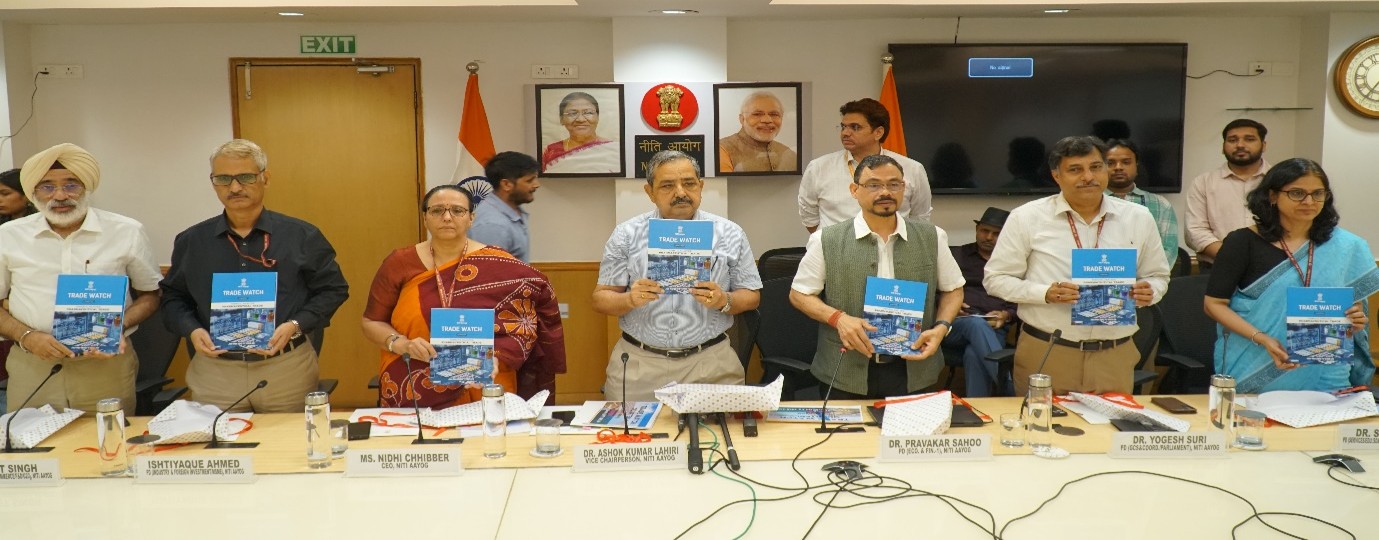
The publication provides a comprehensive assessment of global and domestic trade trends at a time when global trade has demonstrated resilience despite persistent macroeconomic and geopolitical uncertainties. India's trade remained broadly stable, with total merchandise and services trade expanding by 5.4% year-on-year (y-o-y) during April–March FY’2025-26 to reach $1.84 trillion. The thematic focus of this edition is the pharmaceutical sector, one of India's most globally competitive industries. India is a leading supplier of generic medicines and a major provider of vaccines and essential therapeutics, making an important contribution to global health security. The study analyses global demand patterns vis-à-vis India's export profile to identify untapped opportunities, while examining the sector's competitive strengths, existing gaps, and scope for higher value addition and market diversification.
India’s trade performance in Q4 FY’2025–26 underscored the continued resilience of the external sector, supported by robust growth in services trade. While merchandise exports moderated and imports increased, the composition of trade remained broadly stable. Services trade remained a key source of strength, with exports growing by 9.0%, outpacing import growth and sustaining a strong services surplus. India retained its position as the world’s eighth-largest services exporter in 2025, with services exports recording a CAGR of 10.3% during 2015–2025, significantly above the global average. Overall, India’s total trade reached $1.84 trillion during FY2025–26, with exports growing by 4.2% and imports by 6.5%, highlighting the continued dynamism of India’s engagement with the global economy.
The thematic focus of this quarter’s edition, India’s pharmaceutical sector has emerged as a strategic pillar of the economy, supported by a strong manufacturing base, global competitiveness in generic medicines, and growing integration into international healthcare supply chains. Global pharmaceutical and Active Pharmaceutical Ingredients (APIs) demand is estimated at approximately $1.3 trillion in 2025, while India exported pharmaceutical and API products worth $35.8 billion. Supported by its strong capabilities in generic medicines, vaccines, and essential drugs, India continues to play an important role in global healthcare supply chains, although its share in global pharmaceutical trade remains modest, indicating significant opportunities for future growth.
The analysis highlights that India’s export strength remains concentrated in formulations, particularly retail medicaments and generic drugs, where it has established a strong presence across global markets. However, the global pharmaceutical industry is increasingly shifting towards high-value segments such as biologics, immunologicals, and advanced therapeutics, where India’s participation remains limited. In APIs, India has strengthened its position in several specialised chemical intermediates and antibiotics, but continues to face dependence on imported raw materials and intermediates, particularly from China.
Telangana, Gujarat, and Maharashtra have emerged as the key pillars of India’s pharmaceutical industry, driving a significant share of the country’s production, exports, and integration into global value chains. Their success is rooted in strong manufacturing ecosystems, cluster-based development, globally competitive firms, and supportive policy frameworks.
The analysis highlights that India’s pharmaceutical sector is well positioned to strengthen its role in global value chains, supported by a growing innovation ecosystem, strong manufacturing capabilities, and increasing global demand for medicines and healthcare products. Opportunities exist to expand India’s presence in high-value segments such as biologics, biosimilars, and advanced therapeutics, while further strengthening domestic API production and upstream capabilities can enhance supply chain resilience. Continued investments in R&D, technology, skills, and regulatory efficiency, alongside improved market access in key export destinations, can support higher value addition and reinforce India’s position as a leading global pharmaceutical manufacturing and innovation hub.
Addressing the occasion, Shri Ashok Kumar Lahiri stated that “as global trade undergoes structural shifts, India’s ability to diversify its export base while strengthening domestic capabilities in key sectors will be critical to sustaining growth and enhancing resilience. The pharmaceutical sector illustrates both India’s strengths and future opportunities. While India has emerged as a leading supplier of generic medicines to the world, the next phase of growth will depend on moving towards innovation-driven segments, strengthening domestic production of critical inputs, and improving access to global markets.”
The edition serves as a valuable resource for policymakers, industry, researchers, and academia, offering data-driven insights and forward-looking policy recommendations to support informed decision-making and strengthen India’s trade competitiveness in an evolving global landscape.
The full publication can be accessed at: https://niti.gov.in/sites/default/files/2026-06/Trade-Watch-Quarterly-Jan-March-Q4-FY26.pdf
***
MJPS/SS/PRK
(Release ID: 2277232)
Visitor Counter : 4066