PIB Backgrounder
Vikas Bhi, Virasat Bhi
Posted On:
18 JUN 2026 10:52AM by PIB Delhi
|
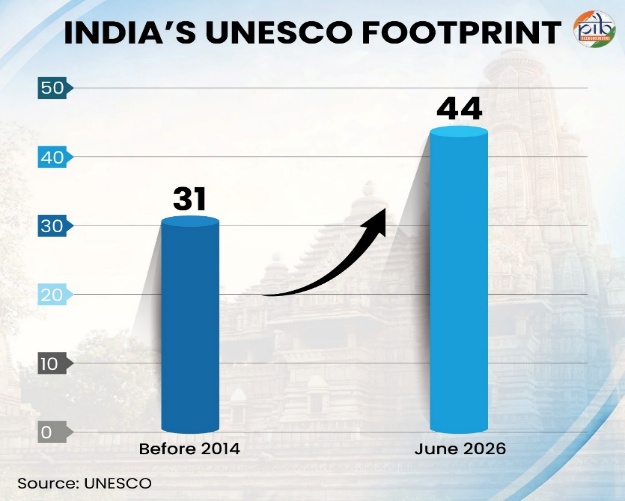
India’s heritage sector has witnessed strong expansion over the past 12 years under the vision of “Vikas Bhi, Virasat Bhi.” Institutional strengthening, and large-scale digitisation via initiatives like National Mission on Monuments and Antiquities (NMMA), Gyan Bharatam, and the Vedic Heritage Portal have improved documentation and access to cultural resources. Heritage-linked tourism schemes like PRASHAD and HRIDAY have upgraded infrastructure and transformed visitor experience at major spiritual and historical sites. India’s UNESCO footprint has grown from 31 to 44 World Heritage Sites. Additionally, India is gaining wider recognition of intangible heritage such as Yoga, Kumbh Mela, Durga Puja, and Garba. Parallel efforts in antiquity repatriation and museum development have reinforced India’s civilisational pride and global cultural leadership.
|
Revitalising India’s Cultural Legacy
India’s vast and diverse heritage embodies thousands of years of history, culture, and tradition. Safeguarding it is central to preserving our nation's unique civilisational identity. In past 12 years, the government has placed renewed emphasis on the conservation, development, and promotion of India’s rich cultural legacy. Wide-ranging efforts have been undertaken to strengthen and preserve this heritage across the country.
Key initiatives have focused on restoring iconic sites, improving visitor facilities, conserving ancient temples and monuments, and developing heritage cities and pilgrimage circuits. Programmes aimed at rejuvenating spiritual and cultural centres have helped preserve India’s historic character while also enhancing public access and tourism potential.
At the same time, investments in connectivity, urban renewal, digital outreach, and tourism infrastructure around heritage destinations have contributed to local economic growth and employment generation. Heritage-led development projects have encouraged sustainable tourism while ensuring that cultural assets are protected for future generations.
India’s cultural landscape includes monuments, antiquities, manuscripts, and historic sites. They are not just remnants of the past, but represent shared memory and continuity across generations.
Since 2014, the government has launched several initiatives to preserve and promote these cultural assets. The government has also focused on linking heritage development with economic growth while strengthening India's global cultural identity. In addition, heritage conservation has increasingly been integrated with tourism, livelihoods, and cultural diplomacy.
Launched in September 2017 and revamped in September 2023, the Adopt a Heritage 2.0 programme creates a framework for collaboration with private companies, public sector units, NGOs, trusts, and societies. It focuses on developing and maintaining visitor-friendly amenities at Protected Monuments of National Importance. Support is provided through Corporate Social Responsibility (CSR) and other contributions. The aim is to improve the visitor experience.
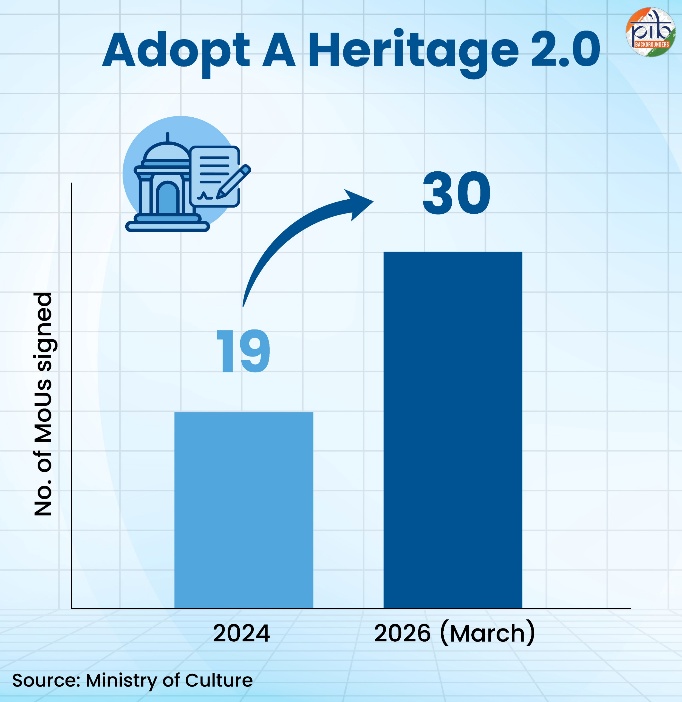
As on March 2026, a total of 30 Memorandums of Understanding (MoUs) have been signed under the Adopt a Heritage 2.0 programme.
The programme is already demonstrating visible outcomes in terms of improved site management and enhanced public engagement. This is reflected in strong visitor participation at adopted monuments, which collectively recorded a total footfall of 13.59 million visitors during FY 2024–25.
These figures indicate strong visitor interest and suggest that improved amenities, services, and on-site facilitation under the programme are contributing to better visitor experience and higher engagement at adopted heritage sites.
Pilgrimage Rejuvenation and Spiritual, Heritage Augmentation Drive (PRASHAD)
The PRASHAD scheme was launched in January 2015. The scheme develops pilgrimage and heritage tourism destinations across India. It improves infrastructure, sanitation, safety, and visitor facilities.
Key Achievements:
- As on February 2026, the Ministry sanctioned 54 projects under the PRASHAD Scheme across 28 States and Union Territories. The total estimated project cost is ₹1,726.74 crore.
- Out of these 54 projects, 32 projects have been physically completed.
- Somnath Promenade Development Project at a cost of ₹47.12 crore. Somnath is now strengthened as a major spiritual tourism destination.
- Kedarnath PRASHAD project has significantly improved pilgrimage facilities, accessibility, sanitation, visitor services, and tourism infrastructure across the Kedarnath circuit. Over 5 lakh pilgrim have already visited during the ongoing season itself.
IIM Rohtak in its 2021 report "Evaluation of Central Sector Scheme PRASHAD" underlined the achievements of the scheme. It mentioned that the scheme has helped in increasing the visitor satisfaction, ease of travel and aesthetical aspects of the selected heritage sites. Also, the report mentioned that the scheme has led to increase in the positive overall visitor user experience.
Launched in 2014–15, Swadesh Darshan was the flagship scheme for integrated development of tourism infrastructure across thematic tourist circuits. The scheme focused on developing integrated tourism circuits covering heritage, spiritual, coastal, desert, Buddhist, tribal and eco-tourism destinations.
- A total of 76 tourism infrastructure projects were sanctioned with an investment of ₹5,290.33 crore.
- As on March 2026, 75 projects have been physically completed.
Swadesh Darshan was revamped as Swadesh Darshan 2.0 to move beyond circuit-based development and adopt a destination-centric approach. The scheme now focuses on developing sustainable, responsible and globally competitive tourism destinations that provide high-quality visitor experiences.
- Under SD2.0, 53 projects have been sanctioned with a total investment of ₹2,208.31 crore, which are at various stages of implementation by States and Union Territories.
Challenge Based Destination Development (CBDD)
Introduced under Swadesh Darshan 2.0 in March 2024, Challenge Based Destination Development (CBDD) promotes tourism development through a competitive, challenge-based framework. The initiative seeks to transform destinations into sustainable tourism hubs through holistic planning, innovation and community participation.
- Under CBDD, 38 projects have been sanctioned with an investment of ₹697.94 crore.
Archaeology and Monument Preservation
Archaeological Survey of India (ASI)
The Archaeological Survey of India (ASI) is the premier organisation responsible for archaeological research and conservation of India’s cultural heritage. ASI carries out its functions through a network of around 38 Circles, which serve as regional administrative units.
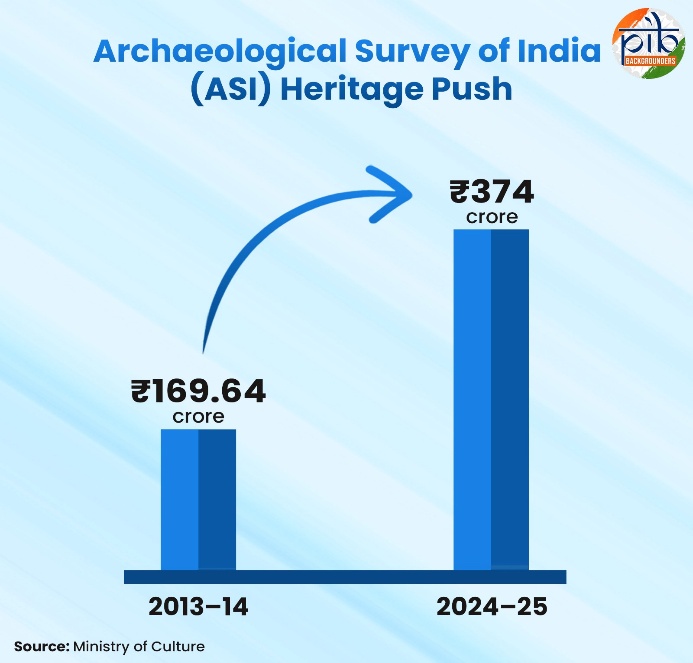
As on April 2026, India has 3,686 centrally protected monuments under ASI.
For the year 2024–25, around ₹374 crore was allocated by the government for conservation and maintenance of protected monuments.
National Mission on Monuments and Antiquities (NMMA)
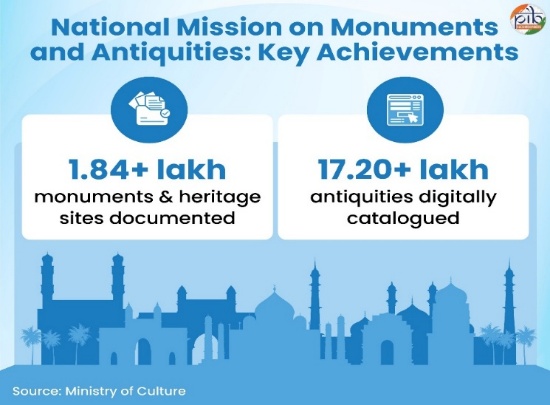
The National Mission on Monuments and Antiquities is implemented under ASI. It plays a crucial role in supporting conservation by building a reliable national database of India’s built heritage and antiquities. The Mission aims to document and create an inventory of all monuments and antiquities in the country, information that directly informs planning, prioritisation and monitoring of conservation work.
- As of March 2026, NMMA has documented 1.84 lakh monuments, including built heritage and sites. It also documented 17.20 lakh antiquities across India.
The Heritage City Development and Augmentation Yojana (HRIDAY) was launched in January 2015. A central sector scheme, it aimed at integrating urban development with heritage conservation. The focus was on preserving the unique character of heritage cities while improving basic infrastructure.
Special attention was given to sanitation, security, tourism, and livelihoods, while retaining the cultural identity of each city.
The scheme was implemented in 12 cities across India.
- Ajmer, Amaravati, and Badami have seen improvements in cleanliness, tourism, and community development.
- Amritsar, Gaya, and Varanasi prioritized heritage revitalization, inclusivity, and economic growth.
- Warangal and Puri witnessed growth in tourism and public amenities.
- Kancheepuram and Mathura witnessed improvements in safety and infrastructure.
- Velankanni stood out for its environmental sustainability and heritage conservation.
Overall, the scheme positively impacted the quality of life for residents and boosted tourism.
The mission period of the scheme ended on 31 March 2019.
Major Heritage Sites Redevloped
- Inaugurated on 13 December 2021, the Kashi Vishwanath Corridor is a transformative ₹355-crore project developed over an area of 5.5 acres. It directly connects the Kashi Vishwanath Temple in Varanasi with the Ganga River through a wide four-lane pathway. The project has significantly improved accessibility for pilgrims and eased movement in the temple precinct, enhancing the overall visitor experience.
- Since its inauguration in December 2021, the Shri Kashi Vishwanath Dham Corridor has recorded over 25.28 crore devotees in just 3.5 years. It has generated an estimated ₹1.25 lakh crore economic impact, with average visitor spending of ₹4,000–₹5,000 per person. Around 70% of visitors are from South India, while about 15% come from other states.
|
- In Somnath, redevelopment of temple precincts has improved visitor experience. A 1.5 km promenade has been developed, and further cultural projects are planned to enhance the site. The transformation coincides with the 75th anniversary of the reconstruction and reopening of the Somnath Temple in 1951, an event commemorated nationally through the Somnath Amrut Mahotsav. The anniversary has reinforced Somnath’s position not only as a major pilgrimage destination but also as a symbol of India’s civilisational resilience and cultural continuity.
- Somnath Temple records 92–97 lakh annual devotees (nearly 98 lakh in 2020), including 13.77 lakh for Bilva Pooja and 3.56 lakh during Maha Shivratri 2025. The Light and Sound Show has drawn over 10 lakh visitors in 3 years. Sustainability measures include treating 30 lakh litres of wastewater monthly, a 7,200-tree Miyawaki forest absorbing ~93,000 kg CO₂ annually, transforming plastic waste into producing 4,700 paver blocks monthly, and benefiting 1.13 lakh families through Somgangajal.
|
- At Kedarnath, redevelopment efforts have focused on improving safety and accessibility for pilgrims. The 12.9 km Sonprayag–Kedarnath Ropeway, approved under the National Ropeways Development Programme (Parvatmala Pariyojana) at a cost of ₹4,081.28 crore, will use advanced 3S (Tri-cable Detachable Gondola) technology with a capacity of 1,800 passengers per hour per direction.
- The project will reduce travel time from 8–9 hours to just 36 minutes, providing safe, eco-friendly, and all-weather connectivity to one of India’s 12 Jyotirlingas, which receives around 20 lakh pilgrims annually.
|
|
The Ram Mandir in Ayodhya, consecrated in January 2024, is supported by large-scale urban development. The city is evolving into a major spiritual destination with improved connectivity and infrastructure.
- Tourism in Ayodhya is estimated to generate ₹18,000 crore annually by 2028, with current tourism revenue of ₹8,000–₹12,500 crore annually. Visitor numbers surged from 57.5 million in 2023 to over 160 million in 2024, with more than 230 million devotees in the first half of 2025. The state is also investing over ₹5,000 crore in development, with Ayodhya contributing nearly 25% of Uttar Pradesh’s projected ₹70,000 crore tourism economy by 2028.
|
- The Mahakal Lok Project in Ujjain has developed a large cultural corridor around the temple complex. Built at a cost of around ₹850 crore, it has upgraded public spaces and pilgrimage facilities.
- The Maa Kamakhya Divya Lok Pariyojana in Assam is modernising infrastructure at the Kamakhya temple. It is improving facilities for pilgrims and enhancing tourism potential in the Northeast region.
|
These initiatives have strengthened infrastructure at major heritage and pilgrimage sites. Accessibility and visitor experience have improved significantly. They have also contributed to the growth of spiritual and cultural tourism across the country.
Preserving Heritage Through Diplomacy and Determination
Over centuries, many sacred relics and antiquities of great religious and historical importance were taken abroad during colonial rule and foreign occupations. Additionally, many of these artefacts were lost due to illegal trafficking. Over the last 12 years, the government has intensified its efforts to reclaim these sacred relics and artefacts.
Repatriation of Sacred Relics
Major repatriation achievements include:
- Piprahwa Relics of Lord Buddha returned in 2025 after 127 years
- Goddess Annapurna idol repatriated from Canada in 2021 after 108 years
- Rama, Sita and Lakshmana bronze idols returned from the UK in 2020
Sacred and cultural objects have also been returned from Australia, USA, UK, Germany, Singapore and Canada.
Global Exposition of Sacred Relics
India expanded international exposition of sacred Buddha relics to strengthen cultural and civilisational ties.
- Vietnam (2025): over 15 million devotees
- Kalmykia, Russia (2025): over 90,000 visitors
- Bhutan (2025): exposition during Global Peace Prayer Festival
- Sri Lanka (2026): exposition at Gangaramaya Temple, Colombo
Domestic exhibitions were also organised in New Delhi and Ladakh in 2026, showcasing the reunited Piprahwa relics.
Repatriation of Antiquities
The repatriation of cultural artefacts has been significantly strengthened in recent years to restore India’s stolen heritage. As on May 2026, a total of 653 antiquities have been retrieved since 2014.
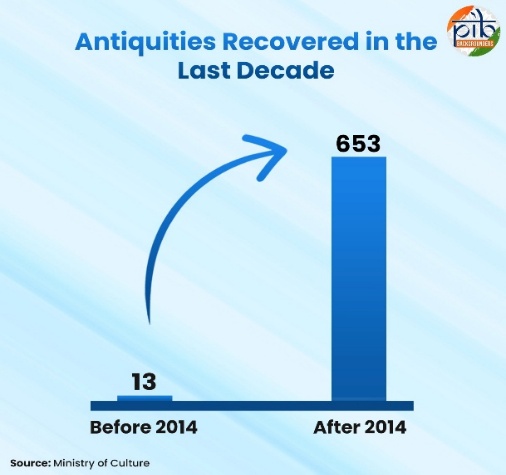
In the last five years itself, 613 cultural artefacts have been brought back to India, reflecting a major acceleration in recovery efforts.
Further, 11 objects with verified origins have been handed over to concerned organisations and institutions. 9 objects have been given on loan to the Indira Gandhi National Centre for the Arts (IGNCA) for display. 1 object has been given to the National Museum, while 14 objects have been allotted to the Indian Institute of Heritage.
Museums and Cultural Infrastructure
Museum Grant Scheme
Museum Grant Scheme provides financial assistance for setting up new museums and for strengthening and modernising existing ones at regional, state, and district levels. It also supports digitisation of art objects and training of museum professionals. Since 2014, the government increasingly promoted immersive museum formats instead of static display only models. This included virtual and theme-based museums and Virtual Experiential Museums (VEM).
India’s First Archaeological Experiential Museum
Established in January, 2025, the Archaeological Experiential Museum at Vadnagar, Gujrat is the only museum in the world which offers an immersive archaeological experience. The museum has been developed at a total cost of ₹298 crore and spans an area of 12,500 square meters.
The museum showcases more than 5,000 artifacts, and also displays organic remains such as food grains, DNA samples, and skeletal remains.
A major highlight is the 4,000-square-meter open excavation site, where archaeological remains are visible at depths of 16–18 meters. An experiential walkway allows visitors to directly observe and understand the excavation process and findings.
Yuge Yugeen Bharat National Museum
The Yuge Yugeen (The timeless and eternal India) Bharat National Museum is being developed as a landmark institution in New Delhi. It will be housed in the historic North and South Blocks under the Central Vista Redevelopment Project.
Spread over 1,54,000 square metres, it will present India’s civilisational and cultural journey spanning thousands of years.
|
UNESCO and Global Heritage Recognition
India has significantly expanded its global heritage recognition over the past decade.
India now has 44 UNESCO World Heritage Sites.
- India added 12 new World Heritage Sites between 2014 and early 2026.
- India has 15 UNESCO Intangible Cultural Heritage elements listed globally.
- India hosted the 46th UNESCO World Heritage Committee Session in New Delhi (2024).
India’s UNESCO recognition now reflects both tangible monuments and living cultural traditions.
Key intangible heritage recognitions include Yoga, Kumbh Mela, Deepawali, Durga Puja, and Garba.
These recognitions have strengthened India’s global cultural diplomacy and heritage leadership.
Digitisation and Knowledge Preservation
Digitisation of Cultural Heritage (Gyan Bharatam)
The Gyan Bharatam Mission, launched in 2025, is the government’s flagship initiative aimed at preserving, digitising, and disseminating India’s vast manuscript heritage. It focuses on preserving ancient knowledge systems recorded in manuscripts. It also makes them accessible for research and public engagement through digital repositories and conservation networks.
The initiative further integrates modern technologies to safeguard these fragile manuscripts and ensure they are globally accessible.
- More than 8 lakh digitised manuscripts in different formats are being reformatted as per Gyan Bharatam Standard Operating Procedures (SOP).
- Out of these 1.29 lakh manuscripts are accessible to the public on the National Digital Repository (NDR).
Additionally, the National Manuscript Survey was also launched in March 2026 for identifying, documenting and creating a comprehensive national database of manuscripts.
Technology-Supported Conservation
Modern technologies/tools are being used as per requirements for proper documentation. These include Light Detection and Ranging (LiDAR) scanning, Geographic Information System (GIS) based mapping and drone-based surveys etc. In parallel, India has expanded the application of digital and spatial technologies that support accurate recording and proactive conservation planning.
In addition to these technologies, the government has begun integrating Artificial Intelligence (AI) within the broader cultural and heritage ecosystem, particularly in areas such as digitisation, documentation, and accessibility of cultural assets. AI-enabled platforms are being used to process and organise large volumes of heritage data, including manuscripts and cultural knowledge systems.
Preserving Culture through Technology
India is using AI to preserve languages, manuscripts, and cultural heritage while improving access to education and public services.
- BHASHINI (launched in 2022) supports 22 languages (voice) and 36 languages (text), with 350+ AI models and over 4 billion+ language transactions. It enabled real-time translation at events like Kashi Tamil Sangamam and Maha Kumbh 2025.
- BharatGen is developing AI models for 22 Scheduled Languages, while Adi-Vaani supports tribal languages such as Santali, Bhili, Mundari, and Gondi through digital preservation and translation.
- Under the Gyan Bharatam Mission, AI is being used to digitise and decode India’s manuscript heritage, with 44 lakh+ manuscripts documented and an outlay of ₹482.85 crore (2024–31).
- It leverages AI-enabled tools such as handwritten text recognition (HTR) and optical character recognition (OCR) for ancient manuscripts, metadata extraction and intelligent cataloguing across scripts and languages, and improved discovery and access to digitised heritage content.
- Adi-Vaani is an AI-based platform for preserving and revitalising India’s tribal languages. It enables real-time translation between Hindi, English, and tribal languages, speech-to-text transcription, language learning for younger generations, and digitisation of folklore and oral traditions.
- Platforms like Anuvadini, e-KUMBH, SPPEL, Sanchika, and Gyan-Setu are expanding multilingual education and preserving endangered languages and traditional knowledge.
- Over 5 crore+ learners are connected through digital education platforms like SWAYAM.
|
The Government launched the Vedic Heritage Portal in March 2023 under the Indira Gandhi National Centre for the Arts. In the portal, India’s ancient Vedic knowledge traditions have been systematically preserved, documented, and made accessible to scholars, practitioners, and the wider public. The portal serves as a national digital repository of Vedic heritage, covering the Rigveda, Yajurveda, Samaveda, and Atharvaveda traditions. It includes extensive audio-visual material, manuscripts, and ritual documentation, with more than 500 hours of recordings integrated into the platform, along with digital learning modules and recitation archives. It also documents Vedic recensions (Shakhas) and oral traditions, strengthening efforts to preserve living knowledge systems. This initiative gains further global significance as the Tradition of Vedic Chanting has been recognised by UNESCO as Intangible Cultural Heritage, while Rigveda manuscripts are included in UNESCO’s Memory of the World Register, underscoring their universal cultural value.
Film and Audio-Visual Heritage
National Film Heritage Mission (NFHM)
In 2015, the government launched the National Film Heritage Mission which aims to preserve, digitize, and restore India’s cinematic heritage.
The mission supports filmmakers across all Indian languages. It safeguards classic feature films, short films, and documentaries, thereby preserving India’s cinematic heritage for future generations.
As of December 2025, 1,469 titles, equalling 4.3 lakh minutes of films have been digitised. These include features, short films and documentaries. The digitised and restored films are maintained by National Film Archives of India (NFAI) and are accessible through its official website on an on-demand basis.
National Museum of Indian Cinema (NMIC)
The National Museum of Indian Cinema (NMIC) was inaugurated in 2019 at a cost of ₹140.61 crore. It has strengthened the preservation and promotion of India’s cinematic heritage.
Located in Mumbai at the Films Division campus, including the restored 19th century Gulshan Mahal (ASI heritage building).
The museum presents the journey of over a century of Indian cinema. This is done through artefacts, vintage film equipment, photographs, memorabilia, interactive exhibits, and multimedia displays. The exhibits showcase the evolution of Indian cinema from the silent era to the present day.
The museum has also witnessed strong public engagement. It recorded over 17,000 visitors in May 2026, emerging as a key cultural and tourist destination in Mumbai.
Synthesis of Achievements
Since 2014, the Government has pursued a focused and sustained approach to heritage conservation anchored in the philosophy of “Vikas Bhi, Virasat Bhi.” This vision has helped transform heritage from a passive archive of the past into an active pillar of national identity, pride, and global engagement.
Over this period, India has strengthened its institutional and technical capacity for conservation, documentation, and restoration of both tangible and intangible cultural heritage. At the same time, heritage-led development has improved visitor experience and connectivity at key cultural and pilgrimage sites, integrating them more closely with India’s broader development journey.
India’s cultural footprint on the global stage has also expanded, reflected in its growing recognition as a custodian of one of the world’s richest civilisational traditions. Alongside this, sustained efforts have brought back important antiquities, reaffirming the principle that cultural heritage is not only to be preserved, but also to be reclaimed.
Taken together, these efforts reflect more than a policy direction. They represent a civilisational commitment—of a nation steadily reconnecting with its roots, strengthening its cultural confidence, and carrying forward its heritage as a source of identity, continuity, and global engagement.
References
PM India
https://www.pmindia.gov.in/en/news_updates/cabinet-approves-proposal-for-transitioning-from-north-and-south-blocks-to-seva-teerth-and-kartavya-bhavans-paving-the-way-for-the-yuge-yugeen-bharat/
Ministry of Home Affairs
https://www.pib.gov.in/PressReleaseIframePage.aspx?PRID=2093525®=3&lang=2
https://www.pib.gov.in/PressReleasePage.aspx?PRID=2093139®=3&lang=2
UNESCO
https://www.unesco.org/en/worldheritage/list?fq%5Bsm_unsc_field_ref_countries_label%5D%5B%5D=India&fq%5Bsm_unsc_hierarchical_field_ref_datasets_filters_label%5D%5BCategory+of+site%5D%5B%5D=Category+of+site+%7C%3E+Cultural&fq%5Bsm_unsc_hierarchical_field_ref_datasets_filters_label%5D%5BCategory+of+site%5D%5B%5D=Category+of+site+%7C%3E+Mixed&fq%5Bsm_unsc_hierarchical_field_ref_datasets_filters_label%5D%5BCategory+of+site%5D%5B%5D=Category+of+site+%7C%3E+Natural&date_from=2014&date_to=2026&query=&op=Search#toggle-facets
https://www.unesco.org/en/memory-world/rigveda
https://whc.unesco.org/en/statesparties/in
https://www.google.com/url?sa=t&source=web&rct=j&opi=89978449&url=https://whc.unesco.org/en/statesparties/in&ved=2ahUKEwikq_mMvLqUAxWo2TgGHWPcAuQQFnoECCUQAQ&usg=AOvVaw3SIh1wpG8wfSUwZNVgnenm
https://www.google.com/url?sa=i&source=web&rct=j&url=https://whc.unesco.org/en/list/1342/&ved=2ahUKEwikq_mMvLqUAxWo2TgGHWPcAuQQqYcPegoIAggACAAIARAy&opi=89978449&cd&psig=AOvVaw1CAZC3F14cwV11A7-icON3&ust=1778906188774000
https://whc.unesco.org/en/statesparties/in
Ministry of Information and Broadcasting of India
https://nfai.nfdcindia.com/introduction.php?rootId=VFZFOVBRPT0=&catId=VG5jOVBRPT0=&patId=VFZFOVBRPT0=
Ministry of Culture
https://culture.gov.in/events/exposition-holy-relics-lord-buddha-vietnam
https://www.instagram.com/p/DYTwj1GTWad/
https://culture.gov.in/memory-world?utm
https://www.instagram.com/p/DYTwj1GTWad/
https://www.myscheme.gov.in/schemes/hriday
https://gyanbharatam.com/
https://www.google.com/url?sa=t&source=web&rct=j&opi=89978449&url=https://culture.gov.in/events/launch-gyan-bharatam-national-manuscript-survey-map-indias-manuscript-heritage&ved=2ahUKEwj1_ZjFu7qUAxWD1jgGHehgMSIQFnoECDgQAQ&usg=AOvVaw3hs2W_9pjRJyeonuWbbao9
https://www.google.com/url?sa=t&source=web&rct=j&opi=89978449&url=https://gyanbharatam.com/faq&ved=2ahUKEwj1_ZjFu7qUAxWD1jgGHehgMSIQFnoECDUQAQ&usg=AOvVaw2qE2WALu7K_biQpphYfz5o
https://culture.gov.in/latest-news/seven-indian-natural-heritage-sites-added-unescos-tentative-list
https://www.google.com/url?sa=t&source=web&rct=j&opi=89978449&url=https://culture.gov.in/files/tender_document/ContentTender.pdf&ved=2ahUKEwiB-oePvbqUAxVBR2wGHaJ5Hv8QFnoECFwQAQ&usg=AOvVaw1N4nKVC_uE4RLG60YjIoQt
LOK SABHA Questions
https://www.google.com/url?sa=t&source=web&rct=j&url=https%3A%2F%2Fsansad.in%2FgetFile%2Floksabhaquestions%2Fannex%2F184%2FAS453_KIMPcM.pdf%3Fsource%3Dpqals&ved=0CAEQ1fkOahcKEwi4lK2Ij7GUAxUAAAAAHQAAAAAQBQ&opi=89978449
https://sansad.in/getFile/loksabhaquestions/annex/179/AU1488.pdf?source=pqals
https://www.google.com/url?sa=t&source=web&rct=j&opi=89978449&url=https://sansad.in/getFile/loksabhaquestions/annex/179/AU1488.pdf%3Fsource%3Dpqals&ved=2ahUKEwjUkoP6urqUAxU3aHADHTteCrEQFnoECBsQAQ&usg=AOvVaw0CWc-b1iR5ToFIrb5YCMNd
Indira Gandhi National Centre for the Arts (IGNCA)
https://vedicheritage.gov.in/
Click Here To See PDF
***
PIB Research
(Release ID: 2274401)
Visitor Counter : 5028