Posted On:
07 JUN 2026 10:47AM by PIB Delhi
|
Wide-ranging reforms have transformed India’s business environment through digital governance, regulatory simplification, and trust-based administration. Consequently, business entry systems have become faster and paperless through initiatives supporting startups, MSMEs, and company incorporation. Property registration and permit procedures are modernised via digital land records, single-window clearances, and streamlined labour and environmental approvals. Market connectivity improved with the advent of digital procurement platforms, logistics reforms, and integrated trade infrastructure. Easier credit access, simplified tax systems, and digital public infrastructure further strengthen business operations across sectors. Reforms in compliance reduction, decriminalisation, and insolvency resolution also promote a more facilitation-driven regulatory ecosystem. Notably, these measures are contributing to stronger investor confidence, reflected in India’s improved global rankings.
|
Transforming India’s Business Environment
India has undertaken sustained reforms over the past years to improve its business regulatory environment. The government’s focus has gradually shifted from a compliance-heavy system to a facilitation-driven ecosystem. Reforms have aimed at enhancing speed, transparency, and trust-based governance across processes. Consequently, this has resulted in growing investor confidence in India’s business environment and improved Ease of Doing Business (EoDB).
The progress is reflected in global assessments such as the Doing Business Report 2020 by World Bank. India’s rank improved from 142 in 2014 to 63 in 2019, marking an advancement of 79 positions over five years.
Additionally, the IMD World Competitiveness Ranking 2025 factors in economic performance of the country, Government and business efficiency and infrastructure development for the businesses. India’s rank improved from 43 in 2021 to 41 in 2025. This highlights stronger business environment, improved governance and better digital and regulatory reforms.
The World Bank’s GovTech Maturity Index, which assesses public sector digital transformation, placed India in Group A in 2020, 2022 and 2025. This category represents countries demonstrating advanced and innovative practices across Core Government Systems, Public Service Delivery, Digital Citizen Engagement, and GovTech Enablers.
United Nations also conducts E-Government Survey to assess the digital government landscape across different countries. India has secured overall high score in the survey. Within this, India has also achieved a very high score in the Online Services Index. India has also acquired high scores in Telecommunication Infrastructure and Human Capital indices. This indicates strong digital public service delivery, expanding digital infrastructure, and improved citizen access to technology-enabled governance services.
These improvements are driven by continued efforts to simplify regulations and streamline procedures. The Government has also reduced compliance burden across the business lifecycle. Reforms span from registration and logistics support to insolvency resolution. This is transforming business practices, making it easier for entrepreneurs in India and globally.
Advancing Business Entry Reforms
Over the last 12 years, the Government has introduced major reforms to simplify business entry and formalisation processes in India. These measures have reduced procedural barriers and enabled faster, technology-driven, and paperless systems for entrepreneurs and MSMEs.
Launched in January 2016, the Startup India initiative aims to support entrepreneurs and build a robust startup ecosystem. It seeks to transform India into a nation of job creators rather than job seekers. Support measures include the Seed Fund, Fund of Funds, investor connect portal, and a credit guarantee scheme.
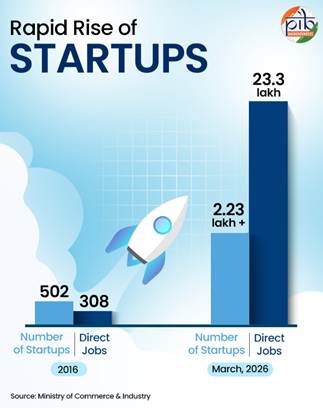
In 2016, only 502 startups were recognised, creating 308 direct jobs. However, by March 2026, over 2.23 lakh startups have been recognised, generating 23.3 lakh direct jobs. This rapid growth has expanded employment and entrepreneurial opportunities. Additionally, ~48% of these startups have at least one-woman director or partner, reflecting growing inclusivity.
With the introduction of SPICe+ Form in 2020, the process of starting and formalising businesses became easier and more streamlined. The integrated web form offers 11 services from 3 Central Government ministries and departments. Services from 3 State Governments and the NCT of Delhi are also integrated into the platform. This has reduced procedures, time, and costs associated with starting a business. The form has consolidated 10 essential procedures, including:
- Incorporation,
- DIN Allotment,
- Issue of PAN,
- Issue of TAN,
- Issue of ESIC Registration,
- Issue of EPFO Registration,
- Issue of Profession Tax Registration (Maharashtra, Karnataka and West Bengal),
- Bank Account Opening,
- Allotment of GSTIN (If So, Applied For) and
- First-Time Registration of Shops and Establishment for all new companies getting incorporated in Delhi.
This efficient system, featuring real-time data validation facilitates on-screen filing also for smooth formation of companies .
MCA21 Project, a forward-looking, AI-driven initiative significantly enhances transparency in India’s corporate landscape. The platform is used for end-to-end registry and incorporation related services of companies & limited liability partnerships (LLPs). MCA21 Version 3 was launched in FY 2021-22 and integrates advanced features like e-Scrutiny, e-adjudication and e-consultation. It also includes Compliance Management System and MCA Lab.
From 2021 to 2025, a total of approximately 3.84 crore filings were made. Of these 3.33 crore filings were approved through Straight Through Process. This has reduced processing time, minimised manual intervention, and improved ease of compliance for businesses.
Udyam Registration Portal
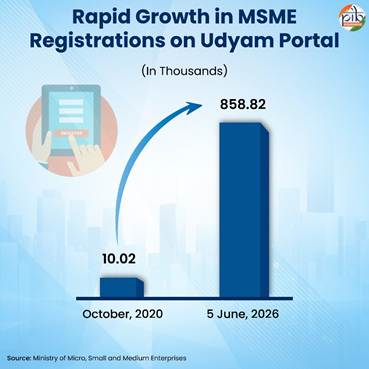
To address procedural hurdles and simplify MSME registration, the Government introduced easier and technology-driven registration systems. Udyam Registration Portal was introduced in July 2020. It offers a free, paperless, and self-declaration-based system for MSMEs (Micro, Small and Medium Enterprises). MSME registrations on the Udyam Portal increased from 10.02 thousand in October 2020 to over 858 thousand by 5 June 2026.
By integrating the portal with CBDT (Central Board of Direct Taxes) and GSTN (GST Network) databases, it provides a fully digital, documentation-free registration experience that eliminates administrative hurdles.
Simplifying Property Registration
Alongside business entry reforms, the Government has also undertaken measures to simplify property registration processes. Property registration in India was traditionally a challenging process, marked by disputes, fraud, and incompetent manual procedures. However, digital transformation and state-level reforms have improved accountability and efficiency in land administration.
Digital India Land Records Modernization Programme (DILRMP)
DILRMP was launched in 2016 to modernize the management of land records and minimize the scope of land/property disputes. The programme enhances accuracy in land records maintenance system. It has effectively shifted land administration from "in-line" to "online".
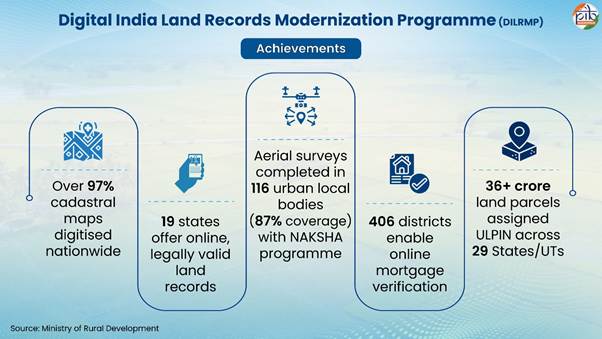
DILRMP has achieved significant progress in recent years:
- Digitization of Maps: Cadastral maps have been digitized for 97.37% of the country.
- Citizens in 19 states can now download digitally signed, legally valid land records from home, and banks in 406 districts can verify mortgages online, significantly speeding up credit access.
- NAKSHA (National Geospatial Knowledge-based Land Survey of Urban Habitations) pilot programme is also building a comprehensive, GIS-integrated database of urban land parcels. Aerial flying has been accomplished in 116 urban local bodies (87% of targets), covering ~5,915 sq. km with high-resolution imagery (December, 2025).
- Unique Land Parcel Identification Number (ULPIN) is a 14-digit alphanumeric code based on geo-coordinates and has been established as the "Aadhaar for Land". As of November 2025, ULPIN has been assigned to over 36 crore land parcels across 29 States and UTs. It eliminates duplicity, prevents benami transactions, and paves the way for a unified land ecosystem.
National Generic Document Registration System (NGDRS): One Nation, One Registration
NGDRS has streamlined property transactions, promoting EoDB by offering a complete user interface for property and document registration. The application also enables citizens buy land online. Buyers can find out the circle rate for land, calculate property valuation as per prevailing rates and understand land type.
It has been implemented in 17 States/UTs across India. 88.6% of Sub-Registrar Offices (SROs) are now integrated with revenue offices, enabling automatic mutation of land records immediately after registration.
Streamlining Permit Procedures
Complementing previous reforms, measures have also been introduced to streamline permit procedures and reduce procedural delays. Before 2014, obtaining business permits and licences often involved lengthy procedures, extensive paperwork, and multiple regulatory clearances. Over the years, the Government has undertaken significant reforms to simplify and digitize approval processes.
With the introduction of Labour codes in November 2025, the permit procedures were simplified. The Occupational Safety, Health and Working Conditions Code (OSH), 2020, replaced 13 Central Labour laws by a single comprehensive legislation. It also introduced the following changes to ease the permit process:
- Electronic single registration, single return, single all-India licences valid for five years, and deemed approvals have promoted ease of doing business. These measures reduce procedural delays, lower compliance costs, and speed up business start-up and operations.
- For electronic registration of establishments, uniform threshold of 10 employees has been fixed. This ensures universal application of occupational safety, health and welfare standards in all establishments having 10 or more workers.
- 1 registration replaced 6 separate registrations for an establishment. This creates a centralized database to improve coordination and process transparency.
- The threshold of no. of employees to obtain license for factory has been increased from 10 to 20 (with power) and 20 to 40 (without power).
- Further, for granting permission for the construction/expansion of factory, a time limit of 30 days has been prescribed with the provision of deemed permission.
- Inspector-cum-Facilitators have been introduced in place of inspector and randomized web-based inspection system that aim to reduce traditional “inspector raj”. Inspectors function more as facilitators who help employers comply with law, rules and regulations.
Further, the Government has amended the Uniform Consent Guidelines notified under the Air (Prevention and Control of Pollution) Act, 1981 and the Water (Prevention and Control of Pollution) Act, 1974 to streamline the consent mechanism for industries across all States and Union territories.
- A major amendment relates to the validity of Consent to Operate (CTO). Under the amended guidelines, CTO, once granted, will remain valid until it is cancelled. This removes the need for repeated renewals, reduces paperwork, compliance burden on industries and ensures continuity of industrial operations.
- Special provisions have been introduced for Micro and Small Enterprises located in notified industrial estates or areas. For such units, Consent to Establish is deemed granted upon submission of a self-certified application, as the land has already been assessed from an environmental perspective.
- The amendments also allow States and Union territories to prescribe a one-time Consent to Operate fee for a period ranging from 5 to 25 years. It reduces repetitive fee collection and administrative processing.
- Alongside this, in 2016, to improve the inspection process of industries, the Central Pollution Control Board directed committees and state boards to inspect industries periodically. Industries were categories on the basis of pollution index under “Red, Orange, and Green” categories. They were inspected every six months, one year, and two years, respectively. This re-categorisation supports a clean and accountable regulatory environment while enabling predictable and risk-based compliance. Also, the processing time for grant of consent to Red Category industries has been reduced from 120 days to 90 days.
National Single Window System (NSWS)
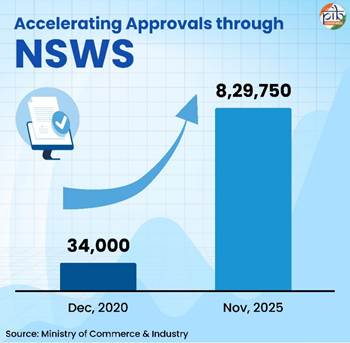
The NSWS is a single window digital platform which guides in identifying and applying for approvals according to the business requirements. It reduces approval timelines, secures document repositories, and enables faster query management. The system integrates approval processes across 32 Central Departments and 34 State Governments. It provides access to over 686 central and 7,498 state approvals. Since its launch in 2021, NSWS has granted over 8,29,750 approvals (20 November, 2025).
PARIVESH (Pro-Active and Responsive facilitation by Interactive, Virtuous, and Environmental Single Window Hub) 2.0
PARVIESH portal was launched in August 2018 with the aim to streamline Environment clearance (EC), Forest clearance (FC), Wildlife (WL) and Coastal Regulation Zone (CRZ) clearances. As a result, the average time for environmental clearance approval reduced to 64 days in 2025-26, against the stipulated timeline of 105 days. It boosts India's EoDB by digitizing and centralizing the previously cumbersome green clearance process.
Together, these reforms have streamlined permit procedures and improved business facilitation across sectors.
Deepening Market Connectivity
The Government has significantly improved market access for businesses through digital public procurement platforms, digital commerce networks, and integrated logistics reforms. Measures have been taken to connect buyers, sellers, manufacturers, and service providers across the country. These initiatives ensure end-to-end solutions, wider market reach, and more efficient supply chains, particularly benefiting MSMEs and small businesses.
With enhanced multimodal connectivity and infrastructure expansion, India’s logistics competitiveness has also improved after 2014. India ranked 38th in the World Bank Logistics Performance Index in 2023, improving from 54th position in 2014. Measures including GeM, ONDC, PM GatiShakti, NLP (Marine), and LDB 2.0, collectively drive inclusion, transparency, and efficiency to enhance the EoDB.
GeM (Government e-Marketplace)
GeM was introduced in 2016 to digitise and make public procurement more streamlined and inclusive. The e-marketplace connects women entrepreneurs, startups, micro and small enterprises (MSEs), artisans, self-help groups (SHGs) and Divyangjans to mainstream procurement.
GeM has achieved a cumulative Gross Merchandise Value (GMV) of ₹18.4 lakh crore, including crossing ₹5 lakh crore GMV in the financial year 2025–26. During FY 2025–26, 68% of total orders were executed by MSEs, which accounted for 47.1% of total GMV. GeM supports the “Make in India” initiative by facilitating market access for over 35,705 start-ups. These startups have cumulatively processed orders worth more than ₹51,494 crore.
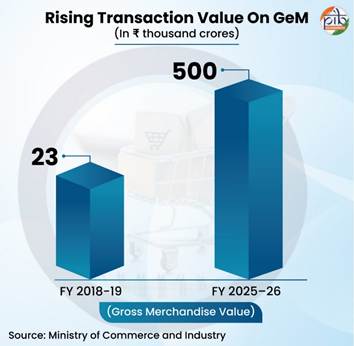
Besides, 2.04 lakh+ women-led MSEs are registered on GeM, servicing over 42 lakh orders valued at ₹79,231 crore (December 2025). Technology continues to play a central role in GeM’s operations. The platform leverages Artificial Intelligence (AI), Machine Learning (ML) and strengthen accountability, streamline processes, and improve integrity in procurement systems. GeM has achieved 100% coverage of states and Union Territories. The e-Learning Training Courses are available in 12 official languages - Assamese, Bengali, English, Gujarati, Hindi, Kannada, Malayalam, Marathi, Odiya, Punjabi, Tamil, and Telugu, catering to diverse user needs. GeM enhances EoDB by replacing fragmented bidding with a smart, and sustainable system that eliminates entry barriers for MSMEs.
ONDC (Open Network for Digital Commerce)
ONDC is an initiative aimed at promoting open networks for all aspects of exchange of goods and services over digital or electronic networks. It was introduced in April 2022 to democratize digital commerce. The sellers and service providers are spread across 616+ cities with 7.64 Lakh+ sellers., By fostering open protocols and reducing dependency on monopolistic platforms, ONDC boosts EoDB with innovation and inclusivity in e-commerce landscape.
PM GatiShakti National Master Plan
India’s logistics ecosystem has undergone transformation since 2014 through integrated infrastructure development, digitalisation, and institutional reforms. Earlier, logistics planning remained fragmented across transport modes, increasing costs and reducing supply chain productivity. Launched in October 2021, the PM GatiShakti National Master Plan is a transformative initiative for integrated infrastructure planning and multimodal connectivity.
- It integrates 58 Central Ministries and all States/UTs on a unified digital platform with 3199 data layers for coordinated infrastructure planning and execution.
- The Unified Geospatial Interface provides 230 curated datasets to support investment decisions and logistics planning.
- As of February 2026, the Network Planning Group evaluated 352 projects worth ₹16.10 lakh crore, with 201 sanctioned and 167 under implementation.
By enabling integrated planning of transport and logistics infrastructure, the plan reduces delays. By avoiding asset duplication and improving multimodal connectivity, the plan enhances ease of doing business.
National Logistics Portal (Marine)
The National Logistics Portal (Marine) is a platform which integrates government and business services to streamline maritime logistics operations. It is a single-window platform for exporters, importers, and maritime logistics service providers. It was introduced in 2023 to reduce the logistics cost and time delays. It enables end-to-end digital logistics solutions, including document exchange and real-time cargo tracking. It also enables digital payments for shipping and container freight services through a unified interface, strengthening the ease of business operations. Since the launch of its mobile application in March 2023, till August 2024, it garnered a base of over 21,000 users spread across diverse geographic regions within India.
Logistics Data Bank (LDB 2.0)
LDB 2.0 strengthens India’s digital logistics ecosystem through real-time multimodal cargo tracking across road, rail, and sea networks. By introducing high-seas container tracking and a live container heatmap to identify bottlenecks, LDB 2.0 fosters a transparent, data-driven ecosystem. It reduces costs and improves supply chain management which makes India’s logistics more credible. In 2025-26, it tracked 100% of EXIM containers and handled around 95 million export-import containers.
Facilitating Easier Credit Access
Access to credit is essential for businesses to manage working capital, expand operations, adopt technology, and meet day-to-day operational needs. Just as simplified registration and licensing support business entry, timely and affordable credit enables businesses to sustain growth and scale resourcefully.
Before 2014, small entrepreneurs faced hurdles like complex paperwork or were forced to rely on informal finance. With the initiation of government measures, the credit market formalised with easy access to the small businessman.
Credit guarantee schemes enhance EoDB by providing collateral-free, or third-party guarantee-free, loans for MSMEs and startups. These schemes reduce risk for lenders, enabling easier access to finance for entrepreneurs, fostering innovation, and simplifying the business environment.
- Under the Credit Guarantee Scheme for Micro & Small Enterprises (CGTMSE) ₹9.34 lakh crore worth cumulative guarantees with 1.15 crore cumulative guarantees have been approved (31 March, 2025).
- Over ₹3.68 lakh crore sanctioned under Emergency Credit Line Guarantee Scheme (ECLGS), out of which ₹2.43 lakh crore sanctioned for MSMEs.
By facilitating the loan approval process, these schemes also help reduce time and cost associated with accessing capital.
Pradhan Mantri Mudra Yojana (PMMY)
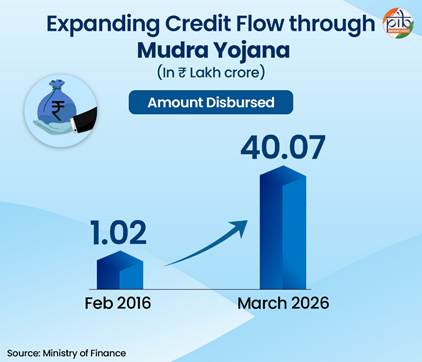
PMMY was designed to bridge the gap in financial accessibility, offering collateral-free loans up to ₹20 lakh to support small-scale business. Notably, as on 27th March 2026, the scheme has disbursed loans worth ₹40.07 lakh crore with over 57 crore accounts since inception in 2015. Besides, 12 crore+ accounts belong to new entrepreneurs, highlighting PMMY’s role in bringing them into the formal financial system. Digitization of MUDRA transactions has further enhanced efficiency, transparency, and ease of credit access for borrowers.
|
|
Loan Accounts Share
|
Disbursed Amount Share
|
|
Women
|
59.81%
|
37.45%
|
|
New entrepreneurs
|
21%
|
30.09%
|
|
SC, ST, and OBC categories
|
45.52%
|
31.77%
|
Credit Assessment Model (CAM)
The public sector banks (PSBs) launched the credit assessment model (CAM) based on the digital footprints for MSMEs in 2025. This model leverages digitally fetched and verifiable data to enable automated loan appraisal for MSMEs. Over 3.96 lakh MSME loan applications amounting to more than ₹52,300 crore have been sanctioned by PSBs under CAM (1 April-21 December 2025). This model results in quicker turnaround time for decision-making, establishing enterprise friendly framework.
TReDS (Trade Receivables Discounting System)
TReDS is an electronic platform that facilitates financing / discounting of trade receivables of MSMEs through multiple financiers. These receivables can be due from corporates and other buyers, including Government Departments and Public Sector Undertakings (PSUs). To enhance MSME liquidity, the Union Budget 2026-27 proposed mandating TReDS for Central Public Sector Enterprises’s transaction settlements. It also introduced a credit guarantee mechanism for invoice discounting. Furthermore, linking GeM with TReDS facilitates quicker financing. Meanwhile introducing TReDS receivables as asset-backed securities develops a secondary market for enhanced transaction settlement.
Improving Ease of Tax Compliance
Over the past decade, India has transformed its tax system through digitisation, simplification, and structural reforms, making compliance more seamless and transparent. Initiatives like Goods and Services Tax (GST), faceless assessments, and digital platforms have reduced procedural complexities. These reforms have eased the burden on taxpayers, encouraged formalisation, and created a more predictable and business-friendly tax environment.
GST was introduced in 2017 and it replaced a fragmented and complex indirect tax regime that burdened businesses and consumers alike. Before GST, the tax framework consisted of numerous levies such as excise duty, service tax, VAT, CST, and others. Each of these taxes had their own set of compliance challenges and inadequacies. This multiplicity increased the cost of doing business and hindered seamless interstate movement of goods due to tax barriers.
Furthermore, GST reforms announced in September 2025 provided an additional boost to EoDB. This shift to a simplified two-rate structure reduces compliance and transaction costs, while rate rationalisation enhances affordability and fosters entrepreneurship.
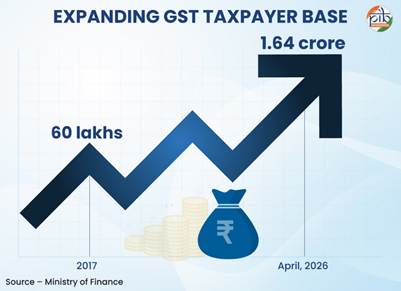
The impact is reflected in the expansion of the tax base, with registered taxpayers increasing from about 60 lakhs in 2017 to over 1.64 crore in April, 2026, indicating deeper formalisation.
GST is also supported by its digital backbone, GSTN platform. It provides a synchronised interface for over a crore of taxpayers, ensuring effortless B2B electronic invoicing. It handled the processing of over ₹107.64 lakh crore payments through the portal as of April 2026. This automated ecosystem fosters a streamlined and technology-driven fiscal framework.
With a view to transforming age-old manual assessment methods, the E-Assessment Scheme was launched in 2019. The scheme aimed to curb undesirable practices in the tax administration system. This eliminated physical interface between the taxpayer and tax officers. The assessment optimizes utilization of resources through economies of scale and functional specialization.
New Income Tax e-Filing Portal
The Income Tax Department launched the new e-filing portal, in June 2021. It aims to provide greater taxpayer convenience and a modern, seamless experience. The portal enables immediate processing of ITRs for quicker refunds. It offers a single dashboard for all interactions and pending actions. Free ITR preparation tools with pre-filled data help reduce effort. Enhanced support includes FAQs, tutorials, and chatbot or call centre assistance. The portal also has multiple digital payment options include net banking, UPI, credit cards, and RTGS/NEFT.
The E-Way Bill system has revolutionized logistics in India by replacing multiple state-level permits with a single, electronic document for the movement of goods. This reform has facilitated the removal of static border check posts, significantly reduced transport time and improved tax compliance. The number of E-Way Bills generated increased from 15.74 crore during July 2018–March 2019 to 188.27 crore during FY 2025-2026. This reflects stronger digital trade and logistics integration.
Enhancing Cross-Border Trade Efficiency
India has transformed cross-border trade through targeted reforms and digital platforms. As trade is a critical part of the business lifecycle, it enables firms to access global markets, scale operations, and enhance competitiveness.
Measures announced in the Union Budget 2026–27, such as the Customs Integrated System (CIS), further strengthen EoDB in trade. Additional steps include exemption from Minimum Alternate Tax (MAT) for non-residents and an extended duty deferral period. Together, these reforms have streamlined procedures, reduced transaction costs, and created a more effectual trade environment for businesses in India.
Districts as Export Hubs (DEH) initiative
The Districts as Export Hubs (DEH) initiative aims to promote exports, manufacturing, and employment at the grassroots level. State/District Export Promotion Committees (SEPCs) have been set up across all 36 States/UTs to facilitate export promotion and address bottlenecks. Draft District Export Action Plans (DEAPs) have been prepared for 590 districts, of which 249 have been formally notified. Outreach events are also organised to build awareness and address exporters’ concerns. The initiative supports local exporters and manufacturers in scaling up and accessing global markets. It also assists in building capacity, creating new exporters, and identifying new markets for products and services.
The Export Promotion Mission (EPM) is a flagship initiative designed to provide coordinated support across key elements of the export ecosystem. It also supports in trade finance, standards compliance, logistics, overseas warehousing and market development.
Approved in November 2025, the Mission brings together multiple export-support measures under a single, unified and digitally driven framework. It is implemented through two integrated sub-schemes: Niryat Protsahan and Niryat Disha. Niryat Protsahan focuses on financial enablers and trade-finance support. However, Niryat Disha, addresses non-financial, market-access and ecosystem enablers. All in all, EPM seeks to enhance export competitiveness and expand India’s global presence.
ICEGATE (Indian Customs Electronic Gateway)
ICEGATE serves as a centralized hub for all electronic interactions between Indian customs and the trading community. It offers a range of services including e-filing, online amendment submission, online duty payment, query resolution. It also provides Integrated Goods and Services Tax (IGST) refund processing for traders. The gateway streamlines customs procedures in cross-border trade easing business for international traders. Bills of Entry filings increased from around 4 lakhs in April 2019 to 5.89 lakhs in March 2026, reflecting growth in digital customs processing and trade activity.
eCoO (Enhanced Certificate of Origin) 2.0 System
The eCoO 2.0 System is a digital upgrade that simplifies the certification process for exporters. It has user-friendly features like multi-user access under a single Importer Exporter Code. The system also has Aadhaar-based e-signing, and an integrated dashboard for Free Trade Agreement resources. These features ensure continuous trade effectiveness. By allowing easy online applications for "in-lieu" Certificate of Origin, the system allows exporters to request corrections. This trade facilitation initiative has streamlined the certification process, and improved turnaround times for exporters. The platform processed over 7,000 eCoOs daily, including both preferential and non-preferential certificates, connecting 125 issuing agencies (January, 2025).
Trade Connect e-Platform provides comprehensive international trade information and services to all exporters, including MSMEs, enabling them easy access to global markets. It enables directs connections between global buyers and Indian exporters with the help of Indian missions abroad. Currently, it has over 20 lakhs registered users with more than 35 lakhs certificate of origin issued (as on 5 June, 2026).
Expanding Digital Public Infrastructure
Digital Public Infrastructure has addressed major challenges in payments, verification, and document management over the last decade. Earlier, businesses faced delays in transactions and dependence on physical documentation. Digital platforms have enabled faster payments, seamless onboarding, and secure access to verified digital records. These initiatives have strengthened digital governance across India’s digital economy.
UPI (Unified Payments Interface)
UPI is a real-time payment system introduced in 2016. It has been transformative for businesses, enabling instant, low-cost, and seamless digital transactions. It has significantly improved cash flow, expanded customer reach, and supported the growth of businesses across India. UPI brings multiple bank accounts into a single app and supports various features. These features include fund transfers, merchant payments, and peer-peer payment requests, making digital transactions quick and convenient. It provides safe and quick payments, ensuring privacy and provides QR code convenience.
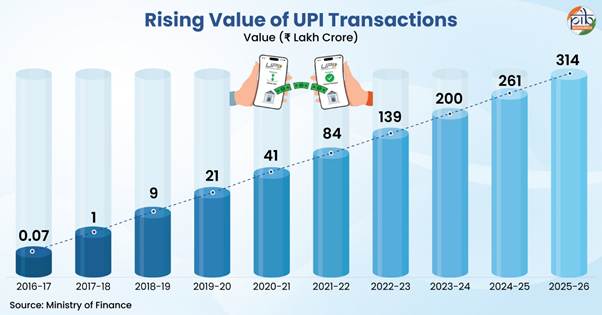
The system connects 713 banks on a single platform allowing people to make payments easily without worrying about which bank they use. The system is now used by close to 540.27 million individuals and 100 million merchants. Over a decade of operations, UPI has demonstrated extraordinary scale and momentum. Annual number of transactions expanded from just 2 crore transactions in FY 2016-17 to over 24,162 crore transactions in FY 2025-26. This represents an almost 12,000‑fold surge in transaction volume. Parallelly, transaction value rose sharply from ₹0.07 lakh crore in FY 2016-17 to approximately ₹314 lakh crore in FY 2025-26. This translates into a more than 4,000‑fold increase in transaction value.
International Monetary Fund (IMF) has also acknowledged UPI as the world’s largest real‑time payment system by transaction volume. This underscores India’s leadership in building scalable, inclusive, and innovative digital public infrastructure.
cKYC (Central Know Your Customer) Registry
The cKYC Registry is a centralized repository of customer KYC records in the financial sector. It enables uniform KYC norms and inter-usability of records across sectors. The registry reduces the need to repeatedly submit and verify KYC documents with different financial institutions. It simplifies customer onboarding and improves ease of access to financial services across the sector.
EntityLocker is a digital locker for the entities launched in January, 2025. It empowers organizations by providing a secure, cloud-based platform for storing, sharing, and verifying digital documents and certificates. It provides access to authentic digital documents through a secure digital document wallet. This platform ensures safe, and streamlined document management for businesses and institutions. Within a year, the number of entities onboarded on entity locker increased from 38 thousand in February 2025 to over 40 thousand in December 2025.
Building a Trust-Based Governance Framework
From complex regulations to compliance reduction, the regulatory measures have reduced administrative burden across sectors and States. These reforms have promoted trust-based governance in regulatory interactions for businesses. The measures have also strengthened different stages of the business lifecycle, supporting faster and more seamless business operations.
The Jan Vishwas (Amendment of Provisions) Act, 2023 decriminalised 183 provisions across 42 Acts, reducing criminal liability for minor and technical offences. Continuing these efforts, the Jan Vishwas (Amendment of Provisions) Act, 2026 came into effect on 7 April, 2026. It also advances a governance framework based on trust and proportionate regulation. The Act has led to:
- Decriminalization of 717 provisions
- Amendment of 784 provisions of 79 Central Acts administered by 23 Ministries
The Act rationalises more than 1000 offences, removing outdated and redundant provisions thereby improving the overall regulatory business environment.
Regulatory Compliance Burden
In addition to decriminalisation reforms, the Government has introduced several complementary measures across sectors and States.
Some of them include:
- The Environment (Protection) Act, 1986, the Air (Prevention and Control of Pollution) Act, 1981 and the Indian Forest Act, 1927 and the criminal Provisions of the Water (Prevention and Control of Pollution) Act, 1974 have been decriminalised. These have rationalised minor offences to further enhance trust-based governance for ease of living and doing business.
- The Task Force on Compliance Reduction and Deregulation was constituted in January 2025 to simplify regulations across States and Union Territories. It identified priority areas across five sectors, including land use, construction, labour, utilities, permissions, and overarching priorities. These sectors account for a significant share of regulatory interactions affecting businesses across the country. Since March 2025, three rounds of Task Force visits have been undertaken across States and Union Territories. The visits focused on cross-agency coordination, problem-solving with States, and real-time learning for regulatory reforms.
- As part of the Reducing Compliance Burden exercise, more than 47,000 compliances have been reduced. This includes 16,108 simplified compliances, 22,287 digitised compliances, 4,458 decriminalised compliances, and 4,270 redundant compliances removed as of November 2025.
- The Reserve Bank of India also consolidated over 9,000 circulars and guidelines into 238 function-specific Master Directions. It is for different categories of regulated entities. Under this initiative, 9,446 circulars are being repealed, consolidated, or deemed obsolete to improve regulatory clarity and ease of doing business.
Business Reforms Action Plan (BRAP) and District Reforms
Backed by a strong digital infrastructure, the Government has further strengthened EoDB reforms through BRAP. Since 2015, BRAP is promoting transparency, simplifying regulatory procedures, and enhancing service delivery across States and Union Territories. BRAP includes recommendations after assessments for reforms on regulatory processes, policies, practices and procedures spread across different reform areas. The reform areas include access to information and transparency enablers; single window; environmental registration enablers; obtaining electricity connection; availability of land; construction permit enablers; inspection reform enablers; labour regulation enablers; online tax and return filing, commercial dispute resolution enablers spanning the lifecycle of a typical business and others. 7 editions of BRAP have been completed, and the 8th edition of BRAP was formally rolled out in November 2025.
To further deepen reforms at the grassroots, DPIIT has also launched the District Business Reform Action Plan (D-BRAP). This strengthens EoDB at the District Level. It is designed to strengthen last-mile delivery, improve service quality, and accelerate regional development by equipping districts with robust institutional and digital infrastructure. These reforms are implemented across District Collectorates, Development Authorities, and Urban Local Bodies. This plays a critical role in regulatory approvals, inspections, and business facilitation.
Resolving Insolvency Concerns
Before the introduction of the Insolvency and Bankruptcy Code, 2016, businesses relied on multiple legal frameworks for debt resolution and recovery. The fragmented system often made coordination complex and time-consuming. The Code consolidated existing laws into a unified insolvency resolution framework. It introduced creditor-driven and time-bound mechanism for resolving financial distress.
Subsequent amendments enhanced the role of creditors in decision-making and revised resolution timelines. They also introduced immunity provisions for corporate debtors and other measures to strengthen the insolvency resolution framework.
Further, the Insolvency and Bankruptcy Code (Amendment) Act, 2026 was enacted to strengthen procedural efficiency. The amendment introduced clearer definitions. It prescribed a 14-day timeline for adjudicating authorities to accept or reject applications. The amendment also restricted withdrawal of cases after a specified stage. Additional provisions strengthened creditor participation and improved access to information across the insolvency process. It also introduced other measures to improve the overall effectiveness of insolvency resolution. These reforms have strengthened India’s insolvency framework by making resolution processes faster, and more predictable for businesses and creditors.
Fostering a Business-Friendly Ecosystem
Over the past years, India has undertaken wide-ranging reforms to create a more transparent, and facilitation-driven business environment. These measures have simplified regulations, strengthened digital governance, improved market access, and reduced compliance burden across the business lifecycle. India’s Ease of Doing Business framework today reflects the combined strength of digital infrastructure, policy reforms, and trust-based governance. Together, these reforms have strengthened investor confidence, promoted entrepreneurship, and enhanced India’s position as a globally competitive business destination.
References
Ministry of Commerce & Industry
https://www.pib.gov.in/PressReleaseIframePage.aspx?PRID=1781851®=3&lang=2
https://sansad.in/getFile/annex/270/AU3874_QoKsRW.pdf?source=pqars
https://static.pib.gov.in/WriteReadData/specificdocs/documents/2022/nov/doc20221123133801.pdf
https://www.dpiit.gov.in/ministry/about-us/details/Title=Ease-of-Doing-Business-(EODB)-ITMwETMtQWa
https://www.startupindia.gov.in/content/sih/en/about-startup-india-initiative.html
https://www.pib.gov.in/PressReleasePage.aspx?PRID=2098452®=3&lang=2
https://www.pib.gov.in/PressReleaseDetail.aspx?PRID=2227597®=6&lang=1
https://www.pib.gov.in/PressReleasePage.aspx?PRID=2201280®=3&lang=2
https://www.pib.gov.in/PressReleasePage.aspx?PRID=2154136®=3&lang=2
https://www.pib.gov.in/Pressreleaseshare.aspx?PRID=1570586®=3&lang=2
https://www.pib.gov.in/PressReleaseIframePage.aspx?PRID=2090097®=3&lang=2
https://www.ondc.org/
https://www.pib.gov.in/PressReleseDetailm.aspx?PRID=2225805®=3&lang=2
https://www.pib.gov.in/PressReleasePage.aspx?PRID=2168993®=3&lang=2
https://www.pib.gov.in/PressReleasePage.aspx?PRID=2244401®=3&lang=1
https://www.trade.gov.in/pages/home
https://www.pib.gov.in/PressReleasePage.aspx?PRID=2246226®=3&lang=2
https://www.pib.gov.in/PressReleasePage.aspx?PRID=2034302®=3&lang=2
https://www.pib.gov.in/PressReleasePage.aspx?PRID=2096786®=3&lang=2
https://www.pib.gov.in/PressReleaseDetail.aspx?PRID=2204665®=1&lang=1
https://www.pib.gov.in/newsite/PrintRelease.aspx?relid=160781®=3&lang=2
Ministry of External Affairs
https://www.eoiparis.gov.in/page/ease-of-doing-business/?utm_
Ministry of Corporate Affairs
https://www.pib.gov.in/PressReleasePage.aspx?PRID=1656755®=3&lang=2
https://www.pib.gov.in/Pressreleaseshare.aspx?PRID=1604176®=3&lang=2
https://www.mca.gov.in/content/mca/global/en/ease-of-doing-business/features.html
https://www.pib.gov.in/PressReleasePage.aspx?PRID=2099226®=3&lang=2
https://www.pib.gov.in/PressReleasePage.aspx?PRID=1695473®=3&lang=2
https://www.pib.gov.in/PressReleseDetailm.aspx?PRID=2226017®=3&lang=2
https://www.pib.gov.in/PressReleasePage.aspx?PRID=1884181®=3&lang=2
Ministry of Micro, Small and Medium Enterprises
https://dcmsme.gov.in/Buletin-I-Analysis-of-Udyam-Registration-Data.pdf
https://udyamregistration.gov.in/
https://www.pib.gov.in/PressReleasePage.aspx?PRID=1847452®=3&lang=2 https://dashboard.msme.gov.in/
https://www.cgtmse.in/
Ministry of Rural Development
https://www.pib.gov.in/PressReleaseIframePage.aspx?PRID=2068408&utm_®=3&lang=2
https://dolr.gov.in/programmes-schemes/dilrmp-2/
https://www.pib.gov.in/PressReleasePage.aspx?PRID=2210412&utm_®=3&lang=2
https://dolr.gov.in/about-naksha/
https://ngdrs.gov.in/NGDRS_Website/
https://dilrmp.gov.in/
Ministry of Environment, Forest and Climate Change
https://www.pib.gov.in/PressReleseDetailm.aspx?PRID=2219415®=3&lang=2
https://www.pib.gov.in/PressReleasePage.aspx?PRID=2040036&utm_®=3&lang=2
https://www.pib.gov.in/newsite/printrelease.aspx?relid=137373®=3&lang=2
https://www.pib.gov.in/PressReleaseIframePage.aspx?PRID=2041465&utm_
https://moef.gov.in/uploads/pdf-uploads/Nitin_Rev_4.pdf
Ministry of Ports, Shipping and Waterways
https://www.pib.gov.in/PressReleasePage.aspx?PRID=2101760®=3&lang=2
https://nlpmarine.gov.in/landings/about-new
https://www.pib.gov.in/PressReleasePage.aspx?PRID=2040640®=3&lang=1
Ministry of Finance
https://www.pib.gov.in/PressReleasePage.aspx?PRID=2119781®=3&lang=2
https://financialservices.gov.in/beta/sites/default/files/AnnualReport2015-16%20DFS.pdf
https://www.pib.gov.in/PressReleasePage.aspx?PRID=2216047®=3&lang=2
https://www.incometaxindia.gov.in/faceless-scheme
https://www.pib.gov.in/PressReleasePage.aspx?PRID=1643250®=3&lang=2
https://www.pib.gov.in/PressReleaseIframePage.aspx?PRID=1720352®=3&lang=2
https://www.pib.gov.in/PressReleasePage.aspx?PRID=2257087®=3&lang=2
https://www.npci.org.in/product/upi/product-statistics
https://www.icegate.gov.in/services/statistics-reports
Ministry of Electronics & IT
https://www.pib.gov.in/PressReleasePage.aspx?PRID=2094574®=3&lang=2
Insolvency and Bankruptcy Board of India
https://ibbi.gov.in/uploads/legalframwork/d36301a7973451881e00492419012542.pdf
https://ibbi.gov.in/webadmin/pdf/whatsnew/2018/Aug/The%20Insolvency%20and%20Bankruptcy%20Code%20%28Second%20Amendment%29%20Act%2C%202018_2018-08-18%2018%3A42%3A09.pdf
https://ibbi.gov.in/uploads/legalframwork/2026-04-07-115842-i5nsk-7ed69ef2a4d23a8b0d472cc0fcd55e79.pdf
PIB Headquarters
https://www.pib.gov.in/PressNoteDetails.aspx?NoteId=154772&ModuleId=3®=3&lang=2
https://www.pib.gov.in/FactsheetDetails.aspx?Id=150475®=3&lang=2
https://static.pib.gov.in/WriteReadData/specificdocs/documents/2026/apr/doc202648842601.pdf
https://www.pib.gov.in/PressReleasePage.aspx?PRID=2236804®=3&lang=1
https://www.pib.gov.in/PressReleasePage.aspx?PRID=2223909®=3&lang=1
https://www.pib.gov.in/PressReleasePage.aspx?PRID=2232079®=3&lang=1
https://www.pib.gov.in/PressReleasePage.aspx?PRID=2254950®=3&lang=1
United Nations
https://www.un-ilibrary.org/content/books/9789211067286/read
World Bank
https://www.worldbank.org/en/programs/govtech/2020-gtmi
https://www.worldbank.org/en/programs/govtech/2022-gtmi
https://www.worldbank.org/en/data/interactive/2022/10/21/govtech-maturity-index-gtmi-data-dashboard
https://www.worldbank.org/en/data/interactive/2022/10/21/govtech-maturity-index-gtmi-data-dashboard
RBI
https://rbidocs.rbi.org.in/rdocs/Bulletin/PDFs/01STATE220520269457A301B061437FB8F5C8A54F6E3BEE.PDF
Others
https://www.itic.org/advocacy/ease-of-doing-business
https://www.imd.org/entity-profile/india-wcr/#_factor_Business%20Efficiency
https://www.gstn.org.in/
https://ldb.co.in/ldb/reports
https://www.gst.gov.in/download/gststatistics
PIB Research
Click here for pdf file.
*****