Ministry of Fisheries, Animal Husbandry & Dairying
Meeting Co-chaired chaired by Hon’ble Minister for Fisheries, Animal Husbandry & Dairying and Hon’ble Minister for Commerce & Industry on fisheries export promotion
Focus on scheme convergence, value addition and export strategies for inland fisheries
Posted On:
14 MAY 2026 7:30PM by PIB Delhi
A Meeting was Co-chaired by Shri Piyush Goyal, Hon’ble Minister for Commerce & Industry and Shri Rajiv Ranjan Singh, Hon’ble Minister for Fisheries, Animal Husbandry & Dairying and Panchayati Raj on 14th May 2026 in New Delhi to deliberate fisheries export promotion. During the meeting, discussions focused on identifying measures to enhance fisheries export potential through convergence of schemes between the Department of Commerce and the Department of Fisheries to boost production and exports, steps for promotion of fishery products including value‑added products, and facilitation of sanitary and phytosanitary (SPS) approvals in key international markets. The meeting also deliberated on assessing export gaps in inland States and developing targeted strategies for promoting freshwater species exports, with a view to strengthening India’s overall fisheries export ecosystem.
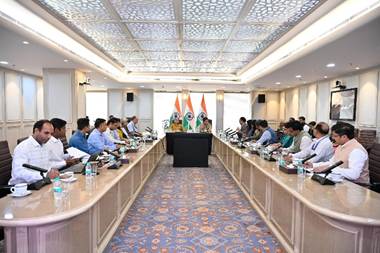
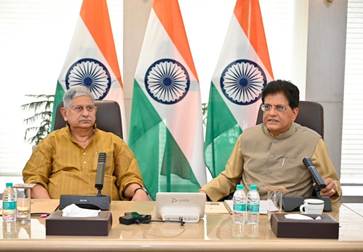
Shri Piyush Goyal, Hon’ble Minister for Commerce & Industry, appreciated the efforts to achieve an all‑time high seafood exports of ₹72,325.82 crore (US$ 8.28 billion) in FY 2025–26. He discussed opportunities to boost fisheries exports and enhance the incomes of fisherfolk. The commitment to fostering sustainable growth & driving innovation in the fisheries sector was also reiterated. He underscored the need for continued collaboration among stakeholders to further strengthen the export segment, focusing on species diversification, branding and value addition. He stressed upon the need to accelerate development of deep‑sea fishing infrastructure and to expand India’s presence in Regional Fisheries Management Organisations (RFMOs). He also called for increasing the number of registered exporters, augmenting processing capacity, and strengthening waste management practices across the sector.
Shri Rajiv Ranjan Singh, Hon’ble Minister for Fisheries, Animal Husbandry & Dairying and Panchayati Raj, highlighted that the department has undertaken various steps and initiative focused on traceability, processing, Value addition, certification to enhance seafood exports in coordination with MPEDA, EIC, Seafood exporters and other stakeholders. He emphasised the need to set up at least one processing plant in each district to strengthen post‑harvest infrastructure. Union Minister Fisheries underscored the need for capacity building of exporters, with time bound program for skill development and market readiness by NFDB and MPEDA. He further urged MPEDA to identify export gaps across inland States and UTs and assess species‑wise export potential in coordination with NFDB. He also highlighted the need for expanded institutional presence of MPEDA and EIC in the Andaman & Nicobar Islands and Lakshadweep, recognising the huge export potential of high vale species like Tuna.
Dr. Abhilaksh Likhi, Secretary, Department of Fisheries, MoFAH&D, also attended the meeting and emphasised the critical role of traceability in enhancing seafood exports and ensuring compliance with international market standards. He also highlighted that the Department of Fisheries, GoI has notified 34 fisheries production and processing clusters aiming to strengthen value chains and supporting export ecosystems. He further called upon institutions such as FSI, MPEDA and NFDB to intensify efforts towards harnessing the untapped potential of tuna resources in the high seas, with a view to expanding India’s footprint in marine fisheries exports.
This joint meeting has carved a roadmap for enhancing seafood export in close coordination and convergence with all stakeholders towards achieving the vision of Viksit Bharat 2047.
Background
India’s seafood exports reaching an all-time high of ₹72,325.82 crore (US$ 8.28 billion) and 19.32 lakh metric tonnes in FY 2025-26 from ₹62,408 Cr (7.45 billion USD) and 16.98 Lakh metric tonnes in FY 2024-25. Frozen shrimp remained the primary growth driver, contributing ₹47,973.13 crore (US$ 5.51 billion), accounting for over two-thirds of total export earnings.
In order to sustain and strengthen India’s seafood export ecosystem, the Department of Fisheries, Government of India has undertaken a range of targeted interventions focused on market development, stakeholder engagement, institutional coordination, and sustainability compliance. These efforts include regular consultations with exporters, State Governments and key stakeholders, as well as organisation of high‑level events such as Seafood Exporters Meets, investor meets in Andaman & Nicobar Islands and Lakshadweep, and nationwide workshops on value addition, logistics, and technology adoption. The Department has also intensively engaged through bilateral meetings and global outreach initiatives to expand market access, address regulatory barriers, and promote Indian seafood in emerging and traditional markets. A multi‑agency coordination mechanism has been institutionalised to address export diversification, branding, and SPS/NTB challenges through regular reviews. In parallel, deliberations in Parliamentary Committees have guided policy focus on infrastructure, traceability, and value addition.
Further, the Department has taken significant steps towards strengthening compliance and sustainability frameworks, including securing marine mammal comparability approval from the United States, promotion of Turtle Excluder Devices (TEDs) in shrimp trawling, strengthening of antibiotic and residue controls, and launch of a National Traceability Framework for Fisheries and Aquaculture (2025). The notification of EEZ Rules and High Seas Guidelines, 2025, has provided a regulatory framework for sustainable and export‑oriented fisheries, particularly in resource‑rich regions such as the Andaman & Nicobar and Lakshadweep Islands, which together account for a significant share of India’s marine potential. These coordinated measures are aimed at enhancing competitiveness, ensuring sustainability, and positioning India as a reliable supplier in the global seafood market.
***
JP
(Release ID: 2261172)
Visitor Counter : 983