PIB Backgrounder
Advancing India’s Fisheries Sector
Institutions, Investment, and Inclusion
Posted On:
06 APR 2026 11:45AM by PIB Delhi
|
Key Takeaways
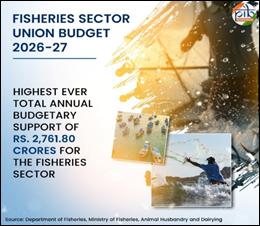
- The Union Budget 2026-27 proposed the highest-ever total annual budgetary support of Rs. 2,761.80 crores for the fisheries sector.
- PMMSY continues to be the central pillar of fisheries development, with an allocation of Rs 2,500 crore in 2026–27.
- KCC benefits have reached 4.39 lakh fishers, insurance coverage has been extended to 3.3 million beneficiaries, and livelihood support has benefited about 7.44 lakh fisher families.
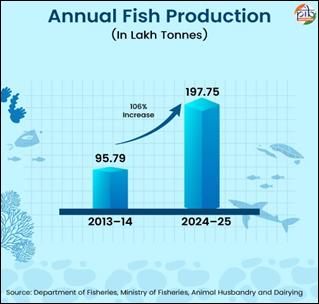
- Fish production has increased to 197.75 lakh tonnes in FY 2024-25 from 95.79 lakh tonnes in FY 2013-14, increasing by a significant 106%.
|
Introduction
India ranks as the world’s second-largest fish-producing nation, accounting for approximately 8 percent of global output. The fisheries sector constitutes a vital component of national food security, employment generation, and income enhancement, particularly across coastal and rural economies. Reflecting its growing structural significance, fisheries account for nearly 7.43 percent of Agricultural Gross Value Added (GVA), the highest share among the agriculture and allied sectors. This growing prominence is further reinforced by sustained policy prioritisation.
Backed by sustained interventions, total fish output more than doubled from 95.79 lakh tonnes in FY 2013–14 to 197.75 lakh tonnes in FY 2024–25, reflecting a 106 percent increase over the period. Concurrently, seafood exports expanded significantly, reaching ₹62,408 crore in FY 2024–25. Frozen shrimp remains the dominant export commodity, with the United States and China serving as key markets, highlighting the sector’s expanding scale and growing global competitiveness.
Union Budget for the Fisheries Sector
The Union Budget 2026–27 has proposed the highest-ever annual budgetary allocation of ₹2,761.80 crore for the fisheries sector, underscoring its growing policy priority. Of this total outlay, ₹2,530 crore is earmarked for implementation through targeted government schemes, including financial assistance, capital subsidies, insurance coverage, capacity-building initiatives, infrastructure development, and welfare support mechanisms designed to directly benefit fishers and fish farmers.
Institutionalising Growth in India’s Fisheries Sector
The fisheries sector is a vital pillar of India’s economy, contributing to food security, employment generation, export earnings, and livelihoods for millions of fishers, particularly in coastal and rural regions. Since the Blue Revolution, the sector has transitioned from traditional practices toward a more organised, technology-driven, and value-chain-oriented framework aligned with the Sustainable Development Goals (SDGs). Policy interventions have prioritised integrated value chain development across the marine, inland, and aquaculture segments. Investments in fishing harbours, landing centres, cold-chain logistics, processing infrastructure, deep-sea vessels, and advanced aquaculture systems have strengthened export competitiveness and value addition.
Blue Revolution
The Blue Revolution, launched in 2015, seeks to increase fish production and strengthen the fisheries value chain across inland and marine sectors by enhancing productivity, expanding infrastructure, and promoting modern practices. To build on these efforts and further advance post-harvest management, traceability, fisher welfare, and market linkages, the Government launched the Pradhan Mantri Matsya Sampada Yojana (PMMSY) in 2020 to accelerate the sector’s transformation.
As per Economic Survey 2025-26, the collective institutions have been strengthened through the formation of 2,195 Fisheries Farmer Producer Organizations (FFPOs), supported by an investment of Rs 544 crore, to improve market access and financial inclusion. Additionally, as of January 2026, nutritional and livelihood support during fishing ban and lean periods, benefiting approximately 4.33 lakh fisher families with an outlay of ₹1,681.21 crore, has reinforced income stability and social protection. Collectively, fisheries-related schemes implemented since 2014–15 have generated an estimated 74.66 lakh direct and indirect employment opportunities, underscoring the sector’s expanding role in inclusive and sustainable economic growth.
Navigating the Transformational Journey of the Fisheries Sector
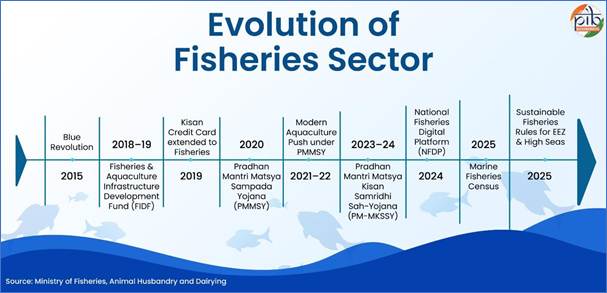
A chronological representation of major policy interventions in India’s fisheries sector illustrates its transition from production-centric expansion to digitalization and sustainability-oriented governance. Blue Revolution (2015) repositioned fisheries as a strategic growth sector. In 2018-19, the Fisheries and Aquaculture Infrastructure Development Fund (FIDF) was launched to address infrastructure gaps in harbours, landing centres, cold chains, and processing units.
The Kisan Credit Card (KCC) (2019) to fisheries improved access to institutional credit, followed by the launch of the PMMSY (2020), a comprehensive scheme focused on production enhancement, infrastructure, and value chain development. Furthermore, the Modern Aquaculture push under PMMSY (2021–22) and Pradhan Mantri Matsya Kisan Samridhi Sah-Yojana (PM-MKSSY) (2023–24) emphasized formalization, insurance, and financial inclusion. The National Fisheries Digital Platform (NFDP) and the Marine Fisheries Census, strengthened transparency and planning. In 2025, the notification of Sustainable Fisheries Rules for the Exclusive Economic Zone (EEZ) and High Seas reinforced regulatory compliance, resource conservation, and long-term sustainability.
Overall, the sector reflects a comprehensive transformation, spanning infrastructure development, expanded production, digital integration, stronger institutions, and sustainable governance. These advancements are positioning India’s fisheries sector as increasingly resilient and globally competitive.
Government Initiatives to Enhance Productivity, Mitigate Risk, and Digital Governance
The fisheries sector is increasingly recognised as an important contributor to rural livelihoods, nutritional security, and export expansion. Targeted public policy interventions have facilitated productivity enhancement, expanded financial inclusion, and strengthened infrastructure across the fisheries value chain.
Policy initiative for Productivity Enhancement
The Government has undertaken policy initiatives to expand modern farming systems, strengthen supply chains, and upgrade post-harvest facilities to reduce losses and improve value realisation.
Pradhan Mantri Matsya Sampada Yojana (PMMSY)
The PMMSY seeks to enhance fish production and productivity, upgrade quality standards, promote technological modernisation, strengthen post-harvest infrastructure, and improve fisheries governance. It adopts a comprehensive value chain approach, emphasising traceability, institutionalised fisheries management, and the socio-economic welfare of fishers. PMMSY continues to anchor fisheries development, with an allocation of ₹2,500 crore in 2026–27.
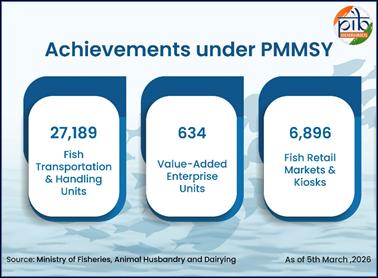
As of 05 March 2026, approved activities under the PMMSY include 23,285 hectares of pond area for inland aquaculture, 52,058 reservoir cages, 27,189 fish transportation and handling units, 634 value-added enterprise units (including ice plants and cold storages), and 6,896 fish retail markets and kiosks. These are complemented by supporting infrastructure such as fishing harbours, fish landing centres, feed mills, cold storages, markets, and other value-addition facilities to strengthen the fisheries value chain.
The scheme prioritises technology-driven aquaculture systems that improve productivity while optimising resource use. It promotes high-density, water-efficient models such as Recirculatory Aquaculture Systems (RAS) and Bio-floc technology, which enhance output, maintain quality, enable nutrient recycling, and support environmentally sustainable fish farming.
Recirculatory Aquaculture System (RAS): It is a modern fish-farming method in which water is filtered and reused. The system removes waste and impurities, allowing the same water to be used again. It is ideal for farming fish in high numbers using very little land and water.
Bio-floc technology: Bio-floc systems utilize beneficial microbes to convert organic waste into feed, improving water quality and fish health. This eco-friendly and cost-effective method is ideal for high-density farming and supports sustainable practices.
As of 05 March 2026, 12,081 RAS units have been approved, with an investment of ₹902.97 crore, while 4,205 Bio-floc units have been approved, with an investment of ₹523.30 crore, under PMMSY. This reflects strong progress in adopting modern, technology-driven aquaculture systems.
Policy Initiatives for Risk Mitigation and Financial Security
The government has focused on improving the financial security of fishers and fish farmers through targeted schemes that bring them into the formal system and expand access to credit, insurance, and income support.
- Pradhan Mantri Matsya Kisan Samridhi Sah-Yojana (PM-MKSSY)
The Pradhan Mantri Matsya Kisan Samridhi Sah-Yojana (PM-MKSSY) is a Central Sector sub-scheme implemented under the umbrella of the PMMSY. Operational across all States and Union Territories for a four-year period from 2023–24 to 2026–27, it carries an estimated financial outlay of ₹6,000 crore.
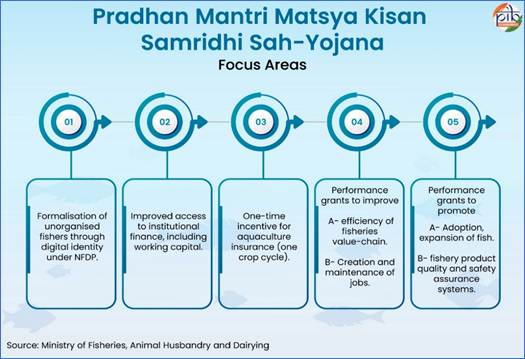
The scheme facilitates the structural transformation of the fisheries sector by advancing formalisation, expanding insurance coverage, strengthening access to institutional finance, and promoting quality assurance and traceability across the fisheries value chain. It aims to enhance financial resilience, risk mitigation, and market integration for fishers, aquaculture farmers, and allied stakeholders, thereby fostering a more organised, transparent, and sustainable fisheries sector.
- Kisan Credit Card for Fisheries
The Kisan Credit Card (KCC) scheme has become a pivotal instrument for advancing financial inclusion within India’s agrarian economy. Structured to provide timely and affordable access to working capital, it enables farmers to finance the purchase of critical inputs and meet liquidity requirements for crop cultivation and allied activities. Since 2019, the scope of the scheme has been expanded to include animal husbandry, dairy, and fisheries, thereby extending access to institutional credit to allied agricultural sectors and promoting integrated rural livelihoods. The Government has raised the lending limit under the KCC scheme for fisheries and allied activities from Rs 2 lakh to Rs 5 lakh, thereby improving access to credit for fishers, farmers, processors, and other stakeholders.
As per the Economic Survey 2024-25, financial inclusion and welfare programmes have extended KCC benefits to 4.39 lakh fishers, providing insurance coverage to 3.3 million beneficiaries, and delivering livelihood assistance to an average of 7.44 lakh fisher families during lean periods. This underscores the role of formal credit in enhancing resilience, stabilizing incomes, and deepening integration with organized markets.
- Fisheries and Aquaculture Infrastructure Development Fund (FIDF)
FIDF was launched in 2018–19 to strengthen infrastructure across marine and inland fisheries and promote sustainable sectoral growth. To continue this momentum, the Government extended the FIDF scheme for three more years, from April 2023 to March 2026. The scheme offers a credit guarantee cover of up to Rs 12.50 crore, helping fishers and entrepreneurs access much-needed credit with lower financial risk. It also provides an interest subvention of up to 3% per year under the FIDF. This support helps Nodal Loaning Entities offer concessional finance at a minimum interest rate of 5% per year.
The key achievements under FIDF as of January 2026 are as follows:
- 225 projects worth ₹6,685.78 crore have been approved under FIDF, covering Fishing Harbours, Fish Landing Centres, and fish processing units.
- These sanctioned projects have mobilised a total investment (₹6,685.78 crore) in the fisheries sector, including ₹754.50 crore contributed by private enterprises.
- Completed projects have created safe landing and berthing facilities for over 8,100 fishing vessels, increased fish landings by 1.09 lakh tonnes, benefited around 3.3 lakh fishers and other stakeholders, and generated nearly 2.5 lakh direct and indirect employment opportunities.
Policy Initiatives for Digital Governance
As part of broader policy initiatives for digital governance, government interventions seek to institutionalize a unified digital framework for the fisheries sector. By creating interoperable databases and enabling seamless access to credit, insurance, traceability, and incentives, it strengthens transparency, accountability, and data-driven decision-making across the value chain.
National Fisheries Digital Platform (NFDP)
The Department of Fisheries launched the National Fisheries Digital Platform (NFDP) in September 2024 under the PM-MKSSY to advance digital governance and formalization in the fisheries and aquaculture sector. At the foundational level, NFDP generates work-based digital identities for fishers, fish farmers, cooperatives, enterprises, and other value chain stakeholders. It is simultaneously building a centralised national database to improve transparency, streamline service delivery, and support data-driven policymaking.
Operationally, NFDP (https://nfdp.dof.gov.in/nfdp/#/?t=PM_MKSSY) functions as a single-window digital system that enables beneficiaries to access institutional credit, aquaculture insurance, traceability mechanisms, and performance-linked incentives. The platform also supports the strengthening of fisheries cooperatives and facilitates training and capacity-building initiatives.
As of 05 March 2026, the platform has registered over 30.60 lakh stakeholders, integrated 12 banks onto a common digital framework, and enabled the disbursement of 217 loans, thereby promoting formalization, financial inclusion, and efficiency across the fisheries value chain.
Marine Fisheries Census 2025
The National Marine Fisheries Census (MFC) 2025, launched on 31st October 2025, represents a significant advancement toward fully digital, georeferenced data collection in India’s fisheries sector.
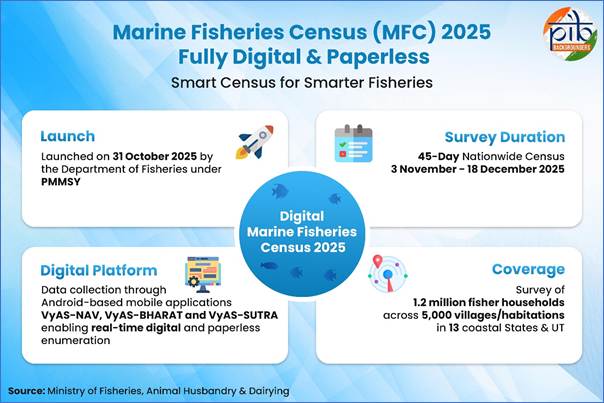
The MFC adopted an advanced digital ecosystem supported by custom mobile applications, including VyAS–NAV, VyAS–BHARAT, and VyAS–SUTRA, which enabled real-time, geo-referenced enumeration, immediate data verification, and continuous monitoring of field operations. For the first time, the Census has generated detailed socio-economic profiles of fisher households, including information on income, insurance status, access to credit, and participation in government schemes.
Mission-Driven Reservoir Development and Fisheries Value Chain Expansion
India has one of the world’s largest inland reservoir networks, spanning approximately 31.5 lakh hectares, offering significant potential for expanding inland fisheries. Under Mission Amrit Sarovar, the Government has facilitated the development of 68,827 Amrit Sarovars, including 1,222 water bodies integrated with fisheries activities, thereby promoting fish culture, livelihood diversification, and the enhancement of aquatic ecosystems (as of 01 February 2026). The targeted interventions are proposed to integrate the development of 500 reservoirs and Amrit Sarovars to further consolidate the fisheries value chain, particularly across coastal and inland regions.
These measures seek to strengthen market linkages and value addition by involving startups, women-led collectives, and Fish Farmer Producer Organizations (FFPOs), fostering inclusive growth, entrepreneurship, and sustainable fisheries-based livelihoods.
Sustainable Governance of Marine Fisheries and EEZ Resources
In addition to the inland reservoirs, India’s extensive coastline of over 11,099 km and an Exclusive Economic Zone (EEZ) of approximately 24 lakh square kilometres sustain the livelihoods of more than 50 lakh members of the fishing community across 13 maritime States and Union Territories. Marine fisheries constitute a strategic component of the blue economy, contributing to export earnings and national nutritional security.
To ensure responsible harnessing of aquatic resources, the Government has notified the Rules and Guidelines for Sustainable Harnessing of Fisheries in the EEZ and High Seas (2025), establishing a forward-looking regulatory framework aligned with sustainability and international compliance standards.
Policy measures granting duty-free status to catch landed abroad and treated as exports aim to enhance price realisation and global competitiveness, while traceability, sustainability, and compliance safeguards mitigate misuse. The Marine Products Export Development Authority (MPEDA) further anchors sustainable export growth through quality assurance, market facilitation, capacity building, and ecological stewardship, reinforcing long-term resource security and livelihood resilience.
Conclusion
The fisheries sector is a critical contributor to India’s economy, supporting the livelihoods of nearly three crore people, particularly among marginalised coastal and inland communities. In recent years, the sector has witnessed sustained growth, driven by targeted policy interventions to expand production, strengthen export competitiveness, upgrade infrastructure, and promote the adoption of modern, sustainable technologies. The Union Budget 2026–27 further consolidates this transition through capital-intensive investments, modern aquaculture systems, smart and sustainable fisheries infrastructure, and targeted measures to unlock export potential, including high-seas fishing.
This transformation is being reinforced by key reforms such as the Sustainable Harnessing Rules for the Exclusive Economic Zone, the Marine Fisheries Census 2025, and major investments under PMMSY and PM-MKSSY, which are strengthening evidence-based governance, responsible resource management, and welfare delivery. Collectively, these initiatives are advancing a more inclusive and resilient blue economy while contributing meaningfully to achieving Sustainable Development Goal 14: Life Below Water by sustainably managing fisheries and aquaculture.
References
Ministry of Fisheries, Animal Husbandry and Dairying
Ministry of Finance
National Fisheries Development Board
Lok Sabha
PIB
***
See PDF
PIB Research
(Release ID: 2249228)
Visitor Counter : 15168