Ministry of Chemicals and Fertilizers :
Department of Fertilizers
Geopolitical Risks Addressed as India Locks in Long-Term Fertilizer Raw Material Supplies
Reducing Urea Dependence: ICAR Highlights Balanced Fertilization and Advanced Nutrient Practices
Posted On:
27 MAR 2026 2:38PM by PIB Delhi
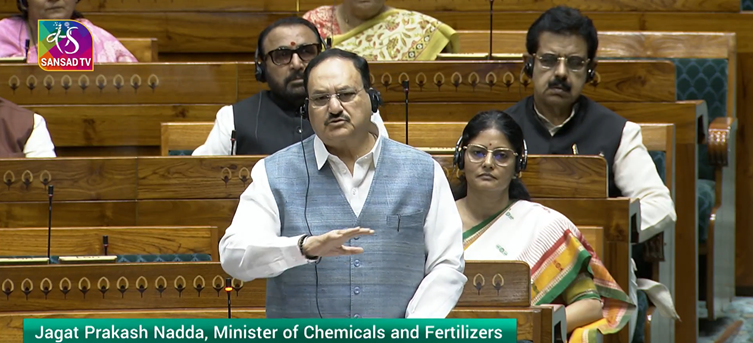
The Government of India has reiterated its commitment to ensuring the availability of fertilizers while addressing challenges of import dependence and soil nutrient imbalance. In a reply to a Starred Question in the Lok Sabha today, Shri Jagat Prakash Nadda, Minister for Chemicals & Fertilizers and Health & Family Welfare, provided details of ongoing measures.
Securing Fertilizer Raw Materials through Strategic Partnerships India continues to rely significantly on imports for key fertilizer raw materials and intermediates due to limited domestic reserves . To mitigate geopolitical disruptions, the Department of Fertilizers has facilitated several Long-Term Agreements (LTAs) and Memoranda of Understanding (MoUs) with resource-rich nations to ensure a stable supply for domestic production. Details of LTAs is attached as Annexure-I.

Estimated Import Share of Key Raw Materials (2024-25):
|
Sl. No.
|
Raw material/ Intermediates
|
Estimated share of import (%)
|
|
1.
|
Rock phosphate
|
86.0
|
|
2.
|
Sulphur
|
52.0
|
|
3.
|
Natural Gas for Urea Sector
|
78.0
|
|
4.
|
Ammonia for Complex Fertilisers
|
75.0
|
|
5.
|
Phosphoric Acid
|
52.0
|
|
6.
|
Muriate of Potash
|
100.0
|
(Source: Fertilizer Association of India)
To achieve domestic substitution, the Government is encouraging capacity expansion under the Nutrient-Based Subsidy (NBS) Scheme . Fertilizer companies are currently establishing new DAP/NPK plants with a combined annual capacity of 59.65 LMT, alongside phosphoric and sulphuric acid plants with a capacity of 44.21 LMT . Furthermore, under the National Green Hydrogen Mission, a provision has been made for the procurement of 7.24 LMT of Green Ammonia for the fertilizer sector.
Indian Council of Agricultural Research (ICAR) recommends soil test–based balanced fertilization, ensuring that nutrients are applied according to the actual needs of the crops and supplementing soil nutrients. This is complemented by the balanced application of NPK fertilizers rather than excessive reliance on nitrogen alone. Integrated Nutrient Management (INM) is promoted through the combined use of inorganic fertilizers and organic sources such as manure, compost, green manure, biofertilizers, and crop residue recycling, which helps maintain soil health and reduce chemical fertilizer dependency.
Efficient fertilizer use is encouraged through practices such as split application of nitrogen, proper placement of fertilizers, and the use of slow-release fertilizers, neem-coated urea, and nitrification inhibitors to minimize nutrient losses. The use of biofertilizers and adoption of organic farming practices further support sustainable nutrient supply and reduce urea consumption. In addition, proper soil and water management practices enhance nutrient use efficiency and prevent losses through leaching and runoff.
ICAR also engaged in capacity building through farmer training, demonstrations, and awareness programs that plays an important role in promoting these practices. Together, these measures help reduce excessive urea consumption, ensure balanced nutrient application, and improve soil health while protecting the environment.
Annexure-I
Rock Phosphate:
Jordan
|
Indian Company
|
Counterpart company
|
Product
|
Annual Quantity (MT)
|
Duration (Years)
|
|
Ostwal
|
JPMC
|
Rock Phosphate
|
5,00,000
|
10 yrs
May 2022 to April 2032
|
Morocco
|
Indian Company
|
Counterpart company
|
Product
|
Annual Quantity (MT)
|
Duration (Years)
|
|
PPL
|
OCP
|
Rock Phosphate
|
16,00,000 to 18,00,000
|
10yrs
(31-Dec-23 to
30-Nov-33)
|
Togo
|
Indian Company
|
Counterpart company
|
Product
|
Annual Quantity (MT)
|
Duration (Years)
|
|
FACT
|
SNPT
|
Rock Phosphate
|
2,40,000 (non-binding)
|
3 yrs
10.02.2025 to 09.01.2028
|
Mauritania
|
Indian Company
|
Counterpart company
|
Product
|
Annual Quantity (MT)
|
Duration (Years)
|
|
RCF
|
M/s. Atlantic Minerals SARL
|
Rock Phosphate
|
1,50,000 (non-binding)
|
3 yrs
2025 to 2028
|
2. Phosphoric Acid:
Morocco
|
Indian Company
|
Counterpart company
|
Product
|
Annual Quantity (MT)
|
Duration (Years)
|
|
PPL
|
OCP
|
Phosphoric acid
|
3,00,000 to 3,50,000
|
Yearly
(Quarterly renewal Agreement)
|
|
Indorama
|
OCP
|
Phosphoric Acid
|
1,20,000 MT of P2O5
|
Ongoing, signed on 01.06.2021
|
|
|
Total:
|
4,20,000 to 4,70,000
|
|
Tunisia
|
Indian Company
|
Counterpart company
|
Product
|
Annual Quantity (MT)
|
Duration (Years)
|
|
GSFC
|
TIFERT
|
Phosphoric Acid
|
1,80,000
|
30yrs
(21/08/2006 to 21/08/2036)
|
Senegal
|
Indian Company
|
Counterpart company
|
Product
|
Annual Quantity (MT)
|
Duration (Years)
|
|
IFFCO
|
ICS
|
Phosphoric Acid
|
5,50,000
|
34 years
Started: 17-May-99
|
3. Ammonia
Saudi Arabia
|
Indian Company
|
Counterpart company
|
Product
|
Annual Quantity (MT)
|
Duration (Years)
|
|
CIL
|
MA’ADEN
|
Ammonia
|
6,00,000 (+/-10%)
|
3yrs
(01/01/2024 to 31/12/2026)
|
Oman
|
Indian Company
|
Counterpart company
|
Product
|
Annual Quantity (MT)
|
Duration (Years)
|
|
PPL
|
East West General Trading, Dubai
|
Ammonia
|
3,50,000
|
3 years
01-Aug-24 to 31-Jul-27
|
Japan
|
Indian Company
|
Counterpart company
|
Product
|
Annual Quantity (MT)
|
Duration (Years)
|
|
Indorama
|
ITOCHU
|
Ammonia
|
15,000 - 60,000 MT
|
1 yr
(01.01.25 to 31.12.25)
|
Malaysia
|
Indian Company
|
Counterpart company
|
Product
|
Annual Quantity (MT)
|
Duration (Years)
|
|
PPL
|
Itochu Corporation
|
Ammonia
|
50,000 to 90,000
|
1 Year
(01-01-25 to 31-12-25)
|
******
Neeraj Kumar Bhatt/ Amit Kumar/ Shatrughna Prasad
cmc.fertilizers[at]gmail[dot]com
(Release ID: 2245973)
Visitor Counter : 2339