Ministry of Electronics & IT
India AI Impact Summit 2026 Session Highlights Pathways to Scale AI from Pilots to Population Impact
Procurement Reform, Digital Public Infrastructure and Data Governance Key to AI at Population Scale
Diffusion and Institutional Capacity Critical to Turning AI into a Public Service Capability
Posted On:
20 FEB 2026 7:56PM by PIB Delhi
Moving artificial intelligence from isolated pilots to systems that serve entire populations requires far more than better models, it demands institutional reform, trusted digital infrastructure, interoperable standards and the deliberate spread of know-how across governments and sectors. This was the central message of the session “From Pilots to Population: Scaling AI for Inclusive Impact” at the India AI Impact Summit 2026.
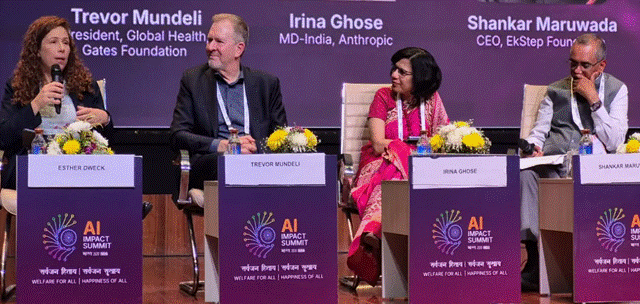
The discussion reframed scaling as a governance and capability challenge rather than a purely technological one. Speakers emphasised that diffusion, the structured spread of tools, skills, infrastructure and trust, is the decisive factor that determines whether AI remains a collection of demonstrations or becomes embedded in everyday public service delivery. From procurement reform and digital public infrastructure to explainability, contextual design and centres of excellence, the conversation focused on the systemic conditions required for durable, population-scale deployment.
Esther Dweck, Minister of Management and Innovation, Brazil, highlighted that the real barrier to scaling AI in government is institutional rather than technological, pointing to procurement reform, integrated digital public infrastructure and stronger data governance as the foundations for durable public-service transformation. She stressed that innovation requires systems that allow learning and responsible risk-taking, noting that “very often, the challenge of innovation in government is not technology, but mindset. If we want AI to move from pilots to durable public services, procurement has to become more outcome-oriented, less process-driven, and supportive of innovation inside the state.”
Trevor Mundell, President, Global Health, Gates Foundation, warned that fragmented, uncoordinated pilots remain the biggest obstacle to population-level impact and outlined the role of national and regional scaling hubs in aggregating demand, aligning funding and accelerating diffusion across sectors. He also pointed to the importance of explainability in high-stakes domains such as health and education. Stressing the need for structured pathways to scale, he said, “one of the biggest barriers to scaling AI to real population impact is fragmentation. Scaling hubs help create that structure, allowing innovation to spread while still aligning efforts, funding and infrastructure around shared public priorities.”
Nandan Nilekani, Chairman, Infosys, drew on India’s experience with Aadhaar and UPI to underline that population-scale technology depends on trust, governance and institutional capacity as much as digital architecture. He also cautioned that public perception will shape the trajectory of AI adoption, with visible social benefits essential to avoid backlash. Emphasising the systemic nature of scale, he said, “when you apply technology at the scale of an entire country, it has very little to do with technology alone. In population-scale initiatives, it is 30 percent technology and 70 percent everything else.”
Irina Ghose, MD – India, Anthropic, focused on interoperability, domain-specific design and local-language usability as the key enablers of real adoption, noting that AI systems often fail when they are transferred across contexts without being made relevant to everyday workflows. She added that common standards can make existing public-sector data AI-ready and accelerate diffusion across use cases. Underscoring the shift from expert tools to mass adoption, she said, “AI starts to matter at population scale when it stops being a scientific tool used only by experts and becomes intuitive for everyday users, only then does it move beyond pilots and become part of everyday life.”
Across regions and use cases, the session presented a clear operational pathway: scale emerges when governments align procurement, infrastructure, standards, talent and funding around shared public priorities. Diffusion, not isolated innovation, is what turns AI into a dependable public capability. The transition from pilots to population impact, speakers stressed, will ultimately be defined by whether institutions are able to integrate technology into the everyday machinery of the state and the daily lives of citizens.
*****
Mahesh Kumar/ Pawan Faujdar/ Navin Sreejith
(Release ID: 2230898)
Visitor Counter : 689