Ministry of Electronics & IT
Global South Calls for Collective Action to Shape AI Safety and Standards
Ministers and Global Leaders Push for Coordinated AI Safety Frameworks Through South–South Cooperation
AI Safety and Sovereignty in Focus as Developing Nations Advocate Collective Governance Model
Scaling AI Responsibly: Developing Economies Push for Shared Safety Benchmarks and Coordinated Oversight
Posted On:
20 FEB 2026 7:54PM by PIB Delhi
At a moment when frontier AI capabilities are advancing faster than the institutions designed to govern them, the session “International AI Safety Coordination: What Policymakers Need to Know” at the India AI Impact Summit 2026 examined how developing economies can shape the safety, standards and deployment pathways of artificial intelligence through collective action rather than remain rule-takers in a fragmented global landscape. As the closing dialogue of the International AI Safety Coordination track, the discussion brought together ministers, multilateral leaders and AI safety experts to focus on the practical mechanisms required to align innovation with public trust, fundamental rights and long-term stability.
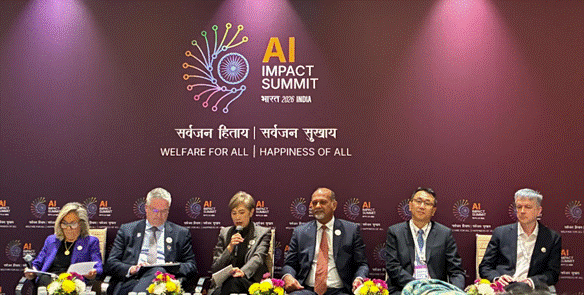
The conversation made clear that for the Global South, collaboration is no longer a matter of diplomatic alignment but of technological and economic necessity. With AI already being applied in real-world conditions across sectors such as health, agriculture and public service delivery, speakers highlighted the need to move from isolated national efforts to shared risk assessment, interoperable governance frameworks and coordinated safety tools. The next phase, they noted, will be defined by whether countries can build institutional capacity, exchange evidence and operationalise common standards quickly enough to keep pace with the accelerating frontier.
In the session, Minister for Digital Development and Information, Singapore, Josephine Teo, highlighted the central role of evidence-based policymaking and globally interoperable standards. Drawing parallels with aviation safety, she noted that effective regulation must be grounded in testing and simulation rather than intuition, warning that without international coordination “fragmentation will persist, trust will weaken, and the safe scaling of frontier technologies will become far more difficult.”
Gobind Singh Deo, Minister of Digital Development and Information, Malaysia, in the session emphasised that credible regional cooperation depends on strong national foundations. He pointed out that middle powers must first build domestic institutional capacity and enforcement capability, while using regional platforms such as the ASEAN AI Safety Network to translate shared commitments into operational mechanisms for risk-sharing and preparedness.
Secretary-General, OECD, Mathias Cormann, stressed that public trust will determine the trajectory of AI adoption, noting that “trust in AI is built through inclusion and objective evidence.” He underscored the need for joint action across governments, industry and civil society to close the gap between innovation and oversight, adding that at times it will be necessary “to slow down, test, monitor and share information to ensure AI systems work as intended and respect fundamental rights.”
Vice President for Digital and AI, World Bank, Sangbu Kim focused on the importance of designing safety into AI systems from the outset, particularly in low-capacity environments. He noted that partnerships enable countries to anticipate emerging threats through practices such as red-teaming and described AI as both “the spear and the shield,” requiring continuous learning and shared experience to manage risks before large-scale deployment.
Jann Tallinn, AI investor and Founding Engineer of Skype and Co-Founder of the Future of Life Institute, situated the discussion in the context of frontier-AI development, warning that competitive pressures on leading laboratories make unilateral restraint unlikely. He argued that political awareness and coordinated international action are essential, observing that the concentration of capital and compute in advanced AI “actually makes governance easier, not harder” if there is sufficient global alignment.
Across regions and institutional perspectives, the session delivered a clear near-term agenda for the next 12–18 months: move from principles to operational cooperation through shared safety benchmarks, structured information-sharing, and coordinated institutional capacity. For the Global South, speakers emphasised, South–South collaboration offers a pathway to shape AI governance rather than merely adapt to it, ensuring that frontier technologies scale in ways that strengthen public trust, protect fundamental rights and support long-term global stability.
*****
Mahesh Kumar/ Pawan Faujdar/ Anil Dutt Sharma
(Release ID: 2230896)
Visitor Counter : 754