PIB Backgrounder
Circular Economy in Agriculture: Waste to Wealth
Posted On:
17 FEB 2026 10:26AM by PIB Delhi
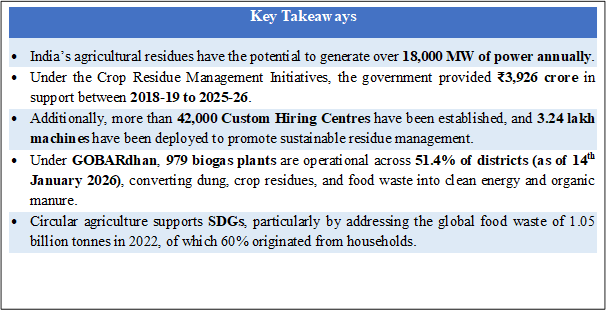
The growing scale of waste generation has emerged as a critical environmental challenge with substantial economic implications. In India, as agriculture plays a pivotal role in ensuring food and nutritional security, it also generates significant waste during cultivation, harvesting, and processing. Inadequate management of agricultural waste has become a substantial source of environmental contamination affecting air, soil, and water. The country generates an estimated 350 million tonnes of agricultural waste annually, comprising crop residues, husk, straw, and by-products from food processing activities. According to the Ministry of New and Renewable Energy, India’s agricultural residues have the potential to generate over 18,000 MW of power annually. In addition to energy generation, these residues can be used to produce nutrient-rich organic fertilisers. Such fertilisers help enhance soil health and reduce dependence on chemical inputs in agriculture.
In addition, globally, an estimated 1.3 billion tonnes of food produced for human consumption are wasted annually, while nearly one-third of biodegradable municipal solid waste is generated in household kitchens. When organic waste, such as food waste, agricultural residues, and other biodegradable municipal waste, is inadequately managed, it decomposes in landfills, releasing methane and other greenhouse gases. This contributes to air and groundwater pollution, generates noxious odours, and accelerates environmental degradation, thereby intensifying the impacts of climate change. Therefore, land use, resource utilization, and sustainable waste management solutions have become both environmental priorities and economic necessities.
Building a Circular Economy to Balance Growth and Sustainability
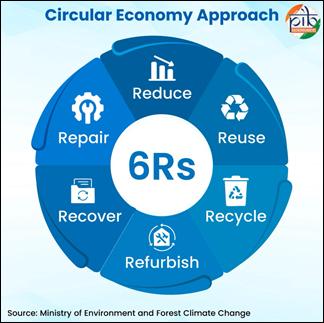
The importance of adopting a “waste-to-wealth” approach lies in reimagining waste as a valuable resource rather than an economic burden and environmental issue. It necessitates a rethinking of material flows within the economy, emphasizing the recovery, reuse, and reintegration of value. The circular economy has emerged as the most comprehensive and scalable approach for enhancing resource efficiency across the full lifecycle of products and processes.
At its core, circularity represents a systemic transformation in production and consumption patterns, aimed at minimizing the extraction of raw materials, water, and energy, while eliminating waste at every stage. This approach is guided by the principles of the six Rs- Reduce, Reuse, Recycle, Refurbish, Recover, and Repair, ensuring that materials remain in productive use for extended periods. A defining feature of this model is “true recycling,” in which waste is converted back to its original form without compromising quality, enabling higher-value recovery and avoiding the losses associated with downcycling.
Circular economy principles offer a viable, forward-looking solution that can help India balance between economic activity and ecological sustainability. By 2050, India’s circular economy is expected to reach a market value of $2 trillion and create 10 million jobs.
Realizing its potential will require aligning economic expansion with environmental stewardship, drawing inspiration from nature's efficient, regenerative recycling systems. Such systems exemplify optimal resource use and minimal waste, thereby providing a model for sustainable development.
Understanding Agricultural Waste from Production to Consumption
Agricultural waste is generated throughout the journey from farm to food plate. It includes crop residues, animal manure, processing by-products, and effluents produced during crop cultivation, livestock rearing, post-harvest handling, and the processing of grains, fruits, vegetables, sugarcane, oilseeds, and dairy products.
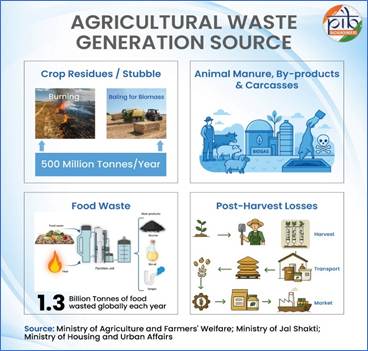
Crop Residues / Stubble: The agricultural waste cycle begins at the post-harvest stage, when crops leave behind residues such as stalks, straw, and stubble. A substantial proportion of this biomass is productively utilized as cattle feed, compost, biogas, mulch, or fuel. However, a significant share is still burned in situ to facilitate rapid land preparation for subsequent cropping cycles. Residue burning leads to the depletion of soil nutrients, degradation of soil health, and the emission of greenhouse gases.
What is Biomass?
Biomass refers to organic material derived from living or recently living plants and animals that can be used as a source of energy, materials, or nutrients.
Animal Manure, By-products, and Carcasses: Livestock farming constitutes a significant source of agricultural waste, particularly in India, where large animal populations generate enormous quantities of dung and bedding waste. In the case of a disease outbreak, the safe and timely disposal of animal carcasses is essential to prevent the transmission of infectious and zoonotic diseases. Therefore, proper carcass management underscores the importance of expanding infrastructure, financing, and technical capacity to ensure environmentally sound and public health-safe disposal practices.
Post-Harvest Losses: Post-harvest losses refer to measurable reductions in both quantity and quality of a product. These losses can occur at any stage of the post-harvest system. Food losses may be quantitative, such as a decrease in weight or volume, or qualitative, including loss of nutrients and undesirable changes in taste, colour, texture, or appearance. Better post-harvest supply chain management would minimize waste, increase real consumption, and enhance income across the economy.
Food waste: Food waste occurs later in the value chain, including markets, retail outlets, and households, where edible food is discarded. Such wastage contributes significantly to greenhouse gas emissions. However, emerging technologies are increasingly converting food waste into value-added products, such as engineered biochar, which has the potential to sequester carbon, enhance soil health, and remove environmental contaminants. By transforming waste into a resource, food waste management is evolving into a crucial pillar of circularity within the agriculture and food systems.
What is Biochar & Engineered Biochar?
Biochar is a carbon-rich material made by heating biomass (such as crop residues or wood waste) in low-oxygen conditions. When this biochar is engineered, it is further treated or enhanced to improve specific properties, such as soil fertility and water retention, and to improve nutrient use efficiency.
Government Initiatives Driving Circularity in Agriculture
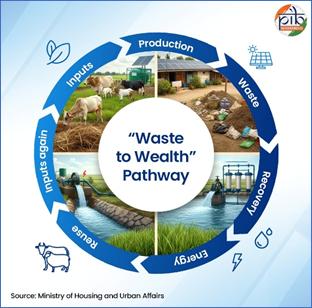
The government is implementing various policies to promote circularity in agriculture and allied sectors by converting waste into valuable resources. Initiatives such as Galvanising Organic Bio-Agro Resources Dhan (GOBARdhan) and Crop Residue Management are transforming agricultural, animal, and food waste into organic manure.
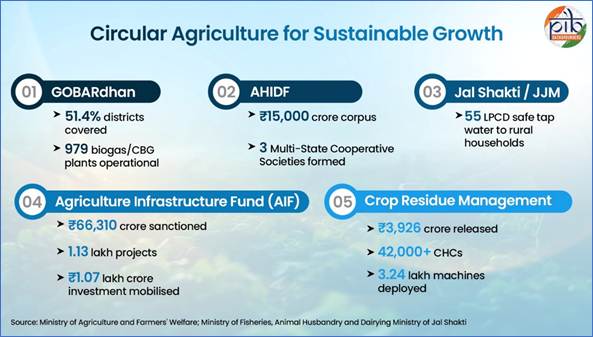
Complementing these schemes, the Agriculture Infrastructure Fund (AIF) and Animal Husbandry Infrastructure Development Fund (AHIDF) support the development of infrastructure to convert agricultural waste into value. Additionally, the Jal Shakti Mission encourages the reuse of domestic and industrial wastewater for non-potable purposes, including agriculture, landscaping, and horticulture. All these initiatives are working towards the ‘waste-to-wealth' approach by promoting resource recovery, reuse, and value addition across the agriculture and allied sectors.
Transforming Crop Residues and Biomass into Resources
Galvanising Organic Bio-Agro Resources Dhan (GOBARdhan): The scheme brings together multiple ministries to convert cattle dung, crop residues, and food waste into compressed biogas (CBG) and organic manure. In 2023, the government launched the Unified GOBARdhan Portal to enhance transparency and functionality. By 14th January 2026, the scheme covered 51.4% of India’s districts and had 979 operational biogas plants, indicating substantial progress in sustainable waste management. Additionally, the Indian Council of Agricultural Research (ICAR) has developed crop-specific guidelines to help farmers use biogas slurry to enhance soil health.
Additionally, the government has eased regulations and introduced targeted incentives to enhance the scheme’s impact. The inclusion of compressed biogas (CBG) in carbon credit trading, tax relief on CBG-blended fuels, and simplified norms for organic manure under the Fertiliser Control Order have accelerated biogas adoption, attracted private investment, and strengthened the national waste-to-wealth ecosystem.
Crop Residue Management (CRM): The CRM initiative aims to reduce the open burning of crop residues by promoting in-situ management, where residues are directly incorporated into the soil or used as mulch, and ex-situ management, where residues are collected for composting, biogas production, or bioenergy. These practices help improve soil health, enhance farm productivity, and promote effective waste management.
Under the scheme, from 2018-19 to 2025-26, Rs. 3,926.16 crore has been released to the states of Punjab, Haryana, Uttar Pradesh, NCT of Delhi, and ICAR. During this period, the states have set up over 42,000 Custom Hiring Centres (CHCs) for crop residue management machines, and more than 3.24 lakh machines have been supplied to these CHCs and individual farmers.
Building Infrastructure to Convert Agricultural Waste into Value
Agriculture Infrastructure Fund (AIF): The AIF plays a key role in strengthening the agricultural value chains, including those involved in organic agriculture. Organic farmers, Farmer Producer Organizations (FPOs), Primary Agricultural Credit Societies (PACS), and agri-entrepreneurs have leveraged AIF support to establish warehouses, cold storage facilities, sorting and grading units, and primary processing centres.
- Launched in 2020-21, the AIF provides medium to long-term institutional credit for the development of post-harvest infrastructure and farm-level assets.
- As of 2025, the AIF has supported 545 projects related to organic input production, with loan sanctions totaling ₹ 850 crore, underscoring the growing recognition of organic farming as both environmentally sustainable and economically viable.
- Additionally, ₹66,310 crore has been sanctioned across 1,13,419 projects, mobilising total investments of ₹1,07,502 crore in the agriculture sector. Major projects supported under AIF include:
- 30,202 custom hiring centres,
- 22,827 processing units,
- 15,982 warehouses,
- 3,703 sorting and grading units,
- 2,454 cold storage projects, and
- around 38,251 other post-harvest management projects,
along with the creation of viable community farm assets. These initiatives contribute to improved value addition, reduced post-harvest losses, and enhanced income opportunities for farmers.
Animal Husbandry Infrastructure Development Fund (AHIDF): Launched in 2020, the Government has introduced the AHIDF. under the Atmanirbhar Bharat Abhiyan, with a corpus of ₹ 15,000 crore to strengthen infrastructure across the livestock value chain. The fund is designed to catalyse private and cooperative investments in meat and dairy processing, animal feed manufacturing, and waste-to-wealth management, thereby enhancing value addition, efficiency, and resilience in the animal husbandry sector. To embed sustainability and circularity into the dairy ecosystem, the government has initiated the formation of three exclusive Multi-State Cooperative Societies (MSCS) with specific objectives: -
- To supply cattle feed, mineral mixtures, and technical inputs that enhance livestock productivity.
- To promote organic manure production and sustainable waste utilization through cooperative models, converting cow dung and agricultural waste into organic fertilizers and biogas.
- To facilitate scientific management of hides, bones, and horns of fallen animals, ensuring responsible disposal while creating additional value streams within the livestock sector.
This approach supports natural farming practices, promotes circularity by minimizing waste, and addresses the rising demand for environmentally sustainable soil inputs, thereby enhancing the resilience and long-term sustainability of the livestock sector.
Water Management for Sustainable Agriculture: Initiatives under Jal Shakti Mission
The Ministry of Jal Shakti promotes the treatment and reuse of domestic and wastewater for non-drinking purposes, such as agriculture, landscaping, and horticulture, through schemes such as the National Mission for Clean Ganga, PMKSY-Watershed Development, and Jal Shakti Abhiyan.
The Ministry also focuses on water conservation and source sustainability by supporting watershed development, rainwater harvesting, revival of traditional water bodies, and groundwater recharge. These efforts improve water availability for irrigation, reduce pressure on groundwater, and encourage a resource-efficient and sustainable approach to water management in agriculture and allied sectors.
Complementing wastewater reuse initiatives, the Jal Jeevan Mission-Har Ghar Jal (launched in August 2019), focuses on ensuring universal access to safe and adequate drinking water in rural areas. The mission provides functional household tap water connections supplying 55 litres per capita per day of potable water, thereby reinforcing India’s long-term objectives of water security and sustainable water governance.
Sustainable Development Goals (SDG)-aligned Circular Agriculture Practices
Circular agriculture is closely aligned with achieving the Sustainable Development Goals (SDGs) at the global level. It supports SDG 2, which aims to “end hunger, achieve food security, improve nutrition, and promote sustainable agriculture”.
In particular, SDG indicator 2.4.1 emphasises the need for resilient farming systems that improve soil health and reduce dependence on chemical inputs. In India, practices such as composting, biochar use, and biomass recycling contribute to these objectives by enhancing soil fertility, improving productivity, and promoting environmentally sustainable agriculture.
Moreover, circular agriculture supports the SDGs by reducing global food waste, which reached 1.05 billion tonnes in 2022, of which 60% generated at the household level.
India’s shift towards a circular economy in agriculture demonstrates that environmental sustainability and economic growth can be mutually reinforcing. While the scale of agricultural and food waste poses a significant concern, targeted policies, strategic infrastructure investments, and coordinated institutional action are increasingly converting waste into energy, organic inputs, water resources, and livelihood opportunities. Flagship initiatives such as GOBARdhan, crop residue management programmes, the Agriculture Infrastructure Fund (AIF), and the Animal Husbandry Infrastructure Development Fund (AHIDF) represent the potential of circular agriculture to enhance soil fertility and water security, and to strengthen farm resilience. By scaling proven interventions, strengthening local institutions, and aligning economic incentives with ecological outcomes, circular agriculture can play a pivotal role in ensuring long-term food security, climate resilience, and inclusive rural development, turning agricultural waste into a cornerstone of sustainable prosperity.
Ministry of Agriculture & Farmers Welfare
Indian Council of Agricultural Research (ICAR)
Ministry of New & Renewable Energy / Energy-linked Platforms
Ministry of Food Processing Industries
Ministry of Housing & Urban Affairs
Ministry of Fisheries, Animal Husbandry & Dairying
Department of Administrative Reforms & Public Grievances (DARPG)
Ministry of Environment, Forest and Climate Change
Ministry of Jal Shakti
Parliament of India (Sansad)
International & Multilateral Organisations / Research
Click here for pdf file.
****
PIB Research
(Release ID: 2228963)
Visitor Counter : 14330