PIB Backgrounder
India’s Drone Ecosystem
From Policy to Public Service Transformation
Posted On:
17 FEB 2026 10:09AM by PIB Delhi
Key Takeaways
- As of February 2026, India has built a regulated drone ecosystem with 38,500+ registered drones (UIN), 39,890 DGCA-certified remote pilots, and 244 approved training organisations.
- Under the SVAMITVA Scheme, 3.28 lakh villages have been surveyed using drones, and 2.76 crore property cards have been prepared for 1.82 lakh villages across 31 states.
- 1,094 drones distributed to women SHGs including 500+ under Namo Drone Didi initiative, enhancing farm productivity and livelihoods.
Introduction
Over the past two decades, drone technology has emerged as a transformative tool globally. India is rapidly leveraging its potential across governance and development sectors. What began as limited experimental deployment has evolved into a structured and expanding drone ecosystem that is reshaping public service delivery, infrastructure management, agriculture, and national security.
Today, drones are used in India for land and property surveys, precision agriculture, infrastructure inspection, disaster management, railway and highway monitoring, and defence applications etc. This growing adoption reflects the maturation of a comprehensive ecosystem comprising manufacturers, software and component developers, service providers, training institutions, certified pilots, start-ups, research organisations, and enabling digital platforms working within a unified regulatory framework.
This ecosystem-wide expansion has been supported by a series of deliberate and enabling policy interventions. The Government of India has played a pivotal role in accelerating this transition through progressive policy reforms, simplified regulations, and robust digital governance mechanisms. Liberalised Drone Rules, the Digital Sky single-window platform, targeted skill development programmes, and manufacturing incentives have reduced entry barriers, improved compliance, and enabled drones to be seamlessly integrated into flagship government schemes and routine public service operations.
Transformation of Public Service Delivery through Drone Technologies
Drone technology has become a key enabler of efficient and responsive public service delivery in India. Integrated into flagship government schemes such as Survey of Villages and Mapping with Improvised Technology in Village Areas (SVAMITVA) and Pradhan Mantri Fasal Bima Yojana (PMFBY), drones are enhancing agility, precision, and transparency in governance. Their deployment in land surveys, crop assessment, infrastructure monitoring, disaster management, and defence is not only improving service delivery but also accelerating the adoption of drones across government programmes, fostering innovation and efficiency at every level.
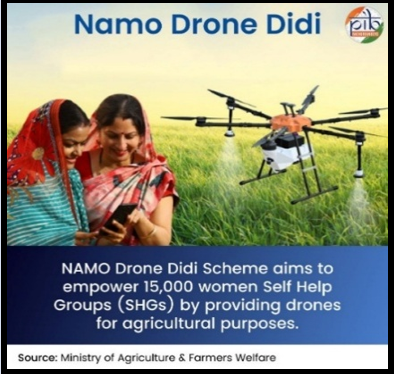
- Agriculture and Farmer Services: The Namo Drone Didi Scheme, launched in November 2023, is a flagship initiative of the Government of India. The scheme aims to provide drones to Women Self Help Groups (SHGs) to support modern farming practices. Its key objectives are to improve farm efficiency, increase crop productivity, reduce input costs, and create sustainable livelihood opportunities for women.
|
Impact of Namo Drone Didi in Agriculture and Farmer Services
- Since the inception of the scheme, 1,094 drones have been distributed to women SHGs by Lead Fertilizer Companies, including over 500 drones provided under the Namo Drone Didi initiative.
- Namo Drone Didi scheme marks a significant shift from manual and labor-intensive practices to precision agriculture.
- A Drone Didi from Sitapur, Uttar Pradesh, featured in the 110th episode of Mann Ki Baat, showcased how drone training enabled her SHG to offer spraying services to farmers, enhancing income and social empowerment.
|
- Land Mapping: Drone technology is central to the Survey of Villages and Mapping with Improvised Technology in Village Areas (SVAMITVA) Scheme. The scheme was launched in April 2020, and implemented by the Ministry of Panchayati Raj, State Governments, and the Survey of India. The scheme is intended for drone-based mapping for survey of rural abadi areas to settle land dispute cases and to improve access to bank credit.
|
Impact of SVAMITVA Scheme
- Under the Scheme, nearly 3.44 lakh villages are targeted to be covered.
- As of December 2025, drone survey is completed in 3.28 lakh villages which is about 95% of the overall target.
- By December 2025, 2.76 crore property cards have been prepared for 1.82 lakh villages across 31 states and UTs.
- As of March 2025, 31 States and Union Territories have signed Memorandums of Understanding.
|
- Aerial Mapping for Highway Development: The National Highways Authority of India (NHAI) mandates monthly drone-video recordings for all highway projects. Contractors are required to upload both current-month and prior-month footage onto NHAI’s Database for month-to-month comparison. Supervision consultants analyze these recordings and provide feedback in digital monthly progress reports, while project directors cross-verify them during physical inspections to identify discrepancies. Drone videos stored in the Data Lake also serve as a permanent record, usable as evidence in dispute-resolution before arbitral tribunals and courts.
- Use of Drones in Disaster Management and Emergency Response: Drones are helping India respond better during natural disasters. The North East Centre for Technology Application and Reach (NECTAR) has developed a special drone system for disaster situations. This drone can stay stable in the air for a long time and carry heavy equipment. It is used to watch affected areas during floods, landslides, and other disasters. The drone sends live visuals from the sky, which helps rescue teams understand the situation quickly. This makes search and rescue work faster and better coordinated.
- Railway Drone Monitoring: The Ministry of Railways has directed all its zones and divisions to deploy UAVs/drones for enhanced monitoring and maintenance of railway tracks, bridges, and other infrastructure. West Central Railway procured the first cameras and trialed them across its divisions, enabling inspections of hard-to-reach areas and improving the efficiency of track and project monitoring. Zonal railways and public sector units have also installed UAV systems to support regular maintenance and infrastructure management.
|
Do you know?
The Railway Protection Force (RPF) has adopted drones for security surveillance in rail yards, station premises, and along railway tracks. These drones provide real-time tracking, video streaming, and aerial monitoring, supporting crowd management and anti-trespass operations.
|
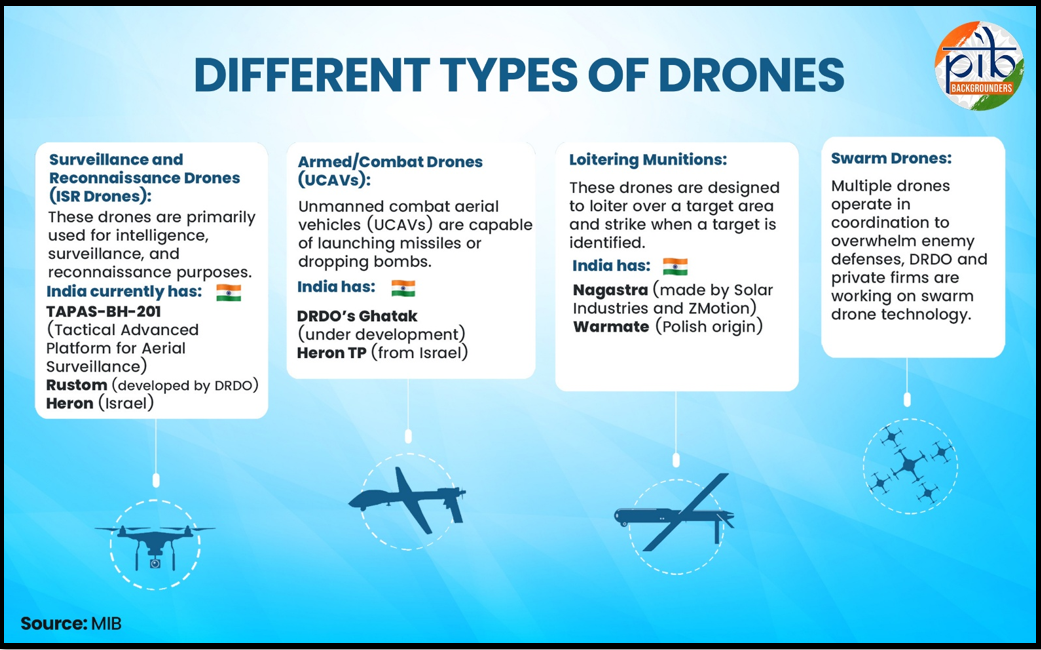
- Drones in Defence: Drones play a key role in India’s defence, helping the armed forces watch borders, gather intelligence, and carry out precise strikes. During Operation SINDOOR, Indian drones and loitering munitions destroyed enemy targets safely and accurately. Drones work together with air defence systems, radar networks, and command centres to protect critical infrastructure and respond quickly to threats.
Drones in India are driving transformative socio-economic and developmental outcomes across sectors. Their use in agriculture has empowered women farmers and improved risk assessment, while in infrastructure and urban planning they have enabled proactive monitoring and better resource management. In disaster management and national security, drones have strengthened preparedness and rapid response capabilities. Together, these applications underscore the role of drone technology as a scalable, future-ready solution that is reshaping service delivery and advancing smarter, more resilient, and sustainable governance in India.
Accelerating Drone Adoption in India via Policy, Programs and Reforms
The Government of India has established a comprehensive policy and financial framework to accelerate the adoption and manufacturing of drones. These measures are designed to encourage innovation, simplify compliance, and strengthen domestic production.
- Drone Rules, 2021 and Drone (Amendment) Rules 2022 & 2023: The Drone Rules, 2021, along with the amendments introduced in 2022 and 2023, have significantly liberalised India’s drone ecosystem.
- Regulatory procedures were simplified, with forms reduced from 25 to 5 and approval requirements lowered down from 72 to just 4.
- Fees were rationalised and delinked from drone size.
- Civilian drone operations were permitted for drones weighing up to 500 kg, thereby expanding commercial and industrial applications.
- Nearly 90% of Indian airspace was declared a Green Zone for drone operations, allowing flights up to 400 feet.
- The requirement for a traditional pilot licence was replaced with a Remote Pilot Certificate issued by the DGCA.
- The passport requirement was removed and any government-issued ID along with address proof became sufficient to operate drones.
Collectively, these reforms significantly lowered entry barriers, encouraged both rural and commercial adoption, and supported the growth of Drone-as-a-Service models.
- Production Linked Incentive (PLI): PLI scheme for drones and drone components has an approved outlay of ₹120 crore. It aims to promote high-value domestic manufacturing by encouraging local production. The scheme enables Indian start-ups and MSMEs to scale up their production capacity and strengthen the domestic drone manufacturing ecosystem.
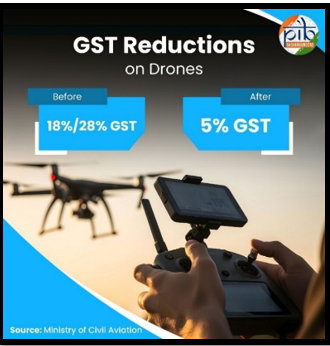
- GST on drones: GST on drones was reduced to a uniform 5% in September 2025. Earlier tax rates of 18% and 28% were removed. This simplified taxation supports wider commercial and personal use of drones. The NextGen GST reform also applies to flight and motion simulators used for drone pilot training. This lowers costs for training institutes will further strengthens skill development in the drone ecosystem.
- Digital Sky, 2018 and eGCA: The regulatory services such as drone registration, remote pilot certification, Type certification and RPTO authorisation has been migrated from Digital Sky platform to eGCA. Further, the operational services such as flight plan and airspace map continue to be integrated with the Digital Sky Platform.
|
Key Achievements of Digital Sky Platform
- As of February 9, 2026, 38,575 drones have been successfully registered and issued Unique Identification Number (UIN).
- 39,890 Remote Pilot Certificates (RPCs) have been issued as of February 2026, enabling certified and compliant drone operations across the country.
- The DGCA has approved 244 Remote Pilot Training Organisations (RPTOs) nationwide as of February 2026, strengthening institutional capacity for pilot training and skill development.
|
- Ecosystem Development and Capacity Building through Flagship Programmes:
- Platform such as Bharat Drone Shakti, Bharat Drone Mahotsav and the Drone International Expo promote Drone-as-a-Service (DaaS) start-ups and new business models. They showcase indigenous technologies and encourage collaboration among start-ups, MSMEs, industry, and research institutions.
- DGCA-approved training programmes & Remote Pilot Training Organisations (RPTOs) are also expanding the national pool of certified drone pilots.
- SwaYaan is a Capacity Building programme for Human Resource Development in Unmanned Aircraft Systems supports training and talent creation. So far, 857+ programme activities have been conducted, benefiting 26,000+ participants, with 337 collaborations.
- National Innovation Challenge for Drone Application and Research (NIDAR) engage students and researchers. It promotes autonomous drones for disaster management and precision agriculture. The programme offers a ₹40 lakh prize pool and supports start-up incubation.
Through progressive regulations, financial incentives, and dedicated capacity-building initiatives, India has created a comprehensive ecosystem that accelerates drone adoption and manufacturing. Simplified compliance under the Drone Rules, support for domestic production via PLI, reduced GST, and platforms like Digital Sky, combined with skill development and innovation programs, are collectively enabling widespread commercial, industrial, and societal use of drones while fostering a self-reliant and future-ready sector.
Conclusion
India’s drone ecosystem has transitioned from pilot projects to a mainstream, innovation-driven sector, underpinned by progressive policies, regulatory facilitation, and targeted financial incentives. With initiatives supporting women-led entrepreneurship, rural access, and domestic manufacturing, the government has created a structured framework that encourages both technological innovation and widespread adoption. Drones are now embedded across critical sectors—agriculture, land and property surveys, infrastructure monitoring, disaster assessment, and public service delivery—demonstrating their potential to enhance efficiency, transparency, and precision in governance.
Looking ahead, continued expansion of indigenous manufacturing, skill development for remote pilots, and integration with state and central programmes positions India to leverage drones for socio-economic empowerment, infrastructure oversight, and national security. With increasing government support, including budget allocations, innovation grants, and strategic deployment, India is set to become a global leader in unmanned aerial systems, fostering an ecosystem that balances commercial growth, technological self-reliance, and inclusive development.
References
Press Information Bureau
Lok Sabha
Rajya Sabha
Ministry of Information and Broadcasting
National Highways Authority of India
Ministry of Civil Aviation
Others
Click here for pdf file.
****
PIB Research Unit
(Release ID: 2228954)
Visitor Counter : 10614