Posted On:
15 JAN 2026 4:26PM by PIB Delhi
A new study has unearthed one of the most detailed climate records from peninsular India, below the modest Kondagai inland lake on the outskirts of Tamil Nadu’s Sivaganga.
In land Tamil Nadu has almost no well-dated multiproxy lake records, despite being sensitive to the Northeast Monsoon. Kondagai Lake which lies close to Keeladi, a significant archaeological site, famous for unearthing evidence of a sophisticated urban civilization from the Sangam period, potentially dating back to the 6th century BCE (or even earlier), pushing back Tamil history by centuries. Researchers recognised that the lake, located in ancient settlement zones, offered a rare opportunity to understand Past monsoon variability, Ecosystem responses, and their relationship with human habitation.
Researchers from Birbal Sahni Institute of Palaeosciences (BSIP), Lucknow (BSIP), an autonomous institution of the Department of science and Technology (DST) excavated a sediment profile just over one metre deep, collected 32 closely spaced samples, each representing a different slice of time. Using a powerful combination of techniques, including stable isotope analysis, pollen studies, grain-size measurements, and radiocarbon dating, they reconstructed past rainfall, vegetation, lake levels, and flood events with unusually high precision.
Through the first high-resolution, multiproxy reconstruction of Late Holocene climate and lake-ecosystem dynamics from inland Tamil Nadu, the research published in the journal Holocene, identified three distinct climatic phases nearly over the past 4,500 years. It documented the 4.2 ka arid event, the 3.2 ka dry phase, and the Roman Warm Period, establishing their direct linkages to monsoon variability, lake hydrology, and human activity in the region.
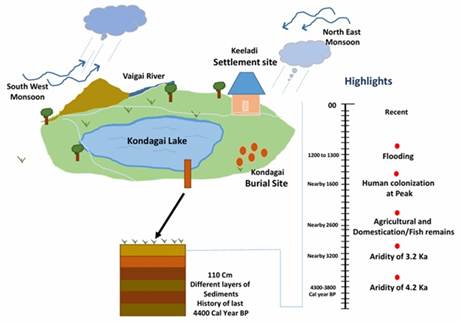
Fig 1: Graphical abstract of the Manuscript
By reconstructing 4,500 years of monsoon behaviour, the research delivers a long-term climatic baseline that strengthens regional climate forecasting and helps anticipate future droughts, extreme rainfall, or flood events. Such historical context is crucial for improving monsoon prediction models in a climate-sensitive region like Tamil Nadu.
The findings also directly support water resource management in drought-prone districts such as Sivaganga and Madurai. Insights on past lake-level fluctuations, sediment inflow, and hydrological changes guide sustainable reservoir restoration, groundwater recharge planning, tank rehabilitation, and climate-smart agricultural water use. This is vital for regions heavily dependent on monsoon-fed water systems.
By identifying ancient flood deposits, terrestrial sediment influx, and phases of land destabilization, the study contributes to risk mapping and disaster preparedness. Authorities can use these signals to recognize zones vulnerable to flooding, channel shifts, and land degradation in the Vaigai basin.
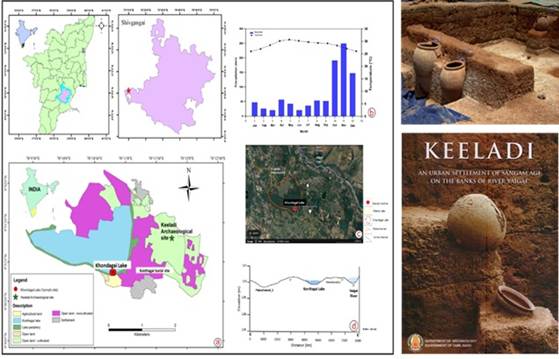
Fig 2: (a) Study map of the Khondagai Lake (KLD), Tamil Nadu, showing the profile location with land use and land cover in the vicinity of the study site. (b) The mean monthly precipitation in the Khondagai district, Tamil Nadu, from 1901 to 2020 AD was extracted online from the KNMI Climatic explorer https://climexp.knmi.nl/start.cgi. (c) Google Earth imagery showing the study site, the location of the paleochannels, and the Ox-bow lakes in the Vaigai River basin. (d) Cross section along KK’, showing that T0 is the active channel and T1 is the river trace and the location of the paleochannels of river Vaigai. (e) Kondagai burial site.
The research significantly benefits archaeology and cultural heritage. Located near the Keeladi settlement, Kondagai Lake’s environmental history offers key insights into how ancient societies adapted to climate variability, water scarcity, and ecological stress. This strengthens archaeological interpretation, conservation strategies, and regional heritage planning.
From an ecological perspective, the work provides a scientific basis for wetland and lake restoration by documenting long-term shifts in aquatic productivity, oxygen conditions, and organic matter sources. This can help design evidence-based conservation and biodiversity strategies.
Publication link: https://doi.org/10.1177/09596836251378011
****
NKR/FK