Ministry of Science & Technology
Technical Hindi Symposium “Abhyuday-3” witnessed presentations on Recent Development of Science & Technology and their Societal Interface
Posted On:
12 JAN 2026 10:58AM by PIB Delhi
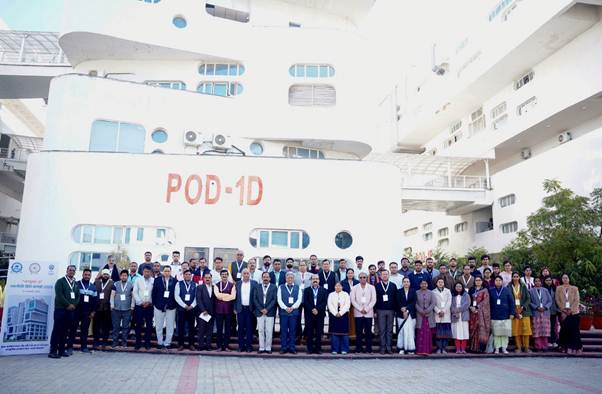
The Third Technical Hindi Symposium (Takniki Hindi Sangoshthi) “Abhyuday-3” was organised with the active collaboration of CSIR-National Institute of Science Communication and Policy Research, along with Indian Institute of Technology Indore and Indian Institute of Technology Jodhpur, with the objective of promoting the use of Technical Hindi and expanding the outreach of science and technology to wider sections of society. The two-day symposium witnessed research study outcomes on recent innovations and development in science and technology and their societal interface. Research scholars presented 25 papers focused mainly on biodiversity values of medicinal plants, biological waste disposal, human-AI collaboration, technology and social innovations, confluence of Rajbhasha and technology.
CSIR-NIScPR, a Delhi based constituent laboratory of CSIR is mandated for science communication and evidence-based policy research, played a key role in conceptualising and supporting the symposium to bridge the gap between scientific research and society through Hindi language. The Institute has been consistently working towards making scientific knowledge accessible to the public, particularly through Indian languages, enabling science communicators, students, teachers, innovators, and citizens to better understand and apply scientific knowledge.
During the event, Shri C. B. Singh, Chief Scientist and Head, Popular Science Division, CSIR-NIScPR, highlighted the importance of Technical Hindi and effective science communication in taking research and innovation to wider sections of society. He also noted CSIR-NIScPR’s sustained efforts in disseminating scientific knowledge in Hindi, including the publication of the popular science magazine “Vigyan Pragati” since 1952.
The Director of IIT Indore, Prof. Suhas Joshi, highlighted the Institute’s initiatives to promote the use of Hindi in technical education, including discussions on science in Hindi, preparation of PhD abstracts compilation as per prescribed official language standards, and delivery of select undergraduate lectures in Hindi to enhance conceptual clarity. The Director of IIT Jodhpur, Prof. Avinash Kumar Agrawal, observed that the symposium had initiated meaningful technical discourse in Hindi and would play a significant role in strengthening its use in technical education and research.
The symposium witnessed participation from eminent educators, scientists, technical experts, official language officers, and researchers from across the country. The programme included technical sessions, research paper presentations, invited talks, panel discussions, and special lectures on contemporary themes such as artificial intelligence, innovation, start-ups, higher education, and the use of Hindi in administration.
A key highlight of the symposium was the release of the Smarika, featuring scholarly contributions received for the event. A total of 26 research papers were accepted after peer review and compiled in the publication. These papers were presented across two technical sessions, namely Science and Engineering, which included 12 papers, and Digital Technology and Innovation, which featured 14 papers. The Smarika reflected growing academic engagement in Technical Hindi and served as a valuable resource for researchers, educators, and policymakers working towards strengthening the use of Hindi in science, technology, and innovation. In the valedictory session, Dr. Manish Mohan Gore, Senior Scientist, CSIR-NIScPR underscored the key takeaways of the two days symposium. He stressed that such programs are much needed to engage scientists and research scholars to discuss latest and socially relevant developments of science and technology in the Indian languages including Hindi.
Through its collaboration in “Abhyuday-3”, CSIR-NIScPR reaffirmed its commitment to inclusive science communication, promotion of Technical Hindi, and building a strong interface between science, technology, and societal needs. The symposium contributed to empowering citizens with scientific awareness in their own language and supported the broader goal of making science more accessible, participative, and socially relevant.
****
NKR/AK
(Release ID: 2213558)
Visitor Counter : 1373