Ministry of Culture
Those Who Remain Connected to Their Roots Speak in Their Own Language – Lok Sabha Speaker Om Birla
Grand Conclusion of the Third International Indian Languages Conference organised by IGNCA, Antarashtriya Sahyog Parishad, Vaishwik Hindi Pariwar, and the Department of Indian Languages and Literary Studies, University of Delhi
Posted On:
11 JAN 2026 9:30PM by PIB Delhi
The Third International Indian Languages Conference- 2026 jointly organised by the Indira Gandhi National Centre for the Arts, Ministry of Culture, Government of India, Antarashtriya Sahyog Parishad, Vaishwik Hindi Pariwar and the Department of Indian Languages and Literary Studies, University of Delhi, concluded on January 11. The valedictory session was attended by the Speaker of the Lok Sabha, Shri Om Birla, as the Chief Guest. The Speaker of the Delhi Legislative Assembly, Shri Vijender Gupta, was present as the Guest of Honour. The session was presided over by the Chairman of IGNCA, Padma Bhushan awardee and eminent thinker Shri Ram Bahadur Rai. The Distinguished Speaker was Shri A. Vinod, National Convener of the Shiksha Sanskriti Utthan Nyas. The occasion was further graced by the presence of Shri Shyam Parande, Secretary General of the Antarashtriya Sahyog Parishad. The Conference Director, Shri Anil Joshi, was also present on the dais. In addition, Shri Ramesh Chandra Gaur, Dean (Administration), IGNCA, and Prof. Ravi Prakash Tekhchandani, Head of the Department of Indian Languages and Literary Studies, University of Delhi, were present and added dignity to the programme.
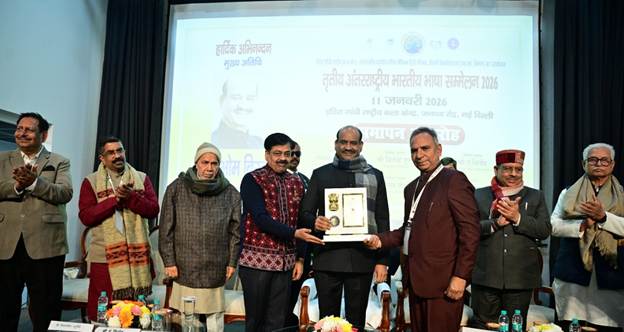
Addressing the gathering, the Lok Sabha Speaker Shri Om Birla said that Indian languages are the soul of India. Expressing his happiness over the organisation of the conference, he said that this conference itself was a platform for sharing ideas, where dialogue took place on the promotion and propagation of Indian languages and on ways to connect today’s youth with them. He said that the biggest challenge today is how to connect our present generation with the world’s richest languages—languages in whose every single word resides the soul and culture of India. Appreciating the efforts being made in this direction, he congratulated and commended all those involved.
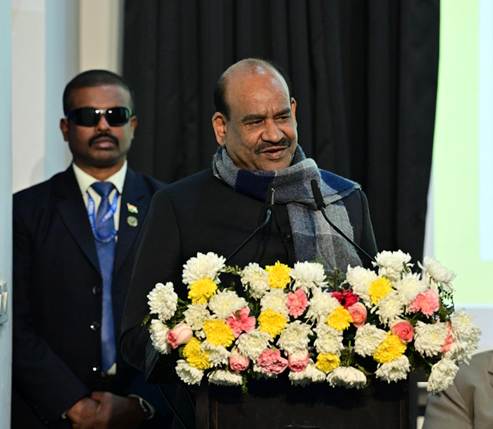
Emphasising the need to connect the coming generations of the Indian diaspora with Indian languages, he said that Non-Resident Indians living in different parts of the world certainly take pride in their culture and values. However, efforts must be made to teach Indian languages to their future generations.
Speaking about the initiatives taken by the Government of India for the advancement of Indian languages, he said that in the Parliament of India, translations are provided in the 22 languages included in the Eighth Schedule of the Constitution. He expressed happiness that many Members of Parliament speak in their own languages in the temple of democracy, the Parliament. He added that his endeavour would be to encourage all Members of Parliament from different regions of the country to speak in their own languages during the Budget Session, so that the expansion of Indian languages begins from Parliament itself. He noted that this effort has already started and has also been appreciated by the Prime Minister.
He further said that those who remain connected to their roots and to the soil of India speak in their own language. Referring to his visits to different countries, he observed that many heads of state speak only in their own languages. He said that whenever the Prime Minister of India addresses any global or international platform, he speaks in his own language. Similarly, when Indian representatives go to world parliaments or other platforms, they speak in their own languages. “We are proud of our language. If we do not express ourselves in our language on global platforms, then who will?” he said, adding that efforts are therefore being made to present Indian languages on international forums as well.
Highlighting the contribution of cinema in the spread of language, Shri Birla said that Hindi films have also played an important role in taking Indian languages across the world. He shared that when he visits other countries, people often tell him how much they like Hindi songs, which reflects how rich Indian languages are. He noted that different regions have different languages, and every language is rich, reflecting the soil and culture of India.
Speaking about the use of Indian languages in Parliament, he said that dialogue and discussion should take place in all 22 Indian languages, and people should listen in whichever language they prefer. “We do not impose any language on anyone,” he said, adding that the endeavour is to ensure the promotion of Indian languages, their prosperity and well-being, and through them, the spread of Indian culture across the world. He expressed confidence that these efforts would certainly yield results and that future generations would take pride in Indian languages. He congratulated and thanked the organisers for their efforts.
In his presidential address, Shri Ram Bahadur Rai said that the hopes and expectations expressed during the conference should be fulfilled, but at the same time, it is necessary to remain grounded in reality. He stressed the importance of understanding where we currently stand. He described the conference as significant and explained its importance in two clear ways. First, the conference proved that Indian languages have an international, indeed global, sphere. Second, if Indian languages have a global sphere, the question arises as to what its centre is. He said that the language in which discussions were held at this conference—Hindi—is that centre. Hindi, he asserted, is the central language of Indian languages.
He further said that we must reflect on why such a conference became necessary, because where Hindi should have been at the centre of languages, English has been placed on a queen-like throne—one from which English is not ready to move, and neither are we ready to remove it. He remarked that this burden has been carried for 75 years. He noted that today the Speaker of the Lok Sabha is a devotee and lover of Hindi. He said that if Indian languages are to be respected and brought into common usage, the government should appoint translators for all 22 languages included in the Eighth Schedule in every ministry.
In the presence of the Lok Sabha Speaker, he urged the Government of India to establish an institution that would provide space to experts for language coordination, language planning, and resolving language-related issues. He said that we must resolve not to turn our languages into mere languages of translation and that we can preserve the originality of our languages. He emphasised that while society, individuals, and organisations have an important role to play, the greatest responsibility lies with the Government of India.
Shri Vijender Gupta said that Indian languages, which have their own place in the world, are a matter of self-respect as well as dignity. Discussing Indian languages, he said, is essentially discussing continuity. Indian languages have neither developed in monotony nor in isolation; rather, centuries of interaction among diverse regions, communities, belief systems, and knowledge traditions have shaped them. He added that international participation in this conference enhanced its significance and demonstrated that Indian languages are not bound by geographical boundaries. Shri Shyam Parande stated that the intellectual thought of any civilisation and culture can exist only in its own languages.
The Conference Director, Shri Anil Joshi, presented a summary of the discussions held over the three days and outlined the future roadmap. At the beginning of the programme, Shri Vinay Sheel Chaturvedi delivered the welcome address and expressed gratitude to the guests. The session was conducted by Dr Anita Verma. Over the three days of this international conference, more than 40 sessions were organised, focusing on issues related to Indian languages. More than 100 international delegates from countries including the United Kingdom, Canada, New Zealand, Australia, Singapore, Sri Lanka, Nepal, the Netherlands, France, Mauritius, Thailand, and Japan participated in the conference.
*****
Sunil Kumar Tiwari
pibculture[at]gmail[dot]com
(Release ID: 2213536)
Visitor Counter : 540