Ministry of Youth Affairs and Sports
Viksit Bharat Young Leaders Dialogue 2026 Commences at Bharat Mandapam, Bringing 3,000 Youth from Across India
MoS Raksha Khadse addresses Orientation Session; highlights Swami Vivekananda’s vision on youth as nation-builders
Over Two Crore Youth Registered on MY Bharat Portal, Says MoS Raksha Khadse
India’s Youth Step Forward as Architects of a Viksit Bharat at VBYLD 2026
Women-Led Development, Fitness and Green Growth Dominate Youth Deliberations at VBYLD 2026
Posted On:
09 JAN 2026 8:20PM by PIB Delhi
The second edition of Viksit Bharat Young Leaders Dialogue (VBYLD 2026) commenced with an Orientation Session today in Bharat Mandapam, New Delhi, setting the tone and direction for the next three days of deliberations, engagement and collaboration among young leaders from across the country. The event was graced by Smt. Raksha Nikhil Khadse, Minister of State for Youth Affairs & Sports, Dr. Pallavi Jain Govil, Secretary, Department of Youth Affairs and Shri Nitesh Kumar Mishra, Additional Secretary, Youth Affairs, among others.
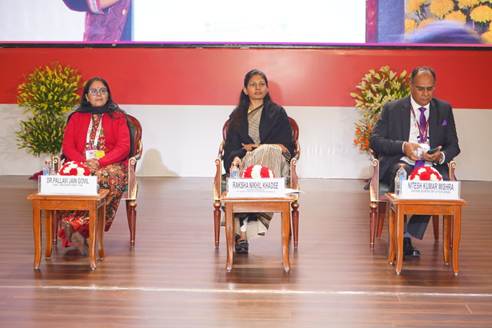
Addressing the gathering of 3000 young minds from across the country alongside youth diaspora delegates, Smt. Raksha Nikhil Khadse recalled Swami Vivekananda’s belief that youth are the real strength of the nation and that when organised, they can make even the impossible possible. She said that inspired by this very thought, Prime Minister Narendra Modi put forth the Viksit Bharat vision, emphasising that the task of nation-building cannot be achieved by the Government alone, but requires active participation of the youth to steer the country over the next 25 years with their ideas, energy and leadership.
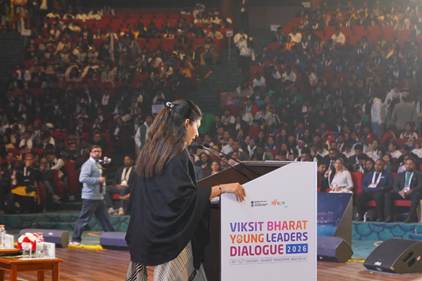
The Union Minister of State expressed happiness over the launch of the ‘MY Bharat’ (Mera Yuva Bharat) initiative under the Prime Minister’s vision, noting that more than two crore youth from across the country have already registered on the MY Bharat portal. She urged young citizens to not view MY Bharat as a limited programme, but to take its ideas forward to colleges and districts, encouraging maximum youth participation so that more young people connect with this platform and collectively advance a spirit of national commitment and patriotism.
In her welcome address, Secretary (Youth Affairs), Dr. Pallavi Jain Govil, said that a dialogue represents two-way communication, where the views of the youth are heard by the leadership and the leadership’s perspectives are shared directly with young citizens. She noted that the VBYLD platform provides a unique opportunity for youth to interact directly with the Prime Minister, reflecting his vision of meaningful engagement with young minds. Emphasising that every opinion matters, the Secretary acknowledged the diverse aspirations of youth across fields such as culture, entrepreneurship, science and creative pursuits, and wished them success in their future endeavours.
This was followed by a felicitation of MY Bharat Volunteers, recognising their significant contributions to youth outreach and participatory initiatives.
After the plenary session, participants proceeded to their assigned locations for presentations and interactive sessions on ten identified themes, which are as follows:
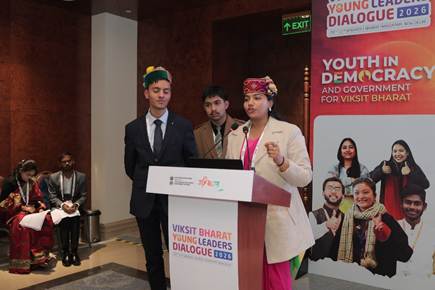
1) Track 1 – Youth in Democracy and Government for Viksit Bharat
The first track featured a focused round where young representatives from various states presented structured policy ideas aimed at strengthening youth participation in democratic processes and public governance.
Jury members Shri Suyash Pande (Advocate, Supreme Court) and Dr. Krunal Shah (Surgeon) underlined that the Dialogue was not a competition but a collaborative national platform, and urged the young delegates to work collectively to shape actionable governance solutions with a long-term national vision.
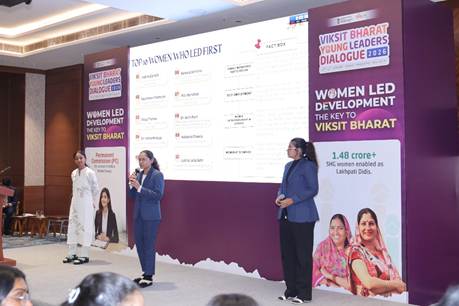
- Track 2 – Women Led Development: The Key to Viksit Bharat
Youth delegates focused on advancing the shift from women’s development to Women-Led Development, positioning women as key drivers of India’s growth by 2047. The Jury comprised Ms. Charu Pragya (Lawyer & Public Policy Professional), Ms. Neha Joshi (National Vice President of the BJP Youth Wing), and Ms. Rimjhim Gour (Political Strategist). Key proposals put forward at the presentation included dual skilling for rural women in emerging technologies, monetising traditional skills through the “Heritage to Home” model, and launching “AI Sahayika Didi” for AI-driven mentorship and workforce re-entry. The framework also emphasised preventive safety solutions, strengthened healthcare delivery through digital tools, and empowered grassroots leadership by addressing proxy governance and recognising unpaid care work through the 3R approach (Recognition, Revaluation, and Redistribution).
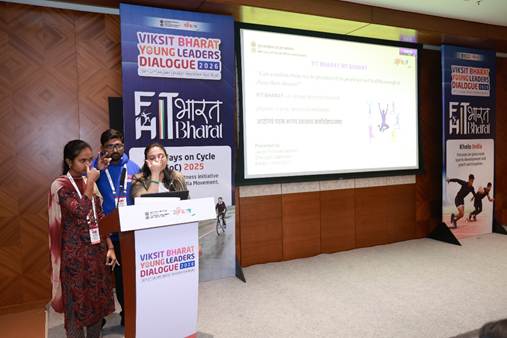
- Track 3 – Fit Bharat, Hit Bharat
Youth teams from across India presented innovative, region-specific ideas aligned with Fit Bharat, Hit Bharat, emphasising community-driven, inclusive, and sustainable fitness. Jury Members included Aravind S (Former Sports Journalist), Rushiraj (Founder of Invincible NGO) and Ajay Kashyap (India’s representative to the Commonwealth Youth Council). Proposals ranged from energy-generating piezoelectric tiles and early fitness integration in schools, to digital fitness incentives, pollution-reducing infrastructure, Agro Olympics for rural fitness, and inclusive community spaces for women and transgender persons. Collectively, the ideas underscored fitness as a catalyst for community participation and a healthier, more inclusive Viksit Bharat.
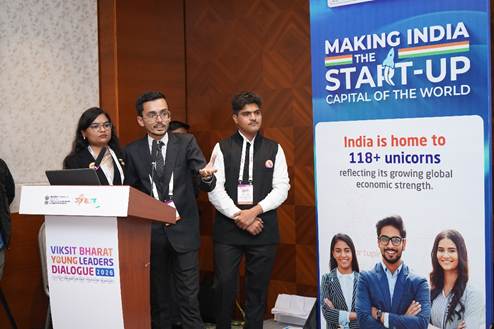
- Track 4 – Making India the Start-Up Capital of the World
Young leaders showcased innovative ideas aimed at strengthening India’s entrepreneurial ecosystem and positioning the country as a global startup hub to the jury which included Shri Anudeep (Senior Director, Motorola Solutions, Dr. Krantisagar More (Pharmaceutical Scientist & Innovator) and Dr. Vijay Radadiya (Academician & Innovator). A key theme that emerged from the presentations was the need to scale rural and grassroots-level startups through coordinated support from communities, corporates and government agencies, alongside sustained investments in entrepreneurial education, research and incubation infrastructure.
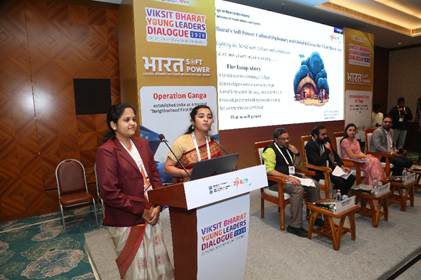
- Track 5 – Bharat’s Soft Power: Cultural Diplomacy and Global Influence
The thematic presentation session witnessed rich deliberations and innovative ideas highlighting India’s civilisational strengths as tools of global engagement. Presentations from participants representing diverse states reflected the pluralistic spirit and cultural depth of Bharat. The session was evaluated by an eminent jury comprising Ms. Nivedita Tiwari (Director of Culture Consulting and Visual Content at Brhat Culture Creatives) , Shri Nikhil Chadwani (Author and Industrialist), Ms. Bhargav Jignasa (Founder, JIGNASA) and Shri Arpit Tiwari, who appreciated the originality and futuristic vision of the proposals.
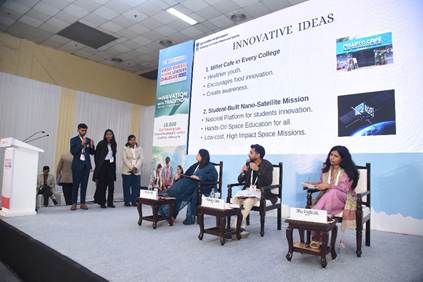
- Track 6 – Innovation with Tradition: Building a Modern Bharat
The session showcased how India’s ancient wisdom can meaningfully converge with modern technology. A distinguished jury comprising Dr. Sakshi Bhardwaj (Founder, JungleVase & Indian Representative to COP29), Ms. Dipali Khandelwal (Food Researcher, Founder- The Kindness Meal), and Shri Prakash Garg (Award WinningContemporary Artist) evaluated innovative, tech-enabled proposals focused on blending India’s ancient knowledge systems with modern technologies such as Artificial Intelligence (AI), Virtual Reality (VR) and Augmented Reality (AR). Some key ideas included an AI-driven NITYA Model, Odisha’s Sagar Samridhi for sustainable coastal development, Gujarat’s smart water management solutions, Assam’s digital platforms for the creative economy, and Bihar’s integration of AI in traditional education. Together, these initiatives illustrated how linking Jan Gyaan (people’s wisdom) with Vigyaan (science) can drive inclusive, eco-friendly, and authentically Indian development.
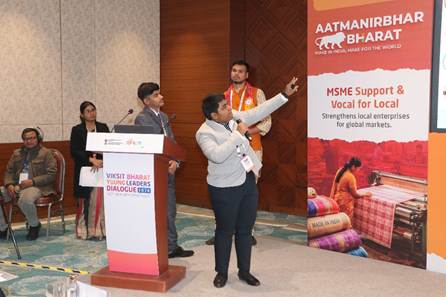
- Track 7 – Aatmanirbhar Bharat: Make in India, Make for the World
This track, evaluated by Jury Members Ms. Srividhya (Senior Advisor, World Association of investment Promotion Agencies) and Mr. Bhaskar Varda (Business Planning Professional), highlighted the role of data and innovation, addressing challenges such as talent loss, import dependence, and policy implementation. Youth proposals focused on strengthening Micro, Small and Medium Enterprises (MSMEs), reviving local textiles, advancing nuclear energy, boosting the millet economy, investing in R&D, empowering women in industry, and promoting sustainability, alongside bold ideas for domains including semiconductors, indigenous AI, defence, and advanced manufacturing.
- Track 8 – Enhancing Productivity through Smart and Sustainable Agriculture
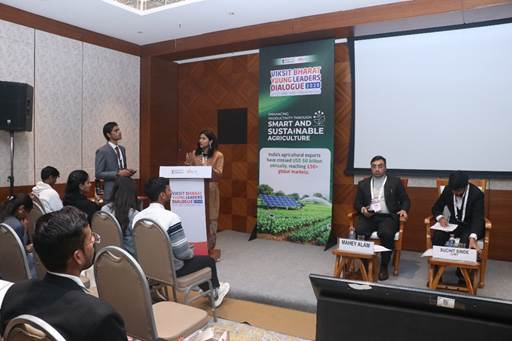
Participants presented smart and sustainable agriculture solutions to enhance productivity. The session showcased AI-driven innovations such as pest surveillance and soil health tools, with jury members Shri Suchit Sinde (Co-founder of OMG) and Shri Rohit Kumar praising the creativity and energy of the participants.
- Track 9 – Building a Sustainable and Green Viksit Bharat
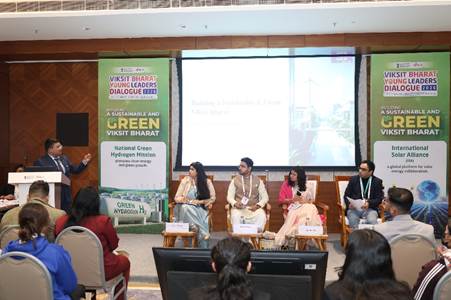
The session brought together youth-led teams from states across India, representing India’s diverse regions, who presented practical and community-driven ideas for sustainable development. Jury Members were Shri Rumit (Creative Environmentalist and Peacebuilder), Ms. Garima (Sustainability Educator and Program Lead at The Greenstraw House) and Ms. Arushi Sana (Entrepreneur and Sustainability Advocate). The discussions focused on promoting green lifestyles, indigenous solutions, and inclusive innovation as key pillars for achieving the vision of Viksit Bharat by 2047.
- Track 10 – Building a Future-Ready Workforce for Viksit Bharat
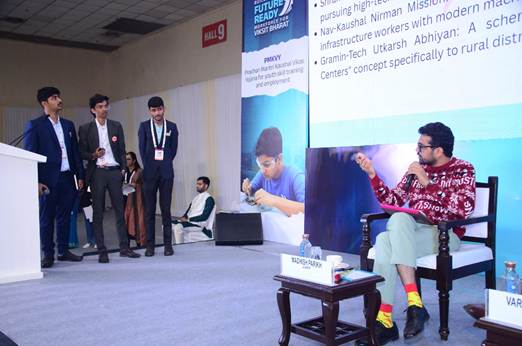
The session saw young changemakers reimagining India’s skilling, employment, and workforce ecosystem in line with emerging economic and technological realities. Jury members were Madhish Parikh (Founder of BRICS Youth Alliance and Elixir Foundation), Shri Varun Jhaveri (National Incharge for Policy, Research, and Training at BJYM) and Dr. Pushpendra Priyadarshi (Associate Professor, IIM Lucknow).The discussions focused on transforming India’s demographic advantage into a productive, skilled, inclusive, and globally competitive workforce. Participants highlighted the urgent need to move beyond traditional education models and adopt skill-first, outcome-oriented frameworks. Emphasis was laid on decentralised skilling, local employment generation, and bridging the gap between education and industry demand.
Selection rounds across various categories were held throughout the day to prepare the participants for the next three days of the programme, during which ‘Design for Bharat’ and ‘Hack for Social Change' were conducted parallelly.
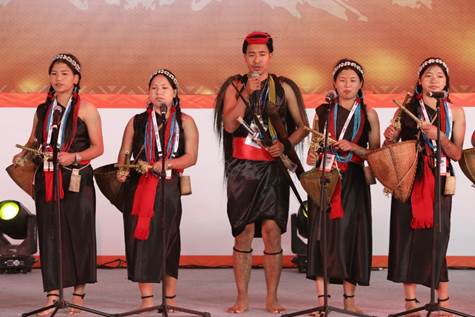
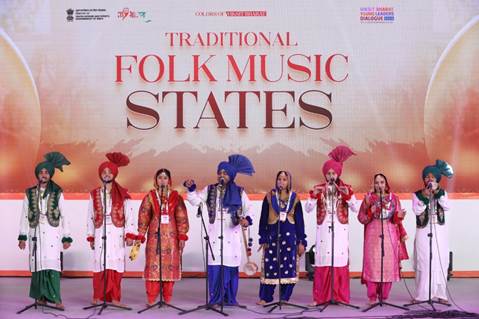
Two batches of participants also visited the Prime Ministers’ Museum and Library, gaining exposure to India’s rich democratic heritage and leadership journey, and deepening their understanding of the vision, contributions and legacy of the nation’s Prime Ministers.
The inaugural day of the Viksit Bharat Young Leaders’ Dialogue 2026 concluded on a strong and purposeful note, reflecting the Government’s steadfast commitment to empowering youth as partners in nation-building. The day marked a strong beginning to the Dialogue, reinforcing the Government’s commitment to nurturing leadership, innovation and civic responsibility among the youth and setting a clear direction for the days ahead. VBYLD 2026 will culminate on 12th January 2026, with Prime Minister Narendra Modi gracing the event to interact directly with young leaders from all corners of the country. Day - 2 will commence tomorrow with a Plenary Session, to be graced by Dr. Mansukh Mandaviya, Union Minister of Youth Affairs & Sports and Labour & Employment, and Shri Ajit Doval, National Security Advisor, along with senior officials of the Ministry of Youth Affairs and Sports.
*****
Pawan Singh Faujdar/Rini/Anjelina
(Release ID: 2213051)
Visitor Counter : 1560