Ministry of Housing & Urban Affairs
From Shell to Soil: India’s Urban Local Bodies Recycle Coconut Waste into Economic and Environmental Gains
Religious centres such as Puri in Odisha, Varanasi in Uttar Pradesh and Tirupati in Andhra Pradesh have established specialised Material Recovery Facilities to process temple-generated coconut waste
MoHUA Initiative in Bhubaneswar Transforms Temple Coconut Waste into Sustainable Livelihoods and Green Wealth
Green De-Fibering Unit in Kunnamkulam Converts Coconut Waste into Odor-Free Compost, Boosting Farmer Income and Local Green Jobs
PPP Units in Chennai Process Over 1.15 Lakh Metric Tonnes of Coconut Waste into Coir and Compost
Indore’s Integrated Coconut Waste Processing Unit Converts 20 TPD into Cocopeat and Coir, Powering Bio-CNG and Circular Economy
Patna’s Zero-Cost Coconut Waste Model Processes 10 TPD into Coir, Cocopeat and Organic Compost, Diverting Waste from Landfills
Posted On:
31 DEC 2025 12:25PM by PIB Delhi
Once a stubborn by-product of consumption, waste became an ever-growing challenge with rising populations and rapid urbanization. Answering the call of Prime Minister Narendra Modi through the Swachh Bharat Mission, India flipped the script—under the Ministry of Housing Urban Affair’s (MoHUA) leadership and SBM-U, waste is no longer a problem but a resource, transformed into products and revenue. Nowhere is this shift more evident than in coastal cities, where coconut waste—once a civic headache—has found a second life in the circular economy, turning nature’s leftovers into livelihoods and value.
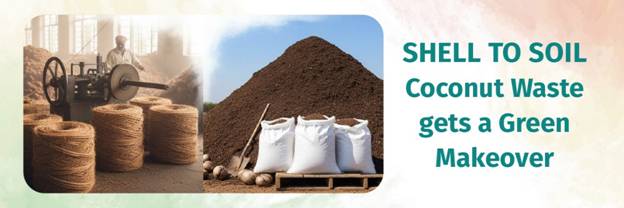
No Shell Left Behind: Under SBM-U 2.0, coconut waste is powering livelihoods—coastal cities convert it into sturdy ropes and rich organic manure.
As tourists flock to coastal cities seeking clean, safe, and beautiful destinations, coconut water remains the drink of choice by the sea—healthy, refreshing, and hugely popular. That popularity once meant mountains of coconut waste heading to landfills. Not anymore. Today, coconut waste is segregated, recycled, and reborn as value—turned into cocopeat for organic manure and soil alternatives, and coir fibres spun into strong ropes. What was once a seaside problem is now a smart solution.

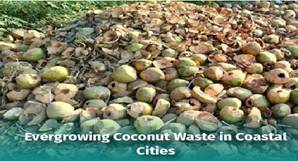
Coconut waste has transformed from mere “green waste” into a high-value resource. Official data shows coconut husk forms 3–5% of urban wet waste—small on paper, but massive when stacked against the 1.6 lakh tonnes of municipal waste generated daily, rising to 6–8% in coastal cities. With Karnataka, Tamil Nadu and Kerala leading production—and Karnataka now taking the top spot—India is proving that even a discarded shell can crack open big economic value.
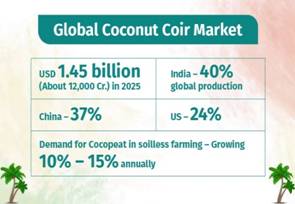
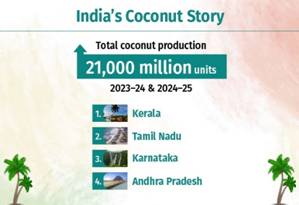
India’s coconut story is making serious noise on the global stage. As per Cocunut Development Board and Coir Board, the total production crossed 21,000 million units in 2023–24 and 2024–25, led by Kerala, Tamil Nadu, Karnataka and Andhra Pradesh contributing nearly 90%. Through this the waste-to-wealth value chain is earning both green points and foreign exchange. The global coconut coir market is pegged at USD1.45 billion (about ₹12,000 crore) in 2025, with India commanding over 40% of global production. Fuelled by booming demand for cocopeat in soilless farming—especially in Europe and the US—exports are growing at 10–15% annually, with China (37%) and the US (24%) emerging as the biggest buyers, followed by the Netherlands, South Korea and Spain.
In Karnataka, Bengaluru, Mysuru and Mangaluru, the coconut waste to wealth story is cracking open at scale.generating 150–300 metric tonnes of tender coconut waste every day. Tamil Nadu’s Chennai, Coimbatore and Madurai add significantly to the flow. From Kochi and Thiruvananthapuram in Kerala to Visakhapatnam in Andhra Pradesh, Surat in Gujarat, and Mumbai and Pune in Maharashtra, heavy coconut water consumption has led urban local bodies and private players to develop dedicated husk-management clusters. Setting the benchmark, Mysuru and Madurai have achieved 100% recycling of coconut waste, while religious centres such as Puri in Odisha, Varanasi in Uttar Pradesh and Tirupati in Andhra Pradesh have established specialised Material Recovery Facilities to process temple-generated coconut waste—ensuring that no shell is left behind.
Government schemes are giving coconut waste a serious financial push. Under SBM-U 2.0, entrepreneurs and urban local bodies are receiving robust support, with the Centre offering 25–50% Central Financial Assistance to set up waste-processing plants. The Coir Udyami Yojana sweetens the deal further, providing a 40% subsidy for micro and small enterprises on projects up to ₹10 lakh. Add to that the GOBARdhan scheme, which is rolling out 500 new waste-to-wealth plants to turn coconut residues into compost and bio-CNG—proving that when policy meets sustainability, even waste can turn profitable.
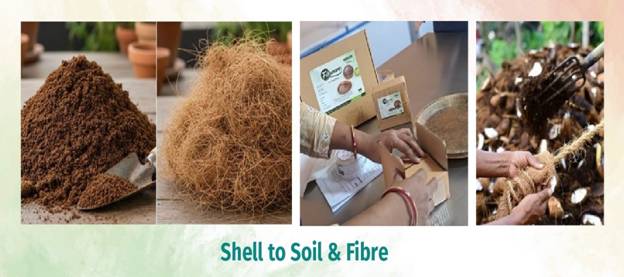
Under SBM-U 2.0, cities are turning coconut waste into opportunity with Material Recovery Facilities (MRFs) and dedicated processing units. Around 7.5 lakh people—80% women running SHG-led units—are part of India’s booming coir sector. With 15,000+ units nationwide (7,766 in Tamil Nadu alone), cities like Indore, Bengaluru, and Coimbatore are keeping 100% of coconut waste out of landfills. Nearly 90% of this waste now becomes ropes, mats, and compost instead of burning away for 10–20 years, emitting carbon and methane. Sustainable, profitable, and employment-packed—coconut waste is getting a serious glow-up.
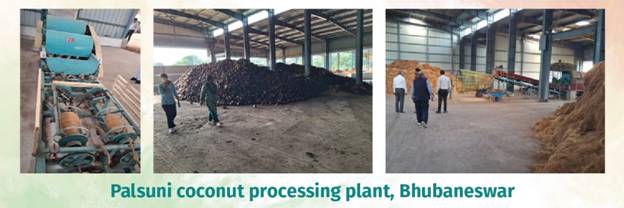
Bhubaneswar’s Palsuni coconut processing plant is turning sacred waste into wealth. It collects 5,000–6,000 coconuts daily from 189 vendors—once discarded temple remnants that clogged drains—and transforms them into 7,500+ kg of coir fiber and ropes, plus 48 metric tonnes of cocopeat-based compost and blocks for farming and gardening. With a 10,000-coconut daily capacity, the plant generates ₹7–9 lakh monthly, while SHG members and Safaimitras gain steady income and dignity through technical training and employment.
Kunnamkulam, Kerala’s Green De-Fibering Unit, with its microbe-enriched cocopeat aerobic composting system is turning coconut husks and wet waste into odor-free compost. Farmers, who once discarded husks, now earn ₹1.25 per husk and deliver them themselves. Run by a six-member team, the unit not only creates local jobs but also teaches advanced composting techniques. Coconut fibers are sold for profit, and leftover short fibers are being turned into innovative bio-pots.
In Greater Chennai, raw coconut husks are converted into compost and coir fiber. Since December 2021, nearly 1.5 lakh metric tonnes of waste have been received, with over 1.15 lakh metric tonnes already processed. Run under a 20-year PPP with WasteArt Communications, the units at Kodungaiyur and Perungudi are operating at full capacity, with a processing fee of about ₹764 per metric tonne. There are nearly 30 regular buyers—including tyre companies, nurseries and forest departments.
In Indore’s coconut waste processing model with a 550 TPD bio-CNG, not a shred of coconut waste goes wasted. Coconut waste is sent straight to a dedicated unit beside the bio-CNG plant, where 20 tonnes are processed daily through a smart dual-line system: the dry line produces cocopeat that boosts soil moisture retention by up to 500%, while the wet line extracts coir fibre for ropes, sculptures and crafts. Spanning 20,000 sq ft and run by 15 workers, the unit earns about ₹20,000 a day, with three major vendors already retailing its products.
Patna, Bihar is cracking the coconut—literally—with a sharp, zero-cost waste-to-wealth model. A modern PMC processing unit in Danapur is diverting coconut waste from landfills and turning it into value, currently handling 10 TPD. Husks become coir fiber and ropes for packaging, construction, and crafts, while wet waste transforms into high-demand cocopeat and organic compost for rooftops, nurseries, and farms.
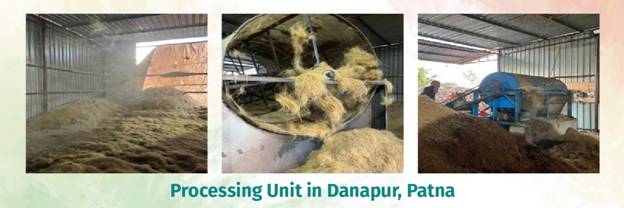
From temple towns to tech hubs, India’s coconut waste journey under Swachh Bharat Mission–Urban proves that sustainability thrives when policy, people, and innovation align.
***
SK
(Release ID: 2210020)
Visitor Counter : 5337