PIB Backgrounder
The Sustainable Harnessing and Advancement of Nuclear Energy for Transforming India (SHANTI) Bill, 2025
Posted On:
19 DEC 2025 5:00PM by PIB Delhi
|
Key Takeaways
-
The Bill consolidates and modernises India’s nuclear legal framework.
-
It enables limited private participation in the nuclear sector under regulatory oversight.
-
It strengthens statutory regulation by granting statutory recognition to the Atomic Energy Regulatory Board (AERB).
-
It supports India’s clean-energy transition and the long-term objective of achieving 100 GW nuclear energy capacity by 2047.
|
Introduction
What is Nuclear Energy?
Nuclear energy is the use of controlled atomic reactions to produce power. At its core, it relies on splitting atoms in a process called fission, which releases large amounts of heat. This heat is then used to generate electricity without producing greenhouse gases. Globally, nuclear energy is valued as a clean, dependable source that complements renewable options like solar and wind.
|
At a time when India is reimagining the future of its energy landscape, a new legislative step has emerged to guide the country toward a more advanced and resilient nuclear ecosystem. The Sustainable Harnessing and Advancement of Nuclear Energy for Transforming India (SHANTI) Bill, 2025, reflects the government’s effort to modernize the laws governing the nuclear sector. It brings together various elements of nuclear development under a single, comprehensive structure, aiming to create a more streamlined and future-ready system. The Bill focuses on a forward-looking approach and its role in shaping India’s long-term energy pathway. As a significant piece of legislation, it marks an important moment in the country’s broader journey toward building a secure and sustainable energy future.
Evolution of India’s Nuclear Laws
India’s nuclear power journey has been guided by a series of landmark legislations that ensured the peaceful use of atomic energy while safeguarding national interests. Each step reflected the country’s growing confidence and maturity in managing nuclear technology responsibly.
Ø The Atomic Energy Act, 1962, replaced the earlier 1948 law and laid down the foundation for India’s nuclear programme. It empowered the government to regulate atomic energy for peaceful purposes, ensuring strict control over research, development, and use of nuclear materials.
Ø Amendments in 1986, 1987, and 2015 in the Atomic Energy Act of 1962 gradually opened the sector beyond the Central Government, allowing government companies and joint ventures to participate in nuclear power generation. The amendments reflected India’s intent to expand capacity while keeping strategic oversight intact.
Ø The Civil Liability for Nuclear Damage Act, 2010, introduced a no-fault liability regime, ensuring compensation in case of nuclear incidents. This law provided clarity on responsibility and built public trust by prioritizing safety and accountability in nuclear operations.
Rationale Behind The Bill
At this stage of India’s energy transition, the country is revisiting the foundations of its nuclear framework to match present-day needs and future ambitions. Over the decades, India’s nuclear programme has matured, its technological capabilities have strengthened, and its clean‑energy goals have expanded. These developments have created the need for a modern, comprehensive legislation that reflects today’s realities and tomorrow’s requirements.
Present Outlook
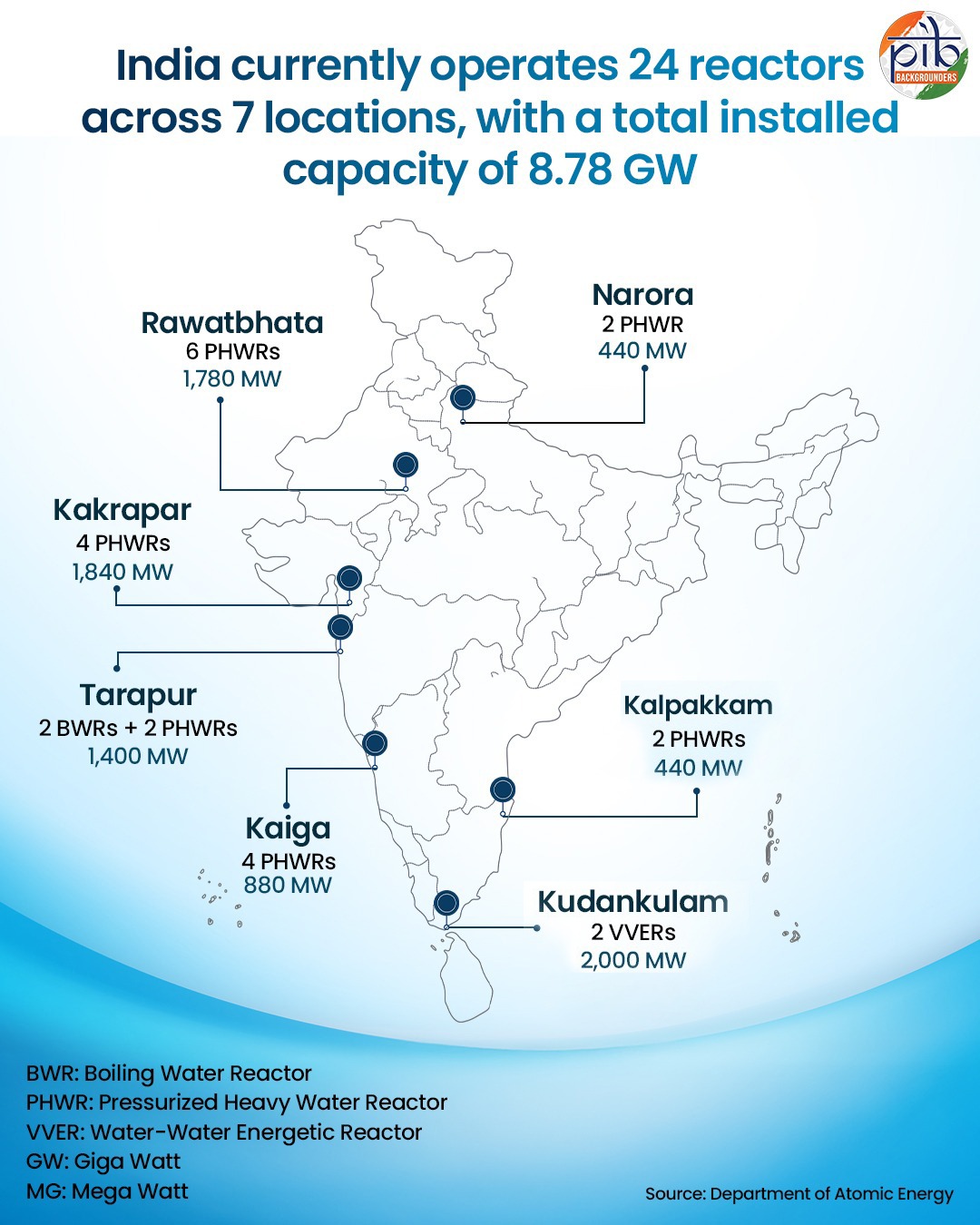
India’s nuclear energy programme has maintained a steady role in the country’s electricity mix and is now poised for significant expansion.
-
Stable Contribution: Nuclear power has consistently accounted for around 3% of total electricity generation, with a share of 3.1% in 2024–25.
-
Installed Capacity: The present nuclear capacity stands at 8.78 GW.
-
Planned Expansion: With the indigenous 700 MW and 1000 MW reactors being developed through international cooperation, the capacity is projected to rise to 22.38 GW by 2031–32.
Why India Needs to Scale Nuclear Power
India’s growing energy demands and clean energy commitments make a strong case for expanding nuclear capacity. Round-the-clock electricity is vital for emerging needs such as data centres and advanced industries, yet existing laws do not provide the flexibility or speed required for such growth. To meet the national target of 100 GW nuclear capacity by 2047 and advance long-term decarbonisation by 2070, a modern legal framework is essential, which enables wider participation, leverages indigenous resources, and integrates innovation with safety.
Taken together, these developments highlight the need for progressive legislation that can repeal the 1962 Act and the 2010 liability law. A unified legislation allows India to expand the role of nuclear energy in its overall energy mix, encourage innovation, support non-power applications, and continue to uphold the highest standards of safety, security, safeguards, and liability. In this way, the bill serves as a natural progression of India’s evolving nuclear journey and provides a foundation for the sector’s future growth.
Defining Elements of the Legislation
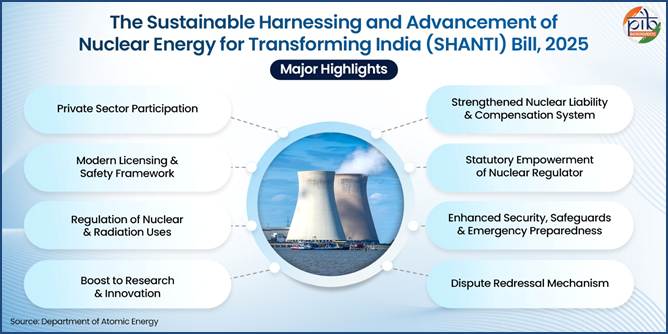
As India moves toward a more modern and future-ready nuclear energy structure, the Sustainable Harnessing and Advancement of Nuclear Energy for Transforming India (SHANTI) Bill, 2025, lays down a set of focused provisions to strengthen governance, safety, and institutional mechanisms. Its key objectives can be understood through the following major elements:
-
Private Sector Integration: The Bill permits private companies to participate in India’s nuclear sector, enabling them to undertake plant operations, power generation, equipment manufacturing, and selected activities such as the fabrication of nuclear fuel including conversion, refining and enrichment of uranium-235 up to such threshold value, or production, use, processing or disposal of other prescribed substances. In addition, all activities that involve radiation exposure must obtain prior safety authorisation from the regulatory authority.
-
Activities Under Exclusive Central Government Purview: Under the Bill, certain sensitive nuclear fuel‑cycle activities are reserved exclusively for the Central Government or its wholly owned institutions. These include enrichment or isotopic separation of prescribed or radioactive substances (unless otherwise notified), management of spent fuel such as reprocessing, recycling, radionuclide separation, and high-level waste handling, production and upgradation of heavy water, and any other facilities or activities specifically notified by the Government.
-
Graded Liability Structure: In contrast to existing laws that impose a single statutory cap on operator liability, the SHANTI Bill establishes a graded liability framework. Under this framework, the limits on operator liability are detailed in the Second Schedule of the bill and vary according to the type and characteristics of the nuclear installation.
-
Regulation of Non-Power Applications: Provides a regulatory framework for the use of nuclear and radiation technologies in health care, agriculture, industry, research, and other peaceful applications.
-
Enhanced Safety, Security, and Safeguards: Improves systems for security, safeguards, quality assurance, and coordinated emergency preparedness and response.
-
Appellate Tribunal Provision: The Appellate Tribunal for Electricity, set up under the Electricity Act, 2003, will serve as the appellate authority, empowered to hear appeals under provisions of the bill and any additional matters as notified by the Central Government.
Ø Nuclear Damage Claims Commission: Provides for a dedicated Commission to handle cases involving severe nuclear damage and ensure timely adjudication.
Safeguards and Strategic Oversight:
At the core of the bill lies a strong emphasis on maintaining India’s strategic control over its nuclear ecosystem. Even as the sector opens up to private participation, the Bill ensures that critical functions remain firmly under sovereign oversight.
Ø Control of Sensitive Domains: The Government retains exclusive authority over the nuclear fuel cycle, waste management, and all security-related operations.
Conclusion:
The Sustainable Harnessing and Advancement of Nuclear Energy for Transforming India (SHANTI) Bill, 2025, stands as a pivotal step in shaping the next phase of India’s nuclear journey. By modernising the legal framework and strengthening institutional oversight, it creates the foundation for a more efficient, innovative, and secure nuclear ecosystem. The Bill supports India’s long-term vision of expanding clean, reliable energy while ensuring that strategic interests remain fully protected. As the country moves toward greater energy independence and technological advancement, this legislation can play a defining role in driving the growth of India’s nuclear power and broader energy landscape.
References:
Parliament of India:
https://sansad.in/ls/legislation/bills
Department of Atomic Energy:
https://sansad.in/getFile/loksabhaquestions/annex/186/AU1638_Yolfxg.pdf?source=pqals
https://sansad.in/getFile/loksabhaquestions/annex/186/AU490_gwc1C9.pdf?source=pqals
The Sustainable Harnessing and Advancement of Nuclear Energy for Transforming India (SHANTI) Bill, 2025
*****
PIB Research
(Release ID: 2206598)
Visitor Counter : 10729