Ministry of Communications
Union Minister Shri Jyotiraditya M. Scindia chairs the Apex Council Meeting under the Bharat 6G Mission
Calls for Focused Roadmap to Achieve Global Leadership in 6G by 2030
Unveiling of Booklets on 100 5G Labs: Infrastructure to Innovation; 5G Innovation Hackathon 2025 and Felicitation of Best Performing Labs
B6GA Presents Breakthrough Progress Across Seven Working Groups in 6G Research and Innovation
Major Boost to R&D Through ANRF and the ₹1-Lakh-Crore RDI Fund for Future Technologies
Strengthened International Engagement and India’s Growing Role in Global Standards and 6G Ecosystem
Stakeholder Feedback, Collaborative Roadmaps and Accelerated Testbeds to Drive Next Phase of India’s 6G Mission
Posted On:
09 DEC 2025 6:16PM by PIB Delhi
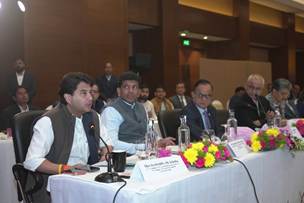
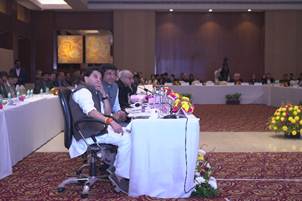
The Union Minister of Communications, Jyotiraditya M. Scindia, today chaired the meeting of the Apex Council under the Bharat 6G Mission and reviewed the progress of the Bharat 6G Alliance.
The meeting was attended by the Union Minister of State for Communications, Dr. Chandrasekhar Pemmasani, Secretary (Telecom) Dr. Neeraj Mittal, the Principal Scientific Adviser to the Government of India Prof. Ajay Sood, senior officials from key Ministries, representatives from academia, R&D institutions, Telecom Service Providers, industry leaders and members of the Bharat 6G Alliance. The high-level interaction underscored India’s accelerating progress towards emerging as a global 6G leader by 2030.
Government’s Vision and Commitment
Addressing the meeting, Union Minister Shri Scindia reaffirmed the Government’s unwavering commitment to accelerating 6G innovation to make India a leader in the emerging communication technologies. He stressed the importance of greater synergy among the seven working groups within the Bharat 6G Alliance and strongly urged them to meet regularly to foster collaboration, strengthen teamwork, and ensure alignment of their efforts.
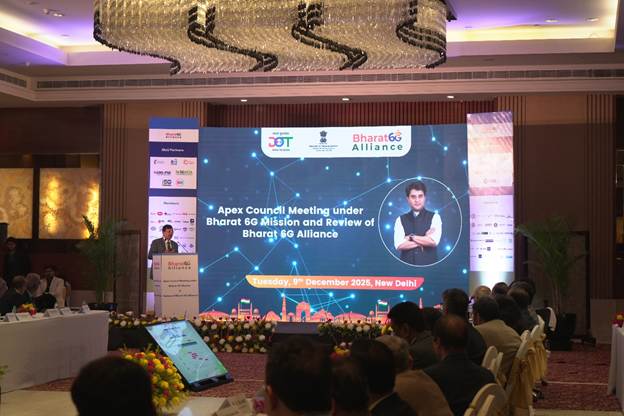
Addressing the Council, Union Minister Shri Scindia congratulated the Alliance for its rapid growth and emphasised that India must now move with confidence toward global leadership. He outlined four key priorities for the 6G Mission: to continue leapfrogging, to examine the entire value chain end-to-end, to break down complex technological challenges into solvable components, and to set measurable quarterly targets for each Working Group. He emphasized the importance of close coordination with the Bharat 6G Alliance, regular progress reviews, and independent evaluations to ensure that the benefits of 6G reach every citizen across the country, including rural communities, as envisioned by Prime Minister Shri Narendra Modi.
The Union Minister also noted that with strong collaboration among industry, entrepreneurs, and academia, India is confidently advancing towards becoming a global leader in 6G intellectual property and standards. India is determined to shape the future of telecom technologies, rather than simply follow global trends, he said.
Union Minister of State for Communications Dr Chandra Sekhar Pemmasani highlighted the B6GA’s release of eight technical reports and whitepapers covering spectrum, AI-native networks, green telecom, emerging applications, and RF sensing. “These achievements signify India’s historic transition from a technology implementer to a technology creator,” he noted.
The Principal Scientific Adviser to the Government of India, Prof. Ajay Kumar Sood, emphasised the need to drive emerging technology initiatives in a mission-mode framework with sharply defined deliverables, enabling India to attain global leadership in standard-setting, use-case development, and future-tech road-mapping. He underscored the critical importance of integrating cybersecurity considerations into the national approach to AI and 6G, noting that secure architectures must be foundational. Highlighting the rapid advancement of quantum communication—now a practical reality rather than a distant concept—Prof. Sood urged experts to examine the convergence of quantum technologies, next-generation communication systems, and cybersecurity, and to chart how their combined momentum can shape India’s technological future.
Secretary (T) Dr Neeraj Mittal recalled key deliberations from the previous review, including refined spectrum timelines, the Indian silicon roadmap, timelines for indigenous 6G BTS and 6G SoCs by 2027–28, sustainability KPIs and enhanced international outreach. He highlighted India’s contribution to the ITU IMT-2030 (6G) framework, securing inclusion of “Ubiquitous Connectivity” and strengthening global recognition of India’s capabilities. Dr Mittal emphasised the need to integrate research, standards, testing, and deployment, and to accelerate national 6G testbeds, IPR generation, device development, and silicon ecosystem growth.
The Government has approved ₹1-lakh-crore Research, Development and Innovation (RDI) Fund under the Department of Science & Technology which marks one of India’s largest public research support frameworks. Anchored within ANRF, the fund is set to significantly boost frontier research in AI-native networks, semiconductors, photonics, sensing, cybersecurity and satellite–terrestrial integration—critical areas for future 6G development.
Unveiling of 5G Lab Booklets and Awards to Top Performers

To showcase the rapid progress of India’s 5G innovation ecosystem, the Union Minister released three booklets, documenting the establishment, performance and impact of the 100 5G Use Case Labs. Together, these booklets highlight the evolution of the labs from infrastructure deployment to hands-on experimentation, prototype development and real-world applications, illustrating how the initiative has laid a strong, industry-aligned foundation for a vibrant research and innovation ecosystem. The compendium “The 5G Use Case Lab: From Infrastructure to Innovation” captures the creation and successful operation of labs across higher-education institutions; the “5G Lab Book – Edition 1: Experiments in 5G Core, 5G NR & Use Cases” provides technical, experiment-oriented guidance for researchers and students working on end-to-end 5G systems; and the “5G Hackathon Book” showcases the nationwide innovation challenge conducted through the labs, featuring prototypes across sectors such as disaster management, healthcare, agriculture, industrial automation and security.
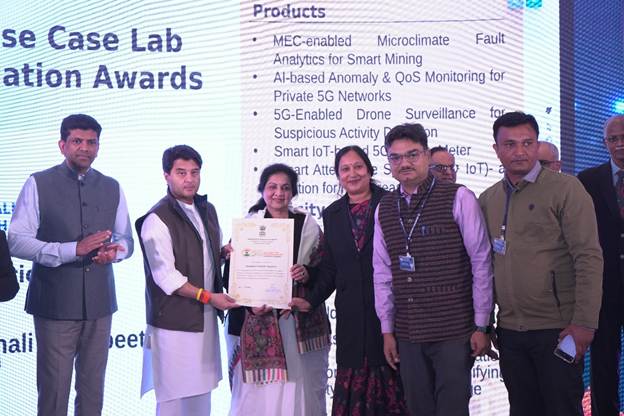
Following the release of the publications, Union Minister Shri Scindia conferred the Gradation Awards, recognising the best-performing 5G Use Case Labs under the “Excellent Category”. Four institutions were specially honoured for exemplary innovation, societal impact and industry collaboration: Punjab Engineering College, for pioneering prototypes in agriculture, healthcare and security and for its strong support to student research and startups; Banasthali Vidyapith, for leadership in private 5G, MEC, AI and automation with solutions showcased at IMC across mining safety, surveillance, energy management and education; IIT Roorkee (AMRIT), for establishing national benchmarks in deep-tech 5G/6G R&D, including India’s first deployed RIS, private 5G-RIS systems, AI-edge solutions, patents and commercialisation; and Thapar University, for solution-driven innovations in transport safety, accessibility and public infrastructure, including V2X crash prevention, Braille-digital learning, track defect analytics and drone detection.
Alliance Reports Strong Expansion and Technological Advancements
The Bharat 6G Alliance presented a detailed account of its ongoing efforts across seven Working Groups focusing on spectrum, devices and components, technologies, applications, sustainability, outreach and 6G use cases. The Alliance informed the Apex Council that it has grown from its initial 16 founding members to over 84 organisations—including startups, academia, industry leaders, R&D institutions and Telecom Service Providers—demonstrating the expanding national commitment to indigenous 6G innovation. The Alliance also shared updates on its recent international collaborations and joint initiatives with leading global 6G alliances, supported through multiple MoUs and cross-partner research engagements.
Feedback and Suggestions from Committee Members
Esteemed members of the Apex Council and Working Groups provided constructive feedback and suggestions to strengthen the next phase of India’s 6G mission. These inputs will support the refinement of standards, testbeds, ecosystem development, and actionable strategies for the forthcoming review cycle.
About Bharat 6G Alliance (B6GA)
The Bharat 6G Alliance is a multi-stakeholder collaborative platform bringing together academia, industry, startups and public institutions to build a world-class, future-ready 6G ecosystem in India. Focusing on R&D, innovation and standardisation, B6GA plays a pivotal role in advancing India’s vision of global leadership in next-generation communication technologies.
***
MI/ARJ
(Release ID: 2201016)
Visitor Counter : 1367