PIB Backgrounder
Sailing Towards Self-Reliance: The Indian Navy’s Aatmanirbhar Bharat Journey
Posted On:
03 DEC 2025 5:59PM by PIB Delhi
- The government has stepped up efforts to implement Indian Naval Indigenisation Plan (INIP) 2015–2030
- Nation Building Through Shipbuilding; 51 large ships are under construction in the country, valued at approximately Rs 90,000 crore
- The 100th and 101st indigenous warships, INS Udaygiri and INS Himgiri, were commissioned in August, advancing the Navy’s Aatmanirbhar Vision 2047
- Since 2014, Indian shipyards have delivered over 40 indigenous warships and submarines to the Navy, with a new vessel being inducted on average every 40 days in the last one year.
- Nearly 67 % of the Navy’s capital acquisition have been with Indian industries in last 10 years.
- The Navy’s budget grew from ₹49,623 crore in 2020–21 to ₹1,03,548 crore in 2025–26, raising its share of defence spending from 15% to 21%.
As the nation marks Navy Day on 04 December, commemorating the Indian Navy’s decisive role in Operation Trident during the 1971 Indo-Pak War, the Navy’s long-term transformation agenda has become increasingly visible. The Indian Navy’s Vision 2047 outlines a structured pathway toward becoming a fully indigenous, technologically advanced, and Aatmanirbhar force. This vision is anchored in three core drivers: sustained innovation, systematic indigenisation, and the integration of emerging technologies into naval operations.
Recent developments offer measurable indicators of this transition. The commissioning of the indigenously built INS Mahe on 24 November 2025 adds to a series of platforms that demonstrate the Navy’s expanding domestic capabilities. Over the past decade, the induction of new indigenous frigates, advanced combatants, and the commissioning of INS Udaygiri in August 2025, its 100th indigenously designed vessel signal a maturing industrial and technological base. Collectively, these milestones highlight India’s steady progress toward maritime self-reliance.
Indigenisation has become a strategic imperative for the Navy, given its impact on operational autonomy, supply-chain security, and long-term defence preparedness. Reducing dependence on external vendors enhances combat readiness and ensures resilience in crisis conditions. Simultaneously, domestic production stimulates national industry, strengthens the defence manufacturing ecosystem, and aligns with the broader objectives of the Government of India’s Aatmanirbhar Bharat initiative. Today, India possesses the capability to design and build a full spectrum of naval platforms, from aircraft carriers and frontline warships to specialised research vessels and energy-efficient commercial ships, reflecting the depth, diversity, and maturity of the country’s shipbuilding infrastructure.
Indigenisation and Maritime Capability: Strategic Imperatives for the Indian Navy
The development of an indigenised naval force, characterised by minimal dependence on external supply chains constitutes a central pillar of the Government of India’s Aatmanirbhar Bharat vision. This shift has become increasingly relevant as India positions itself as the Indian Ocean Region’s (IOR) primary “first responder”. In recent months, the Indian Navy has conducted multiple humanitarian assistance, disaster response, and maritime security operations, safeguarding lives and high-value cargo. These interventions have enhanced global confidence in India’s maritime capabilities and reinforced its role as a stabilising actor in the region.
India’s maritime geography underscores the strategic necessity of such capability. The nation’s coastline, extending approximately 11,098 kilometres, and its 2.4 million sq. km Exclusive Economic Zone (EEZ) encompass significant economic resources and critical infrastructure. Close to 50% of the Global Trade and 40% of Oil passes through Indo-Pacific region and 90% of our trade and 80% of our critical freight, Coal, Petroleum, Iron Ore, and Fertilizers transit through maritime routes. Ensuring the security of these sea lines of communication is therefore essential for sustaining national economic growth and strategic resilience.
India’s expanding maritime engagements further amplify this demand. The Navy’s presence has strengthened economic and security linkages with ASEAN, Australia, the Persian Gulf, and Africa. Since 2008, sustained anti-piracy deployments in the Gulf of Aden and along the East coast of Africa have facilitated the safe transit of 3765 merchant vessels and ensured protection for over 27260 seafarers, demonstrating India’s capacity for long-duration operations and global maritime stewardship.
Consequently, the Indian Navy’s functional domain now extends well beyond conventional naval warfare. Its responsibilities span EEZ surveillance, anti-piracy missions, protection of merchant shipping, maritime domain awareness, and coordinated operations with international partners to preserve the stability of the IOR.
In this evolving strategic environment, indigenisation has emerged as a foundational component of maritime capability. By strengthening domestic capacities in shipbuilding, weapons systems, sensors, and logistics infrastructure, the Navy enhances operational autonomy, sustains forward deployments, and mitigates vulnerabilities linked to external supply disruptions.
India’s push toward naval self-reliance, guided by the Indian Naval Indigenisation Plan (INIP), has gained renewed urgency. Global disruptions in supply chains, emerging technological paradigms, and intensifying maritime threats increasingly define the contours of modern naval warfare. Indigenisation therefore functions not only as an industrial or technological goal but as a critical strategic determinant of India’s ability to maintain a secure, credible, and resilient maritime posture in the decades ahead.
INIP 2015–2030: Objectives, Recommendations, Pursuance & Outcomes
The Indian Naval Indigenisation Plan (INIP) 2015–2030 was conceived to accelerate India’s naval self-reliance by systematically indigenising equipment across the Float, Move and Fight categories. Its core objective was to transition from partial import dependence to a structured, long-term, 15-year roadmap enabling domestic development of advanced shipborne systems, in alignment with the national Make in India vision. It sought to identify capability gaps, particularly in high-end weapons, sensors, propulsion systems, gearboxes and underwater technologies, and provide industry with a clear forecast of future requirements to stimulate indigenous R&D and production.
Key recommendations included partnering with DRDO, DPSUs and private industry; adopting Buy Indian/Buy & Make Indian procurement; strengthening collaboration with MSMEs; and building domestic capacity in propulsion, electronics, submarine technologies, aviation systems and critical components. The plan further recommended standardisation, open architecture controls, ToT absorption and formation of joint development ecosystems.
Pursuance involved structured engagement with industry, progressive replacement of imported systems, and targeted development projects under DRDO and the MAKE category. As a result, significant indigenisation was achieved in hull, auxiliary systems, combat management, EW suites, sonars, UAVs, aviation spares and submarine sub-systems, with industry participation expanding across major and MSME sectors.
Reflecting this push, the armed forces, including the Navy, have identified over 5,000 items that will be sourced domestically. Indigenous construction of frigates, warships and submarines is driving defence production under Aatmanirbhar Bharat and helping transform the Navy into a Builder’s Navy, with its Warship Design Bureau having designed over scores of vessels since inception.
Indigenisation lies at the heart of shift from a Buyer’s Navy to a Builder’s Navy
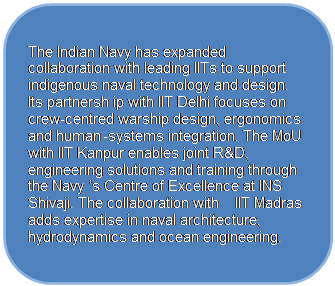
Over the past two decades, the Indian Navy has undergone a marked transformation from an import-dependent “Buyer’s Navy” to a predominantly indigenous “Builder’s Navy.” This evolution is reflected in the domestic design and construction of more than one hundred warships across major shipyards, supported by the Warship Design Bureau. Recent indigenisation platforms have articulated the goal of increasing private-sector participation to 50 percent or more, while strengthening partnerships with academia to accelerate research and technology development. Navy has been collaborating with IITs to strengthen research, innovation and capability development for future naval platforms. Indian Navy’s Swavlamban 3.0 Indigenization Plan, released in 2023, provides an industry- and academia-oriented roadmap that identifies platforms, systems and subsystems prioritised for indigenous development.
As per the indigenization plan, the machinery fitted onboard ships in the three categories of Float, Move and Fight has been indigenised to the extent of about 90%, 60% and 50% respectively, an indication of shortfall in the third category.
Though, substantial self-reliance has been realised in hull design, ship construction, propulsion auxiliaries, power and distribution systems, combat management systems, communication suites, sonars and electronic warfare equipment. The commissioning of INS Mahe, the first vessel in the indigenously designed Mahe-class ASW–Shallow Water Craft series, exemplifies the maturing collaborative ecosystem. Its development brought together Bharat Electronics Limited, L&T Defence, Mahindra Defence Systems and more than twenty MSMEs, along with design and testing support from research institutions and academic partners engaged through the naval innovation framework.
Modernisation of major shipyards, strengthened linkages with technical universities and specialised research centres, advances enabled complex programmes, culminated in the development of state of art weapon systems for Indian Navy. INS Vikrant, incorporates a wide range of Indian-made equipment supplied by major firms such as BEL, BHEL, GRSE, Keltron, Kirloskar, L&T and Wartsila India, supported by over 100 MSMEs. Warship-grade steel was developed jointly by the Navy, DRDO and SAIL, making India self-reliant in producing steel required for naval vessels. Collectively, these developments demonstrate the consolidation of a robust naval-industrial-academic ecosystem and
affirm the Navy’s emergence as a capable builder’s navy.
Major capability areas: State of indigenisation
Surface Fleet and Shipbuilding
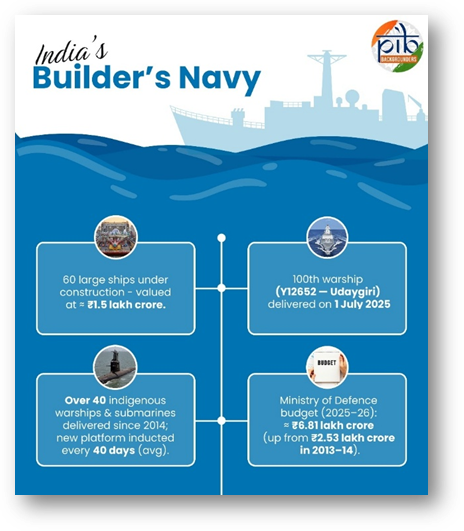
The Indian Navy’s surface fleet indigenisation has progressed rapidly: 51 large ships are under construction in the country, valued at approximately Rs 90000 crore, demonstrating the country’s growing shipbuilding capability.
India’s naval modernisation has accelerated little over the past one and half decades, marked by the induction of advanced indigenous platforms across aircraft carriers, destroyers and multi-mission frigates, underscoring the country’s growing self-reliance in maritime defence.
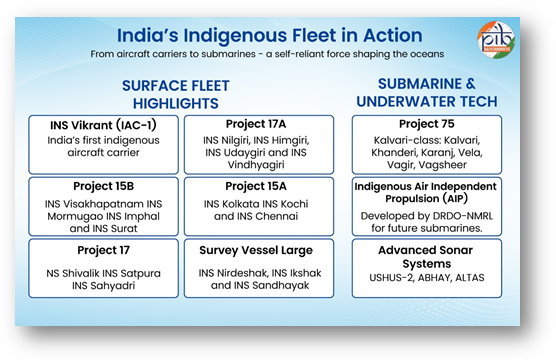
INS Vikrant (IAC-1)
INS Vikrant is India’s first indigenous aircraft carrier, built with 76% local content. Commissioned on 2 September 2022, it uses nearly 30,000 tonnes of steel supplied by SAIL, making it a major milestone in self-reliant shipbuilding.
Project 15B – Visakhapatnam-class Destroyers
Project 15B includes the Navy’s latest guided-missile destroyers: INS Visakhapatnam (November 2021), INS Mormugao (Dec 2022), INS Imphal (December 2023), and INS Surat (Jan 2025). These ships enhance India’s surface warfare and air-defence capabilities.
Project 17 – Shivalik-class Frigates
The Shivalik-class under Project 17 consists of INS Shivalik (April 2010), INS Satpura (August 2011), and INS Sahyadri (July 2012). These multi-role stealth frigates strengthen the Navy’s blue-water operations.
Project 17A – Nilgiri-class Stealth Frigates
Project 17A features advanced stealth frigates, INS Nilgiri (Jan 2025), INS Himgiri (Aug 2025), INS Udaygiri (Aug 2025), and Taragiri third ship of P17A at MDL has been delivered to Indian Navy on 28 Nov 2025. Three more ships, INS Dunagiri, INS Vindhyagiri, and INS Mahendragiri are currently under construction. The class incorporates modern sensors, weapons, and high indigenous content.
Project 15A – Kolkata-class Destroyers
The Kolkata-class destroyers: INS Kolkata (August 2014), INS Kochi (Sept 2015), and INS Chennai (November 2016) form a key part of India’s naval-defence and strike capabilities with advanced radars and missiles.
Survey Vessels (Large)
The Navy has inducted INS Sandhayak (Feb 2024), INS Nirdeshak (December 2024), and INS Ikshak (August 2025), while INS Sanshodhak remains under construction. INS Ikshak highlights India’s growing shipbuilding capability with over 80% indigenous components, reflecting the progress of Aatmanirbhar Bharat.
Anti-Submarine Warfare Shallow Water Crafts (ASW SWCs)
It includes, INS Arnala (June 2025), INS Androth (Oct 2025), and INS Mahe (Nov 24, 2025). INS Androth, built with over 80% indigenous content, serves as a strong symbol of India’s maritime self-reliance under Aatmanirbhar Bharat.
Submarine and Underwater Systems
India’s submarine capability has witnessed a major transformation under the Aatmanirbhar Bharat vision, with a sharp focus on indigenous construction and technology development. Ongoing indigenous submarine programmes and follow-on initiatives (including design and localised subsystem development) continue under MoD/DRDO partnership and domestic yard execution.
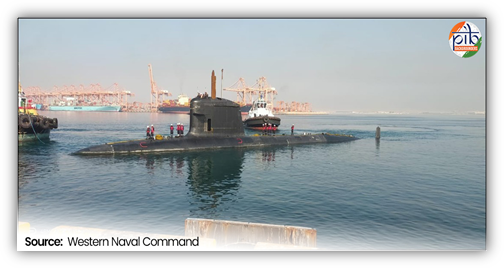
Project-75 (Kalvari-class Submarines)
Project-75 includes six Kalvari-class submarines: INS Kalvari (Dec 2017), INS Khanderi (Sept 2019), INS Karanj (March 2021), INS Vela (Nov 2021), INS Vagir (Jan 2023), and INS Vagsheer (Jan 2025). These diesel-electric submarines strengthen India’s underwater warfare capabilities.
Indigenous Air Independent Propulsion (AIP) System
Developed by DRDO-NMRL for integration on Project-75 submarines
Advanced Indigenous Sonar Systems
USHUS-2 (March 2017), HUMSA NG/UG (Hull-Mounted Sonar Array Next Generation / Upgrade) (Dec 2016), ABHAY (Compact Hull-Mounted Sonar for Small Ships & Shallow Water Crafts), NACS (Near-field Acoustic Characterization System (NACS) for Ship Sonars), AIDSS (Advanced Indigenous Distress Sonar System (AIDSS) for Submarines, and Advanced Light Towed Array Sonar (ALTAS) (Developed & tested).
Weapons, Sensors and Combat Systems
The DRDO, in partnership with the Navy and DPSUs/industry, has indigenised critical sensors, radars, EW suites and naval weapons, and continues to conduct user trials and production handovers. In July 2025, the DRDO handed over six strategic, indigenously designed and developed products, including surveillance systems and vehicles, to the Indian Navy. The Ministry’s Positive Indigenisation Lists and PIL-driven programmes have prioritised high-end LRUs, sensors and weapons for domestic sourcing, and the SRIJAN portal tracks items offered to industry for indigenisation.
Missile Systems: Vertical Launch Short Range Surface to Air Missile (VL-SRSAM) on March 2025, and BrahMos Supersonic Cruise Missile.
Torpedoes & Countermeasures: Maareech Advanced Torpedo Defence System (flagged off), Varunastra (heavyweight torpedo), Advanced Light Weight anti-submarine Torpedo (ALWT) (trials complete), Multi-Influence Ground Mines (MIGM) (developed and ready for induction).
Electronic Warfare & Combat Management: Advanced Electronic Warfare (EW) System ‘Shakti’, Electronic Support Measure ‘Varuna’, Electronic Warfare System ‘Sangraha’.

Aviation (Shipborne & Rotary-Wing)
The Indian Navy’s shipborne and rotary-wing aviation capabilities have increasingly incorporated indigenous platforms, systems, and support infrastructure, contributing to self-reliance in maritime air operations.
- HAL Advanced Light Helicopter (ALH/Dhruv): Serves multi-role functions including utility transport, search and rescue (SAR). More than 340 Dhruv helicopters has been produced by HAL. In overseas market, Dhruv is operated by Mauritius Police & Nepal Army.
- Indigenous Shipborne Helicopters & Sensors: The Navy operates ALH Mk III with advanced radar, and weapon integration, used for surveillance, and utility missions.
Key domestic shipyards
Mazagon Dock Shipbuilders Ltd., Garden Reach Shipbuilders & Engineers, and Cochin Shipyard Ltd. remain the principal partners for construction, outfitting and life-cycle support of frontline platforms. In order to fund the initiatives, acquisition of new warship, and indigenization efforts, the government has over the past five years, increased the naval budget to a historic high.
Navy Budget Doubles to ₹1.03 Lakh Crore, Share Rises from 15% to 21% in five years
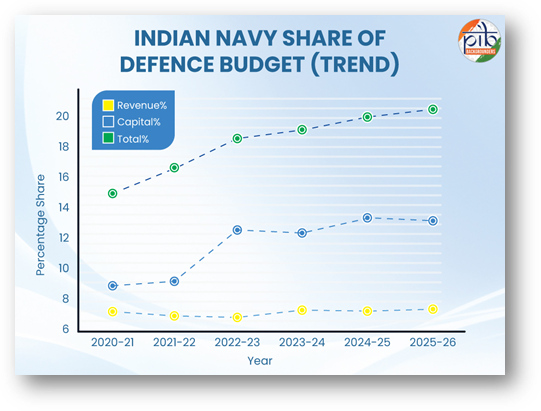
India’s defence budget has risen from ₹2.53 lakh crore in 2013–14 to ₹6.81 lakh crore in 2025–26, a 9.53% increase over last year. The Indian Navy’s budget has also grown consistently from 2020–21 to 2025–26, especially in capital spending, reflecting India’s focus on building a technologically advanced and strategically capable maritime force.
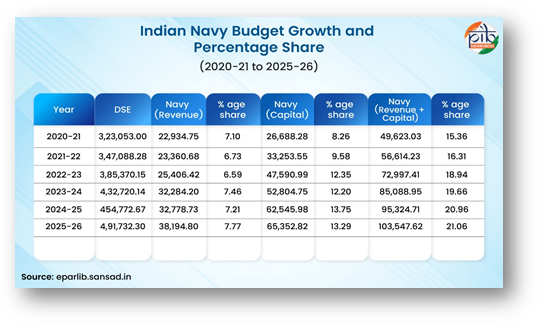
Although the Navy’s share of the total Defence Services Estimates (DSE) has remained relatively modest, both Revenue and Capital allocations have shown consistent upward movement in absolute terms, demonstrating sustained investment in naval readiness.
Revenue expenditure, which covers operations, maintenance, fuel, training, and logistics, has increased from ₹22,934.75 crore in 2020–21 to ₹38,194.80 crore in 2025–26, though its percentage share of total defence spending has hovered between 6.5% and 7.5%. In contrast, Capital expenditure, used for ships, submarines, aircraft, weapons, and infrastructure has grown more sharply, moving from ₹26,688.28 crore in 2020–21 to ₹62,545.98 crore in 2025–26, with the capital share rising from 8.26% to 13.75%. The combined Navy budget (Revenue + Capital) has increased substantially over this period, rising from 7–8% of the total defence budget in 2020–21 to about 21% in 2025–26, indicating a major push toward high-value modernisation programmes such as submarines, surface combatants, naval aviation, and undersea warfare technologies. This upward trend highlights the efforts of the government in boosting Navy’s expanding role in safeguarding India’s maritime interests, enhancing presence across critical sea lanes, and supporting the broader vision of an Atmanirbhar, technologically advanced indigenized maritime force.
Policy Framework and Initiatives
The Indian Navy continues to strengthen its capabilities through indigenous equipment, positioning itself as a key driver of Aatmanirbhar Bharat. Over the past decade, nearly 67% of its capital acquisition contracts have gone to Indian industries, reflecting reduced dependence on imports and growing confidence in domestic talent, MSMEs, and start-ups. The Navy is currently pursuing 194 innovation and indigenisation projects under various initiatives that enhances technological self-reliance and integrates private industry, and innovators into defence ecosystem.
The Indian Navy's indigenization drive is simultaneously guided by key government policies, including the Defence Acquisition Procedure (DAP) 2020 and the Defence Procurement Manual (DPM) 2025, which prioritize procurement from indigenous sources to achieve self-reliance in defence manufacturing. The Atmanirbhar Bharat initiative has been central focus as Indian Navy is committed to become fully Atmanirbhar by 2047.
Key initiatives include:
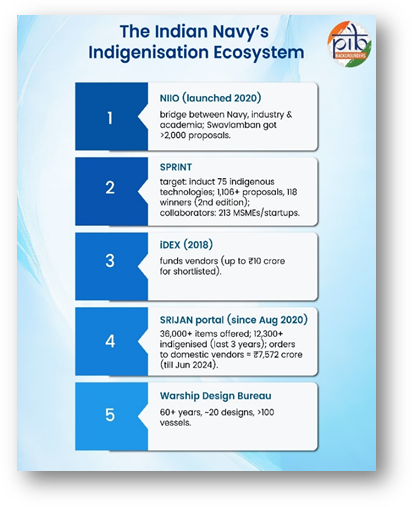
- The Naval Innovation and Indigenisation Organisation (NIIO), set up in August 2020, works with the Navy’s Directorate of Indigenisation to drive Made-in-India defence technology. It brings together the Naval Technology Acceleration Council and a Technology Development Acceleration Cell to speed up innovation. NIIO connects startups, MSMEs, industry, and universities to develop practical, affordable, and indigenous naval solutions, strengthening India’s defence self-reliance.
- SPRINT Challenges: Under the NIIO umbrella Unveiled by the Prime Minister in 2022, SPRINT aims to develop and induct at least 75 indigenous technologies into the Navy. It has spurred collaborations with 213 MSMEs and startups under the Innovations for Defence Excellence (iDEX) scheme to foster innovation.
- iDEX: The Innovations for Defence Excellence initiative was launched in April 2018 with the aim to achieve self-reliance and foster innovation and technology development. iDEX serves as the overarching defence innovation framework, providing funding and support to industries, including MSMEs, start-ups, individual innovators, R&D institutes, and academia. Under iDEX, the Defence India Start-up Challenge (DISC) is launched periodically with problem statements from the Armed Forces and DPSUs, often including the Indian Navy. Through these programs, iDEX offers funding of up to ₹10 crore to shortlisted innovators across various schemes, enabling the development of advanced solutions.
- SRIJAN Portal: The portal launched in 2020, is used by the Indian Navy (along with the Army and Air Force) to partner with the private sector for indigenization by displaying items that need to be developed or manufactured in India. The Indian Navy, as a user of the portal, can interact with the industry through this platform to find partners for its indigenization requirements. Launched by the Department of Defence Production (DDP) in August 2020 to drive indigenisation under Aatmanirbhar Bharat, the initiative now hosts over 38,000 items, of which more than 14,000, including for the Navy have been successfully indigenised as of February 2025.
- Positive Indigenisation Lists (PILs) Drive Indigenous Boost to Naval equipment: The Ministry of Defence has released successive PILs identifying systems, sub-systems, and components to be procured exclusively from Indian industry. Out of more than 5,500 items included in the PILs, over 3,000 have been indigenised by February 2025. Among the major successes are key naval technologies such as corvettes and advanced sonar systems, alongside artillery guns, assault rifles, transport aircraft, LCHs, radars, armoured platforms, rockets, bombs, and other critical defence equipment.
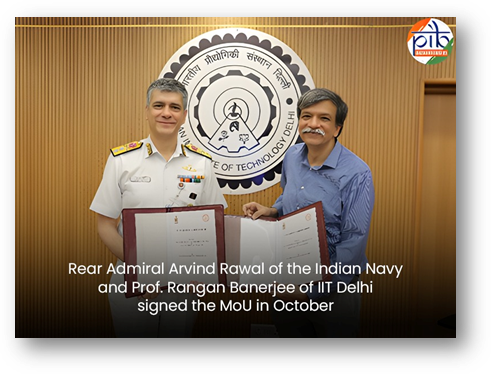
Weapons System Procurement via Buy Indian–Indigenously Designed, Developed, and Manufactured (IDDM) category: ‘Buy (Indian-IDDM)’ category refers to the acquisition of products from an Indian vendor that have been indigenously designed, developed and manufactured with a minimum of 50% Indigenous Content (IC) on cost basis of the base contract price i.e. total contract price less taxes and duties. Examples include the LCA Tejas, and MAAREECH Advanced Torpedo Decoy System, which was inducted by the Navy. Additionally, the Navy has signed MoUs with entities like BEML Ltd. for marine equipment and IIT Delhi for crew-centered warship design, reducing reliance on external standards.
Since 2014, Indian shipyards have delivered over 40 indigenous warships and submarines to the Navy, with a new platform being inducted on average every 40 days. On this Navy Day, the Indian Navy's indigenization journey underscores its transformation into a builder's navy, contributing to India's strategic autonomy and economic growth through job creation and MSME empowerment.
‘Jalmev Yasya, Balmev Tasya’
(One Who Controls the Sea is All Powerful)
References:
Press Information Bureau (PIB)
Ministry of Defence
Indian Navy
Society of Indian Defence Manufacturers
Hindustan Aeronautics Limited
Parliament / Standing Committee Reports
All India Radio
IIT
Click here to see PDF
RK
(Release ID: 2198298)
Visitor Counter : 6218