PIB Backgrounder
Rural Tourism in India
Promoting Sustainable Tourism and Strengthening Local Economies
प्रविष्टि तिथि:
29 NOV 2026 11:11AM by PIB Delhi
|
Rural tourism is emerging as an important avenue for strengthening village economies, generating livelihoods and promoting sustainable tourism in India. The Government's National Strategy and Roadmap for Development of Rural Tourism focuses on developing village tourism clusters, improving infrastructure, promoting local experiences and encouraging community participation. Initiatives such as Swadesh Darshan, the Best Tourism Villages Competition and the Rural Tourism Village Portal support destination development and promotion. Rural homestays are receiving targeted support through DA-JGUA, MUDRA loans and skill development programmes, creating opportunities for local entrepreneurship, particularly among women and youth. The Government also launched Travel for LiFE in 2023 to promote sustainable practices among tourists and tourism enterprises. These efforts aim to strengthen community-based tourism while preserving rural heritage, traditional livelihoods and natural resources.
|
Introduction: Rural Tourism in India
India's villages offer considerable potential for tourism, with their distinctive traditions, handicrafts, agricultural practices, natural attractions and cultural heritage. Beyond established tourist destinations, villages offer opportunities for experiential travel through farm visits, traditional craft workshops, local cuisine, cultural activities and community-run homestays.
Rural tourism presents an opportunity to diversify tourism activity while creating new sources of income within villages. It connects visitors with local communities and supports tourism-related activities such as hospitality, handicrafts, agriculture and guiding services. This approach also encourages the preservation of traditional occupations and cultural practices.
Recognising this potential, the Government formulated the National Strategy and Roadmap for Development of Rural Tourism in India in December 2021, as an initiative towards Aatmanirbhar Bharat. The strategy focuses on developing rural tourism clusters, improving digital access and destination promotion, strengthening local skills and entrepreneurship, and encouraging community participation. It also emphasises coordination between Central and State Government schemes to support rural tourism infrastructure and services.
The strategy provides a framework for developing villages as sustainable tourism destinations, with local communities participating in tourism activities and the economic opportunities they generate.
Impact and Outcomes: Strengthening Rural Economies
Rural tourism creates opportunities for economic activity beyond agriculture by linking village households, local producers and traditional occupations with the tourism market. Its significance lies in the participation of local communities in providing accommodation, food, guided experiences, handicrafts and other visitor services.
The benefits are particularly relevant to villages where existing cultural and agricultural resources can support tourism without replacing traditional livelihoods. Villages that build on these resources have won global recognition: Pochampally in Telangana was named a Best Tourism Village by the United Nations World Tourism Organization in 2021, and Dhordo in Gujarat in 2023.
Economic and Social Impact
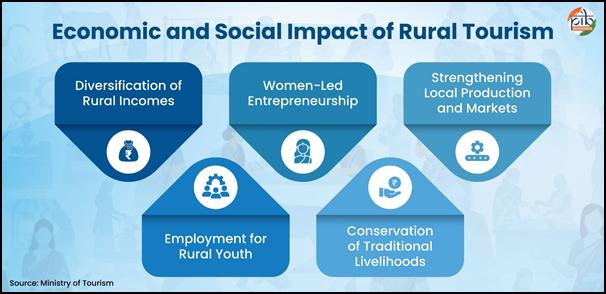
- Diversification of rural incomes: Homestays, farm tourism and village experiences provide additional earning opportunities for agricultural households, artisans and local entrepreneurs. Growth in homestays also raises demand for farm produce.
- Women-led entrepreneurship: Community-based tourism creates opportunities in food preparation, homestay management, handicrafts and local experience programmes. Women's self-help groups can also participate in tourism supply chains, supplying food, souvenirs and services.
- Strengthening local production and markets: Direct linkages between tourism establishments and village producers can create demand for locally grown vegetables, traditional foods, handloom products and handicrafts. This helps extend tourism expenditure into agriculture and village enterprises.
- Employment for rural youth: Local guiding, hospitality, transport, cultural activities and digital tourism services offer opportunities for self-employment and skills development within rural destinations.
- Conservation of traditional livelihoods: Tourism experiences built around weaving, pottery, local festivals and agricultural practices can create additional markets for traditional occupations while encouraging their continuation.
These are the principal channels through which rural tourism can contribute to local development. Homestays show the effect most clearly. The Tourism Satellite Account of India gives the homestay sector the highest employment and output multipliers among tourism sub-sectors, 4.38 and 2.04, and each unit rise in homestay output adds 0.42 units to agricultural output.
Role of Homestays in Strengthening Rural Economies
Homestays enable rural households to participate directly in tourism by offering accommodation, local cuisine and cultural experiences. Their economic contribution extends beyond room rentals to agriculture, handicrafts, food production and other village-based services.
|
4.38
Employment multiplier
|
2.04
Output multiplier
|
0.42
Agricultural output linkage
|
|
Government Framework and Initiatives for Rural Tourism
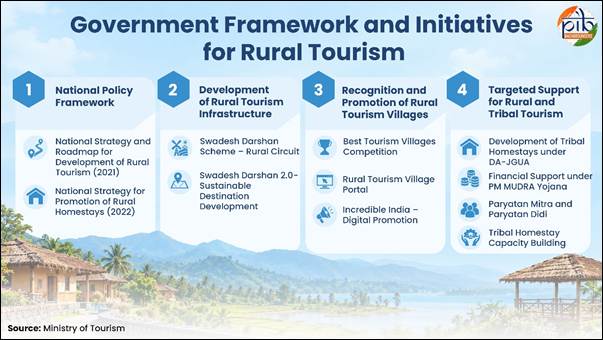
The Government's approach to rural tourism combines national policy frameworks with destination infrastructure, financial assistance, community participation and promotional initiatives. State Governments and Union Territory Administrations are primarily responsible for developing rural tourism destinations. The Government supports these efforts through national strategies, centrally sponsored interventions, capacity building and marketing support.
National Policy Framework for Rural Tourism
Two complementary national strategies provide the policy framework for developing rural destinations and expanding community participation in tourism.
National Strategy and Roadmap for Development of Rural Tourism in India (2021)
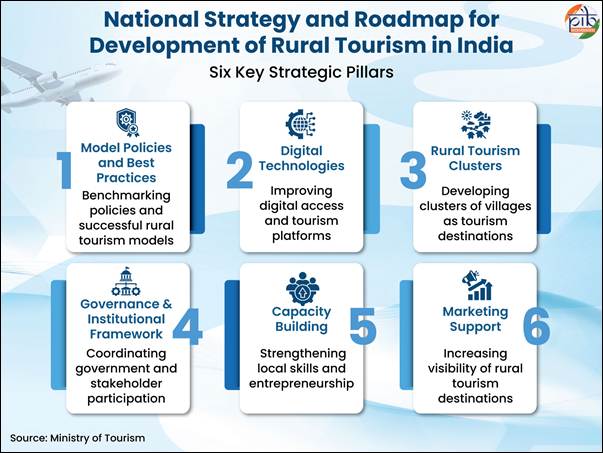
Introduced as an initiative towards Aatmanirbhar Bharat, the strategy aims to develop rural tourism through six pillars:
- Model policies and best practices: Benchmarking State policies, documenting successful models and encouraging public-private-community partnerships.
- Digital technologies: Improving access to digital platforms for destination promotion and tourism services.
- Rural tourism clusters: Identifying groups of villages with tourism potential and developing them through coordinated infrastructure, visitor facilities and local experiences.
- Marketing support: Promoting rural destinations through digital campaigns, industry partnerships and domestic and overseas outreach.
- Capacity building: Training local communities in hospitality, guiding, entrepreneurship and tourism-related services.
- Governance: Establishing institutional coordination among Central Ministries, States, Panchayati Raj Institutions and tourism stakeholders.
The roadmap proposes identifying clusters of five to seven villages based on their tourism potential. Development plans are to address last-mile connectivity, sanitation, waste management, digital infrastructure, local entrepreneurship and the marketing of village experiences.
National Strategy for Promotion of Rural Homestays (2022)
The complementary strategy identifies rural homestays as an experiential tourism product and provides a framework for strengthening their financial, technical and marketing support.
Its principal provisions include:
- Encouraging States to provide financial incentives and operational support for rural homestays.
- Developing homestay clusters with the participation of local communities, Panchayats and industry partners.
- Facilitating access to digital registration, booking and marketing platforms.
- Supporting women's self-help groups, local entrepreneurship and hospitality training.
- Encouraging the development of model rural homestay clusters through government-industry partnerships.
The strategy also recommends specific State-level incentives, including subsidies for setting up homestays and performance-linked assistance. Under the strategy, State Governments have provided these incentives through their own homestay policies. For instance, Meghalaya allows homestay operators to combine subsidies available under national and State-level schemes, while Gujarat enables operators to avail benefits under its solar mission and other State policies. Uttarakhand follows a structured, phase-wise incentive programme tailored to hilly and plain regions, while Maharashtra has introduced a zone-based classification system for tourism projects, linking incentives to the location of the property. Other States have adopted regulatory and operational measures, such as Goa's simplified online registration system, Chhattisgarh's flexible classification of homestays, and Delhi's provision of residential utility and tax rates for registered B&B establishments. Madhya Pradesh's Gram Stay Establishment (Registration and Regulation) Scheme, 2019, revised in 2026, covers homestays in Gram Panchayat areas set up by registered cooperative societies or self-help groups, with one-time support for marketing and incentives on reaching minimum occupancy. Under Sikkim's Mega Homestay Scheme, more than 1,000 homestays, including sites designed in traditional Bhutia, Lepcha and Nepali architectural styles, are being developed across the State, to be handed over to beneficiaries on completion, to promote village-based tourism and sustainable livelihoods. The State's Commerce and Industries Department has also circulated the Homestay Guidelines under the Uttar Poorva Transformative Industrialization Scheme (UNNATI) 2024, which offer homestays capital investment incentives and interest subvention, and aim to enhance livelihood opportunities for rural residents.
Development of Rural Tourism Infrastructure
Swadesh Darshan Scheme: Rural Circuit
The Ministry of Tourism identified the Rural Circuit as one of the 15 thematic circuits under the Swadesh Darshan Scheme, launched in 2014-15, to support tourism infrastructure development in rural destinations.
As on 9 March 2026, two projects had been sanctioned under this component:
|
State
|
Rural Tourism Project
|
Sanctioned
|
Released
|
|
Bihar
|
Bhitiharwa-Chandrahia-Turkaulia
|
₹44.27 crore
|
₹40.31 crore
|
|
Kerala
|
Malanad Malabar Cruise Tourism Project
|
₹57.35 crore
|
₹45.88 crore
|
|
Total
|
₹101.62 crore
|
₹86.19 crore
|
Of the ₹101.62 crore sanctioned for the two projects, ₹86.19 crore had been released.
The revamped Swadesh Darshan 2.0 focuses on developing sustainable and responsible tourism destinations, including rural and tribal areas. Under the scheme, the Rural Tourism Cluster Experience at Gunji, Pithoragarh, Uttarakhand, was sanctioned on 5 March 2024 at a cost of ₹17.86 crore.
Recognition and Promotion of Rural Tourism Villages
Best Tourism Villages Competition
Launched by the Government in 2023, the Best Tourism Villages Competition aims to identify and recognise villages that preserve their cultural and natural heritage, promote community-based tourism and adopt sustainable practices. The initiative encourages villages to develop their tourism potential while protecting local traditions, resources and livelihoods.
The competition honours villages with renowned cultural and natural assets that preserve and promote community-based values, goods and lifestyles, and show a clear commitment to economic, social and environmental sustainability.
Key Highlights: 2024 Competition 991 applications received from 30 States and Union Territories, up from 795 in the first edition in 2023.
- 36 villages recognised across eight categories.
- Eight categories: Heritage, Agri Tourism, Craft, Responsible Tourism, Vibrant Villages, Adventure Tourism, Community-Based Tourism, and Spiritual and Wellness.
- Heritage: Hafeshwar (Gujarat), Andro (Manipur), Mawphlang (Meghalaya), Keeladi (Tamil Nadu) and Pura Mahadev (Uttar Pradesh).
- Agri Tourism: Kumarakom (Kerala), Karde (Maharashtra), Hansali (Punjab), Supi (Uttarakhand) and Baranagar (West Bengal).
- Craft: Sualkuchi (Assam), Pranpur (Madhya Pradesh), Umden (Meghalaya), Maniabandha (Odisha) and Nirmal (Telangana).
- Responsible Tourism: Dudhani (Dadra and Nagar Haveli and Daman and Diu), Kadalundi (Kerala), Tar Village (Ladakh), Sabarvani and Ladpura Khas (both Madhya Pradesh).
- Vibrant Villages: Harsil and Gunji (both Uttarakhand).
- Adventure Tourism: Dhudmaras (Chhattisgarh), Aru (Jammu and Kashmir), Kuthlur (Karnataka) and Jakhol (Uttarakhand).
- Community-Based Tourism: Chitrakote (Chhattisgarh), Minicoy Island (Lakshadweep), Sialsuk (Mizoram), Deomali (Rajasthan) and Alpana Gram (Tripura).
- Spiritual and Wellness: Ahobilam (Andhra Pradesh), Bandora (Goa), Rikhiapeeth (Jharkhand), Melkalingam Patti (Tamil Nadu) and Somasila (Telangana).
The competition helps bring lesser-known rural destinations into focus and encourages villages to strengthen tourism experiences based on their distinctive cultural, natural and community assets.
Digital Promotion of Rural Destinations
The Ministry launched the Rural Tourism Village Portal on 16 February 2023. It provides information on rural destinations, homestays and government and industry initiatives. Rural tourism destinations are also promoted through Incredible India's website and digital channels.
The Ministry has also worked with the Indian Institute of Tourism and Travel Management (IITTM) as a central nodal agency for rural tourism initiatives, including the Best Tourism Villages Competition.
Targeted Support for Rural and Tribal Tourism
Alongside destination development and promotion, the Government has introduced measures supporting rural households and communities participating directly in tourism.
Development of Homestays in Tribal Areas under DA-JGUA
Launched in 2025-26 as a sub-scheme of Swadesh Darshan, under the Dharti Aaba Janjatiya Gram Utkarsh Abhiyan (DA-JGUA), the initiative targets the development of 1,000 tribal homestays. It provides for assistance of up to ₹5 lakh for village community requirements, ₹5 lakh for constructing two new rooms per household and ₹3 lakh for renovating existing rooms. Projects costing ₹24.53 crore had been approved across eight States/UTs as on 29 September 2026.
Financial support for homestays under PM MUDRA Yojana
The Union Budget 2025-26 introduced a separate category for homestays under the Pradhan Mantri MUDRA Yojana (PMMY), including those in rural areas. The provision aims to improve access to institutional credit for small-scale homestay operators, encourage rural entrepreneurship and create additional livelihood opportunities through tourism.
To facilitate access to credit, the Ministry of Tourism, in collaboration with the Department of Financial Services, organised a workshop on MUDRA loans for homestays in September 2025. The Guide to MUDRA Loans for Homestays, launched on 27 September 2025, provides step-by-step guidance on eligibility, documentation and loan applications through the Jan Samarth Portal.
Paryatan Mitra and Paryatan Didi
Launched on 27 September 2024, the initiative emphasises training women and youth for tourism-related occupations, including homestay operations, local cuisine experiences, cultural guiding and nature guiding. Around 4,382 candidates had been trained under the initiative by March 2026.
Tribal homestay capacity building
In March 2026, the Ministry of Tribal Affairs, in collaboration with India Tourism Development Corporation (ITDC), organised a training workshop for tribal homestay owners and their teams from Gujarat, Arunachal Pradesh and Sikkim, focusing on strengthening community-led tourism enterprises.
These interventions link rural destination development with local accommodation, entrepreneurship and skills.
Sustainable Rural Tourism and the Way Forward
India's rural tourism development is being guided by a framework that brings together destination planning, community participation and sustainable tourism practices. The National Strategy and Roadmap for Development of Rural Tourism provides for the development of village tourism clusters through coordinated infrastructure, skill development and marketing support.
A key component is the integration of tourism with existing village resources and institutions. The strategy envisages the development of clusters of five to seven villages, supported by destination management plans covering connectivity, sanitation, waste management, digital infrastructure and locally managed tourism experiences. It also encourages the participation of Panchayati Raj Institutions, local entrepreneurs and village communities in tourism planning and development.
Going forward, the focus is on strengthening rural tourism as an organised, community-based economic activity. The development of tourism clusters, greater visibility for village destinations through digital platforms and stronger participation of local enterprises can support the growth of rural tourism across regions. Together, these measures provide a framework for expanding tourism opportunities while retaining the cultural and environmental character of rural India.
References
Ministry of Tourism
https://www.pib.gov.in/PressReleasePage.aspx?PRID=2237047®=48&lang=2
https://www.pib.gov.in/PressReleasePage.aspx?PRID=2172092®=48&lang=2
https://www.pib.gov.in/Pressreleaseshare.aspx?PRID=1777305®=48&lang=2
https://sansad.in/getFile/lsapps/loksabhaquestions/annex/188/AU2520_WwWdgo.pdf?source=lsapps
https://sansad.in/getFile/loksabhaquestions/annex/187/AU2729_S4AMdg.pdf?source=pqals
https://sansad.in/getFile/loksabhaquestions/annex/187/AU321_uhIKfN.pdf?source=pqals
https://sansad.in/getFile/annex/271/AU3025_DQPk9d.pdf?source=pqars
https://www.pib.gov.in/PressReleasePage.aspx?PRID=2059419®=48&lang=2
https://www.pib.gov.in/PressReleasePage.aspx?PRID=2036824®=48&lang=2
https://www.incredibleindia.gov.in/en/rural-tourism
https://master-tourism.digifootprint.gov.in/static/uploads/2025/06/7cf843f13625000392d95befbb3e0507.pdf
https://www.pib.gov.in/PressReleasePage.aspx?PRID=1989107®=48&lang=2
https://www.pib.gov.in/PressReleasePage.aspx?PRID=2223766®=48&lang=2
https://www.pib.gov.in/PressReleasePage.aspx?PRID=2238965®=48&lang=2
https://www.pib.gov.in/PressReleasePage.aspx?PRID=2059419&lang=2®=48
https://www.tourism.gov.in/whats-new/national-strategy-and-roadmap-development-rural-tourism-india-initiative-toward
https://www.pib.gov.in/PressReleasePage.aspx?PRID=2150720®=48&lang=2
https://www.pib.gov.in/PressReleasePage.aspx?PRID=2223768®=48&lang=2
https://www.pib.gov.in/PressReleasePage.aspx?PRID=1961216®=48&lang=2
https://www.pib.gov.in/PressReleasePage.aspx?PRID=2204113®=48&lang=2
Ministry of Tribal Affairs
https://www.pib.gov.in/PressReleasePage.aspx?PRID=2242751®=48&lang=2
Ministry of Commerce and Industry
https://industries.sikkim.gov.in/circulardoc/circulardoc-B9k2X7QQ9RupRY1josL6WSXO8pWs6y0Bbkc84JFp.pdf
NITI Aayog
https://www.niti.gov.in/sites/default/files/2025-08/Rethinking-Homestays-Navigating-Policy-Pathways.pdf
Madhya Pradesh Tourism Board
https://tourism.mp.gov.in/contents?page=homestay&number=jtgYPf+tmICK2N8tHLothw==
Tourism and Civil Aviation Department, Government of Sikkim
https://www.sikkim.gov.in/media/press-release/press-info?name=Press+Release+from++Tourism+and+Civil+Aviation+Department++Government+of+Sikkim&id=164987
Department of Information and Public Relations, Government of Sikkim
https://www.sikkim.gov.in/uploads/SikkimHerald/aug_15_0_20260817.pdf#page=3
Click here to see pdf
PIB Research
(रिलीज़ आईडी: 2343378)
आगंतुक पटल : 269