Ministry of Environment, Forest and Climate Change
India to pursue Solution-oriented and Equitable Climate Action at UNFCCC COP31 in Antalya: Union Environment Minister
Predictable Climate Finance, Party-Driven Mitigation and Adaptation Outcomes, Technology Transfer and Just Transition to be India's Focus: Shri Bhupender Yadav
प्रविष्टि तिथि:
03 NOV 2026 2:54PM by PIB Delhi
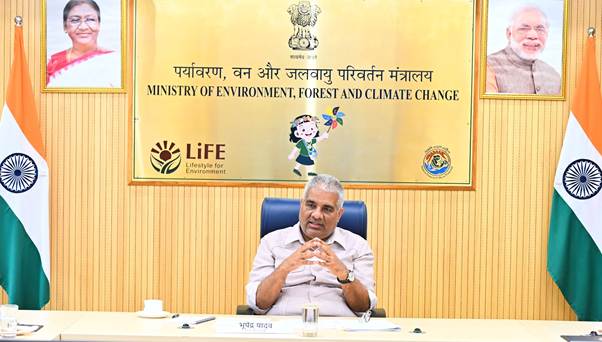
Union Minister for Environment, Forest and Climate Change, Shri Bhupender Yadav, outlined India’s priorities for COP31 of the UNFCCC, to be held in Antalya, Türkiye, from 9th to 20th November 2026, and highlighted the key outcomes of India’s participation in CBD COP17 and UNCCD COP17. Briefing the media in New Delhi today the Minister said India will approach COP31 with a solution-oriented vision, bringing practical solutions for the Global South, with capacity building, knowledge sharing and geography-specific solutions at the core. India will work closely with G-77 and China, LMDC and BASIC, he informed.
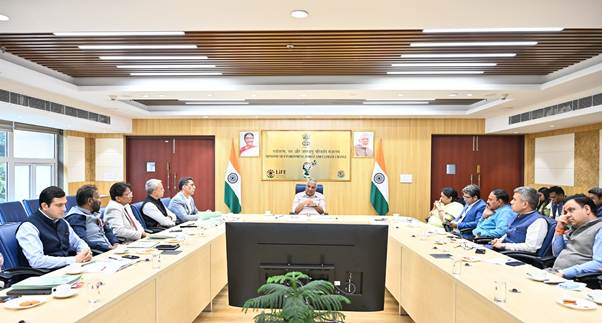
The Minister reaffirmed that India stands committed to make positive contributions to global efforts to achieve objectives of climate convention and goals of Paris Agreement. He said Climate finance will be a key priority, with India seeking a COP31 decision to commence the Climate Finance Work Programme. Shri Yadav emphasised that finance is an obligation of developed countries under Article 9.1 and must be predictable, largely public and concessional, and should not add to the debt burden. India will also press for mitigation and the Global Stocktake to remain Party-driven, facilitative and non-punitive, respecting the nationally determined nature of NDCs and ruling out new top-down targets.
Further, the Minister informed that Adaptation will remain a priority for India, with Global Goal on Adaptation indicators being voluntary and not conditioning access to finance, alongside scaled-up adaptation finance. India will support continuation of the Just Transition Work Programme through a Party-driven mechanism, viewing just transition through the lens of climate justice, the right to development and affordable energy access. On technology, India will emphasise that technology transfer is an obligation of developed countries and that barriers related to cost, IPR and trade must be addressed. Participation in carbon markets should remain voluntary. India will also underline that voluntary initiatives under the Presidency Action Agenda should remain separate from negotiations and that uniform global targets must respect national circumstances.
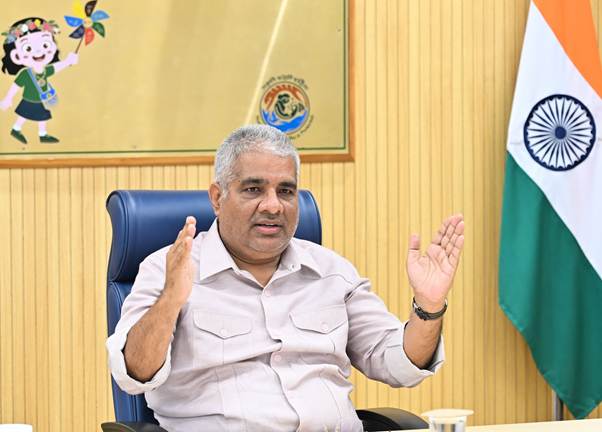
India will also highlight the linkage between the need for adaptation in agriculture, food security and the livelihoods of small and marginal farmers. Its engagements at COP31 will include LeadIT 3.0 with Sweden, in addition to high-level side events on coastal resilience, panels on IBCA and forests. Shri Yadav said India will play a constructive, bridge-building role in Antalya, seeking an outcome that moves from commitments to implementation and support.
Shri Yadav informed that during CBD COP17 in Yerevan (Armenia), India's reaffirmed its commitment to the effective and equitable implementation of the Kunming–Montreal Global Biodiversity Framework (KMGBF), underscoring the importance of national priorities, circumstances and legislative frameworks, community participation, fair and equitable benefit-sharing, and adequate and predictable financial resources, capacity-building and technology transfer. During the negotiations, he stated, India strongly advocated the fulfilment of developed countries' obligations under Article 20(2) of the Convention, opposed any mandatory expansion of the contributor base or shifting of existing financial responsibilities onto developing countries, and called for accessible, adequate and equitable biodiversity finance. On Digital Sequence Information (DSI), Shri Yadav highlighted that India emphasised the need for fair and equitable benefit-sharing through the multilateral mechanism, including the Cali Fund, while underscoring the importance of respecting national access and benefit-sharing (ABS) frameworks and sovereign rights. India also advocated a party-driven, facilitative, non-intrusive and non-punitive approach to the global review of KMGBF implementation, guided by national circumstances and priorities, and emphasised the need for a whole-of-government and whole-of-society approach to biodiversity conservation and implementation, he added.
Talking about UNCCD COP17 in Ulaanbaatar (Mongolia), the Minister stated that India highlighted land restoration as central to food and water security, biodiversity, livelihoods and rural economies. He informed that India, after being elected Chair of the Asia-Pacific Regional Group, reiterated its commitment to restore over 26 million hectares by 2030 and called for diversified, adequate, predictable and sustained international finance for restoration and drought resilience. Shri Yadav highlighted that India advocated a shift from drought response to drought resilience, supported science-based and community-led restoration of rangelands, and highlighted pastoralists as custodians and partners. India also launched its first Guide to Grasslands and Other Open Natural Ecosystems of India, underscoring its science-based, landscape-specific approach to restoration, the Minister stated.
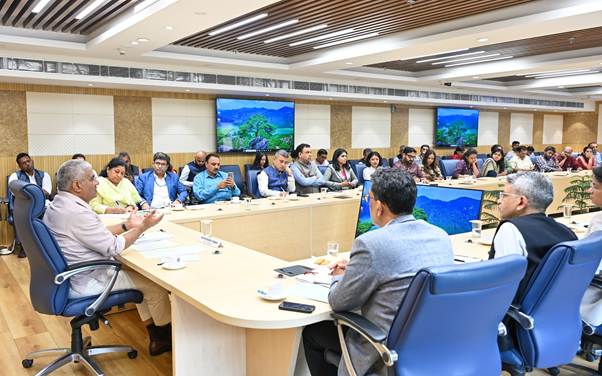
Shri Yadav said India’s engagement across the three processes reflects its commitment to equity, national circumstances, science-based solutions and adequate means of implementation, particularly for developing countries. At COP31, India will work towards balanced and practical outcomes that strengthen implementation, support and international cooperation. Other dignitaries present on the occasion included Secretary (MoEFCC), Shri Narendra Bhooshan; Additional Secretaries, Dr. Amandeep Garg and Shri Ashutosh Agnihotri; Joint Secretaries, Shri Rajat Agarwal and Shri Uday Chaudhari; IG (Forest), Dr. Clement Ben, besides other senior officers of the Ministry.
*****
VM
(रिलीज़ आईडी: 2332018)
आगंतुक पटल : 242