Ministry of Science & Technology
India–UK Bilateral Talks Explore Expanded Cooperation in Space, Civil Nuclear Energy and Emerging Technologies: Dr. Jitendra Singh
Discussions Cover Small Modular Reactors, Clean Energy Technologies and Opportunities for Startups, says Dr. Jitendra Singh
Dr. Jitendra Singh Highlights India’s Expanding Science and Technology Ecosystem and Opportunities for Deeper Bilateral Engagement
Both Sides Explore Collaboration in AI, Quantum Technologies, Cyber-Physical Systems and Medical Research: Dr. Jitendra Singh
प्रविष्टि तिथि:
12 OCT 2026 4:45PM by PIB Delhi
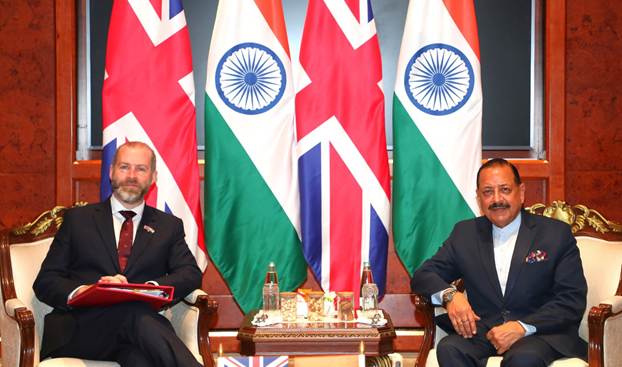
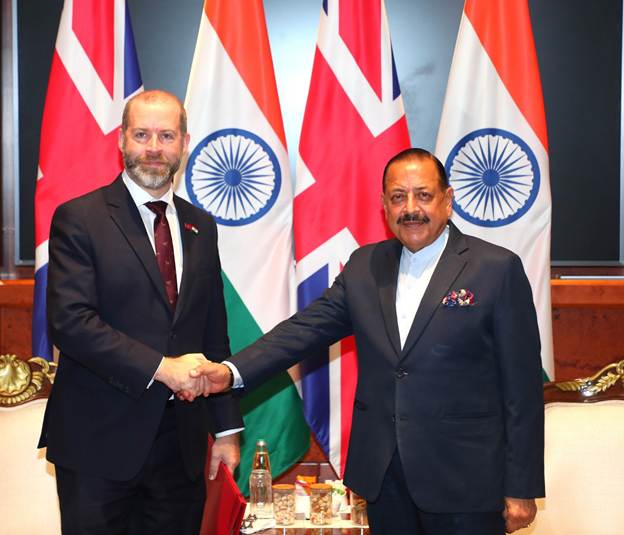
Union Minister of State (Independent Charge) for Science & Technology and Earth Sciences, and Minister of State in the Prime Minister’s Office, Personnel, Public Grievances and Pensions, Atomic Energy and Space, Dr. Jitendra Singh, today held bilateral talks with Mr. Jonathan Reynolds, Secretary of State for Business, Innovation, Science and Trade of the United Kingdom, to explore avenues for strengthening India–UK cooperation in space, civil nuclear energy, scientific research and emerging technologies.
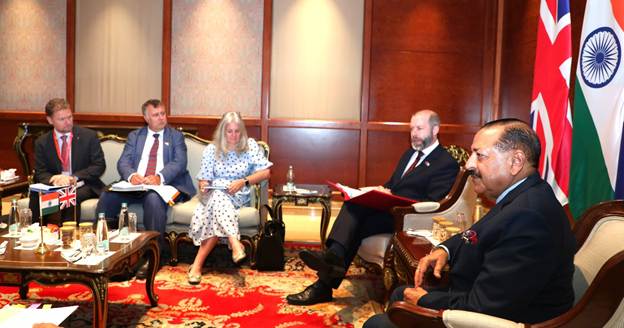
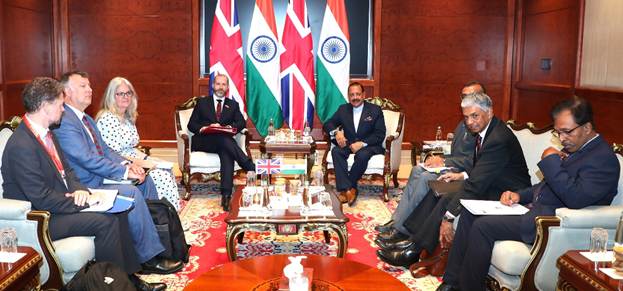
The Indian delegation was led by Union Minister Dr. Jitendra Singh, and comprised Prof. Umesh Waghmare, Secretary, Department of Science and Technology (DST); and Dr. Praveenkumar Somasundaram, Adviser and Head, International Bilateral Cooperation, DST.
The UK delegation comprised Mr. Jonathan Reynolds MP, Secretary of State for Business, Innovation, Science and Trade; Ms. Lindy Cameron, British High Commissioner to India; and Ms. Amanda Brooks, Interim Permanent Secretary, Department for Business, Innovation, Science and Trade.
Dr. Jitendra Singh said India’s space-sector reforms had opened new opportunities for private industry, startups and technology developers, enabling established research institutions to focus on advanced research and technology development. Building on this experience, India and the UK can expand cooperation through research partnerships, technology development, investment and greater industry participation. Their longstanding relationship and complementary scientific capabilities provide a strong foundation for taking bilateral cooperation to the next level.
The discussions covered collaboration in space science, satellite development and research, along with stronger engagement between scientific institutions and technology enterprises in both countries. With around 800 space-technology startups in India, Dr. Jitendra Singh proposed greater connectivity between Indian and British startups and smaller companies to facilitate innovation, strengthen supply chains and expand commercial opportunities.
On civil nuclear energy, Dr. Jitendra Singh spoke about India’s nuclear-sector reforms, including the Sustainable Harnessing and Advancement of Nuclear Energy for Transforming India (SHANTI) Act, 2025. Drawing on the experience of opening up the space sector, India is creating avenues for wider participation in nuclear energy and technology development.
The discussions explored opportunities for India–UK cooperation in small modular reactors (SMRs), advanced nuclear technologies and associated industrial capabilities, particularly in the context of growing energy requirements, industrial development, electrification and data-centre demand.
Dr. Jitendra Singh also spoke about the wider applications of India’s nuclear programme beyond electricity generation, particularly in nuclear medicine and healthcare. India’s work involving radioisotopes and cancer-related applications offers scope for engagement with British expertise in life sciences and medical research. The longstanding scientific links between the two countries, including historical research on tropical diseases, provide a further basis for exploring collaboration in biomedical research.
Artificial Intelligence (AI), quantum technologies, cyber-physical systems and cybersecurity also featured in the discussions. Dr. Jitendra Singh said AI would be an essential tool for future development and that its effective use would be critical to maximising its benefits. India is exploring smaller-scale AI models suited to local requirements and available resources.
The discussions also covered the practical applications of emerging technologies, the need to address associated risks and the importance of cybersecurity as these technologies become increasingly integrated into critical systems.
The two sides also discussed potential collaboration in quantum technologies, advanced sensors, gravimeters and geospatial applications linked to space research. The convergence of space science with emerging technologies offers scope for joint research and new applications, while greater engagement among scientific institutions, experts and industry can help translate research capabilities into practical outcomes.
Mr. Jonathan Reynolds welcomed closer engagement between the two countries and emphasised the scope for regular interaction between institutions, research and innovation partnerships, and commercial cooperation. Referring to the UK’s space strategy, he expressed interest in advancing civil nuclear cooperation for peaceful purposes, including opportunities to facilitate research, trade and collaboration. He also referred to AI as a priority for the UK’s forthcoming G20 Presidency and welcomed opportunities for India–UK engagement on technological innovation and productivity.
The discussions focused on advancing the India-UK partnership in scientific research, technological innovation and mutually beneficial cooperation. Both countries can build on their complementary strengths, strengthen institutional and industry linkages, and explore practical avenues for collaboration across strategic technology sectors.
*****
NKR/AK/NM
(रिलीज़ आईडी: 2322301)
आगंतुक पटल : 108