PIB Backgrounder
Deen Dayal Upadhyaya Grameen Kaushalya Yojana 2.0
Building a Skilled and Self-Reliant Workforce
प्रविष्टि तिथि:
24 SEP 2026 10:47AM by PIB Delhi
|
Equipping rural youth with relevant skills and access to employment opportunities is central to advancing inclusive and sustainable rural transformation. To advance this goal, the Deen Dayal Upadhyaya Grameen Kaushalya Yojana (DDU-GKY) was launched on 25 September 2014 under the National Rural Livelihoods Mission. Building on this, the DDU-GKY 2.0 scheme is currently being implemented across 31 States and Union Territories through over 749 approved projects, with more than 760 active training centers and over 455 Project Implementing Agencies, covering all sectors of the economy as on date. Since inception in 2014-15, more than 18.47 lakh candidates have been trained for more than 800 job roles, and over 12.43 lakh have been placed. Complementing the skilling efforts, RSETIs promote self-employment and rural entrepreneurship. As of date, 647 RSETIs across 634 districts have trained 63.47 lakh candidates, with 45.60 lakh successfully settled. These initiatives strengthen industry-aligned training, digital delivery, employment retention, and sustainable livelihood opportunities for rural youth.
|
Strengthening Rural Youth through Skills and Opportunities

India’s young population presents a significant opportunity to strengthen economic growth and rural livelihoods. The youth population is projected to reach nearly 345 million by 2036. Harnessing this demographic potential requires greater access to quality skills, employment, and livelihood opportunities.
Recognizing this need, the Ministry of Rural Development (MoRD) launched the Deen Dayal Upadhyaya Grameen Kaushalya Yojana (DDU-GKY) on 25 September 2014, under the National Rural Livelihoods Mission. As DDU-GKY marks its 12th anniversary this year, the programme continues to strengthen pathways from skills to employment and sustainable livelihoods for rural youth. For more than a decade, the scheme has been providing placement-linked skill training to rural youth aged 15-35 years from poor households.
It also promotes social inclusion through mandatory coverage of SC/ST communities (50%), women (33%), and persons with disabilities (5%). Over the past decade, the scheme has evolved to place greater emphasis on employment outcomes and post-placement support. The Government notified the upgraded DDU-GKY 2.0 Guidelines in May 2025, strengthening the framework around training, placements, employment sustainability, and post-placement support. The revised framework provides training across multiple sectors based on industry requirements, including aerospace and aviation, agriculture, beauty and wellness, green jobs, healthcare, textiles, and others. The continued focus on rural skilling is also reflected in the Union Budget 2026–27, which has allocated ₹750 crore to DDU-GKY.
Special Initiatives: Targeted Interventions for Vulnerable Regions
Two special programmes are being implemented under DDU-GKY 2.0:
Roshni: It addresses the specific needs of Left-Wing Extremism (LWE)-affected districts notified by the Ministry of Home Affairs. It mandates residential skill training, with 40% coverage for women candidates. The initiative has been extended to Aspirational Districts, focusing on local infrastructure, education, health, natural resources, and traditional skills.
Himayat: It is a special DDU-GKY scheme for Jammu & Kashmir and Ladakh. It covers rural and urban youth, including BPL and APL persons, and supports wage, self, and gig employment. The scheme is 100% centrally funded and implemented with State support through dedicated Mission Management Units.
North East: Acknowledging the challenges in terms of socio-cultural differences and topography unique to the North Eastern States, out of the total allocation for DDU-GKY, 10% is earmarked for the North-Eastern States.
Hard to reach Areas: Further there is provision for Special Area Allowance where Project implementing agencies shall be eligible for a payment at the rate of an additional 10% of the Base training cost per candidate.
DDU-GKY 2.0: A Shift Towards Sustainable Employment
DDU-GKY 2.0 adopts a more end-to-end approach to skilling and employment, covering the journey from training and placement to employment retention and career progression.
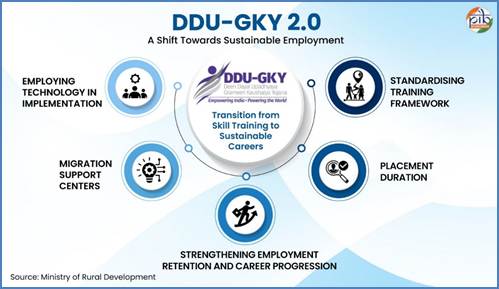
The revised framework strengthens training standards, extends the minimum placement duration, and enhances post-placement support. It also addresses the challenges associated with migration and strengthens technology-enabled monitoring and implementation.
Standardising Training Framework
DDU-GKY 2.0 retains the 576-hour minimum while providing a more structured training framework. A three-month course comprises 396 hours of domain training and 180 hours of mandatory non-domain training. The non-domain component is standardised across four areas: English Communication (60 hours), Employability and Life Skills (60 hours), Computer and Digital Literacy (30 hours), and Entrepreneurship (30 hours). It ensures that candidates receive job-specific technical skills alongside communication, workplace, digital, and entrepreneurial capabilities.
Earlier, DDU-GKY placement was defined as continuous employment for a minimum of three months. Building on this stronger training foundation, under DDU-GKY 2.0, the minimum placement duration has been extended to six months. The revised guidelines cover both continuous and non-continuous employment, including wage, self-employment, and gig employment.
Job Melas for Connecting Rural Youth with Employers
Job Melas are organised by SRLMs at the block and Gram Panchayat levels to connect local youth with potential employers. They include youth registration and counselling, employer verification, and tracking of placement outcomes for one year through Kaushal Panjee. The Melas are mainly for youth with employable skills, including DDU-GKY-trained candidates seeking better job opportunities. Funding of up to ₹50,000 per GP-level fair and ₹1 lakh per block-level fair is available from the DDU-GKY budget, subject to placement of 100 and 200 candidates, respectively.
Strengthening Employment Retention and Career Progression
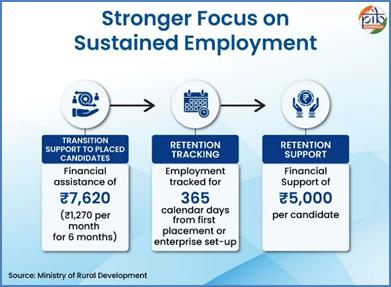
Under DDU-GKY 2.0, greater emphasis has been placed on sustained employment. To support the extended six-month placement duration, DDU-GKY 2.0 provides 12 months of post-placement tracking to facilitate employment continuity, specifically:
- Placed candidates receive financial assistance of ₹7,620, at ₹1,270 per month for six months.
- In addition, retention support of ₹5,000 per candidate is provided to candidates who remain employed for 365 days, with a maximum employment break of 60 days.
- Placed candidates are also provided with upskilling and reskilling opportunities after 12 months of placement, enabling them to strengthen their skills and improve their prospects for continued employment and career progression.
Migration Support Centres (MSC)
Given that a considerable proportion of trained candidates migrate in search of livelihood opportunities, DDU-GKY 2.0 has placed renewed emphasis on strengthening migration support systems. State Rural Livelihoods Missions (SRLMs) establish Migration Support Centres (MSCs) in areas with a high concentration of placed candidates. These centres operate both within the home state and in destination states. MSCs offer a range of services to support candidates during this transition, including accommodation assistance, counselling, and placement support.
They also facilitate the flow of employment-related information, encourage alumni networking, and strengthen engagement with employers. Beyond this, the centres liaise with local administrative bodies and service providers to help candidates settle into urban work environments and remain in stable employment over time. Reflecting the growing importance of this support system, per-centre annual funding for MSCs has been increased considerably, from ₹10 lakh earlier to as much as ₹30 lakh under the revised framework.
Employing Technology in Implementation
Technology integration has been a defining feature of DDU-GKY since its inception. The framework relies on geo-tagged and time-stamped biometric attendance records, computer labs, and e-learning facilities. These measures strengthened programme monitoring while enhancing trainees' exposure to digital tools.
DDU-GKY 2.0 builds upon this technological foundation by introducing an end-to-end digital solution encompassing the entire programme lifecycle. The platform spans PIA onboarding, project submission and evaluation, training-centre and candidate management, assessment and certification, financial management, and project monitoring and placement tracking.
The revised approach also introduces:
- Advanced dashboards for real-time programme monitoring.
- Public candidate portal for training search and viewing PIA performance ratings.
- Automated processes, including Project Registration Number (PRN) generation, grievance redressal, and certificate verification.
- Digital attendance and assessment through face authentication and real-time dashboards.
- Skill India Digital Hub integration for automated course-detail validation.
Leading the Rollout (2025-26) of DDU-GKY 2.0
- Goa has emerged as the pioneer in creating batches of DDU GKY 2.0.
- Andhra Pradesh has commenced training of more than 12000 candidates in a short span of 3 months.
- Jammu & Kashmir allocated 100% targets allocated and commenced trainings for 91% of the allocation.
Key Milestones Achieved Under the Scheme
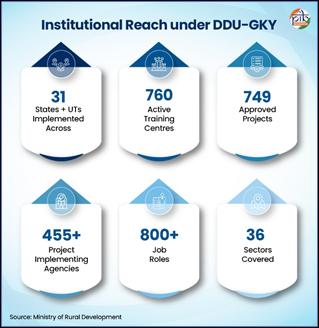
DDU-GKY is currently being implemented across 31 States & Union Territories through an extensive skilling network. As on date, the programme has 749 approved projects, with 760 active training centres, in partnership with more than 455 PIAs.
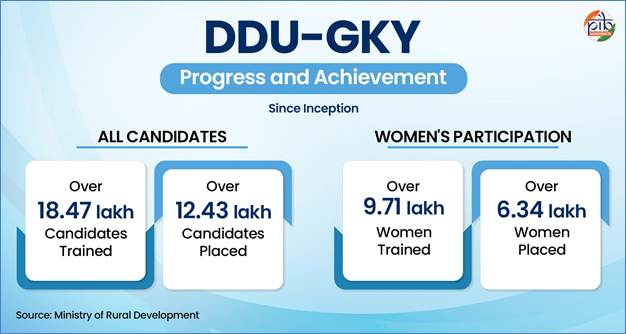
Since its inception in 2014-15, DDU-GKY has trained over 18.47 lakh candidates, covering all 36 sectors of the economy and over 800 job roles, and placed over 12.43 lakh. This reflects the scheme’s wide sectoral reach and focus on industry-aligned skill development for rural youth.
Over 9.71 lakh women were trained, and over 6.34 lakh women secured placements under the scheme.
Other Initiatives Supporting Rural Youth Entrepreneurship
While DDU-GKY focuses on placement-linked wage employment, the Government has simultaneously strengthened self-employment and entrepreneurship pathways through Rural Self-Employment Training Institutes (RSETIs). The programme provides free residential training to rural unemployed youth aged 18-50 years, followed by handholding support for setting up sustainable livelihoods. The programme creates dedicated skill infrastructure in every district of the country. It focuses on upskilling rural youth, especially those from below poverty line (BPL) and DAY-NRLM households.
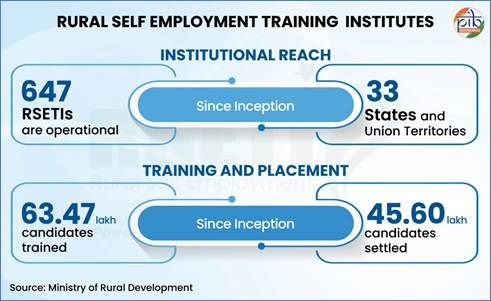
As on date, a total of 647 RSETIs are operational across 634 districts in 33 States/UTs. Since its inception (2009), the scheme has trained 63.47 lakh candidates. Total of 45.60 lakh candidates have also been settled. Among the candidates settled under RSETI, around 94% have established sustainable self-employment ventures. About 6% have secured wage employment.
Shaping Rural India’s Workforce for the Future
Strengthening the skills, employability, and entrepreneurship potential of rural youth remains central to inclusive economic growth in India. Through DDU-GKY 2.0, the Government is creating a more responsive, technology-driven, and outcome-oriented skilling ecosystem. The programmes prepare rural youth for jobs and support sustained livelihoods. Continued focus on quality training, industry partnerships and responsive support can help translate skills into durable livelihoods. DDU-GKY 2.0 represents an important step towards building a skilled, empowered, and self-reliant rural workforce for the future. It also promotes India’s vision of Viksit Bharat @2047 that aims to transform the country into a global economic and knowledge hub.
Ministry of Rural Development
https://kaushal.rural.gov.in/#/about-us
https://kaushal.rural.gov.in/#/training-center-list
https://kaushal.rural.gov.in/assets/files/Deen%20Dayal%20Upadhyaya%20Grameen%20Kaushal%20Yojana.pdf
https://kaushal.rural.gov.in/#/key-features
https://ddugkysop.in/pluginfile.php/21940/mod_resource/content/2/DDUGKY_CNN_aligned_Guidelines_July_2016.pdf
https://www.dord.gov.in/static/uploads/2024/07/ee7db3320bf3aa165fdb69f12cbb2c38.pdf
https://sansad.in/getFile/loksabhaquestions/annex/187/AU3964_UIXOj8.pdf?source=pqals
https://sansad.in/getFile/loksabhaquestions/annex/187/AU5192_zshReo.pdf?source=pqals
https://www.pib.gov.in/PressReleasePage.aspx?PRID=2148466®=3&lang=2
https://www.pib.gov.in/PressReleasePage.aspx?PRID=2294539®=3&lang=1
https://cdnbbsr.s3waas.gov.in/s3e9412ee564384b987d086df32d4ce6b7/uploads/2025/06/20250625554506571.pdf
https://cdnbbsr.s3waas.gov.in/s3e9412ee564384b987d086df32d4ce6b7/uploads/2025/06/20250625108042813.pdf
Ministry of Finance
https://www.indiabudget.gov.in/doc/eb/sbe87.pdf
NITI Aayog
https://www.niti.gov.in/sites/default/files/2026-02/Revitalizing-India-Apprenticeship-Ecosystem-Insights-Challenges-Recommendations-and-Best-Practices.pdf
Ministry of Information and Broadcasting
https://www.newsonair.gov.in/bulletins-detail/parikrama-688/
Click here to see pdf
****
PIB Research
(रिलीज़ आईडी: 2314249)
आगंतुक पटल : 341
इस विज्ञप्ति को इन भाषाओं में पढ़ें:
हिन्दी