Ministry of Jal Shakti
As a follow up to Departmental Summit, DDWS Organised First Virtual Conference With States and UTs on Strengthening Skilled Rural Water Workforce Under Jal Jeevan Mission 2.0
States/UTs urged to accelerate Nal Jal Mitra and Sujalam Shakti initiatives to build a professional, locally available workforce for sustainable rural water service delivery
प्रविष्टि तिथि:
21 SEP 2026 8:21PM by PIB Delhi
The Department of Drinking Water and Sanitation (DDWS), Ministry of Jal Shakti, today organised the first National Virtual Conference with States and Union Territories, as a follow up to the Departmental Summit ( organized from 1-2 September 2026) to discuss the roadmap for strengthening the skilled rural water workforce required for sustainable operation and maintenance (O&M), water quality surveillance and long-term functionality of rural drinking water infrastructure under Jal Jeevan Mission (JJM) 2.0.
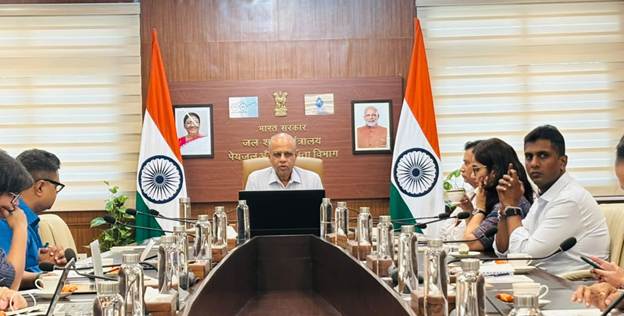
The Conference brought together representatives from State Water and Sanitation Missions, Public Health Engineering Departments, State Skill Development Missions, Rural Development Departments, Panchayati Raj Institutions, Technical Education Departments and other partner institutions working in skilling and technical education.
In his opening remarks, Shri Ashok K.K. Meena, Secretary, DDWS, emphasised that the long-term success of Jal Jeevan Mission depends not only on infrastructure creation but also on the availability of trained and skilled human resources to operate, maintain and monitor rural water supply systems. He highlighted the need to establish a structured and professional ecosystem for operation and maintenance to sustain safe and reliable drinking water services in villages.
A major focus of the Conference was the rollout of the Nal Jal Mitra (NJM) programme. Participants were informed that DDWS, in collaboration with the Ministry of Skill Development and Entrepreneurship and NCVTE, has developed an NSQF-aligned Nal Jal Mitra qualification for rural drinking water systems. The programme aims to create a cadre of village-level multi-skilled technicians capable of undertaking routine operation, preventive maintenance and first-level repairs of rural water supply infrastructure. Covering skills related to pumps, pipelines, treatment systems, electrical installations and associated infrastructure, the programme forms a key component of DDWS's strategy to build a professional workforce for sustaining rural drinking water systems under JJM 2.0.
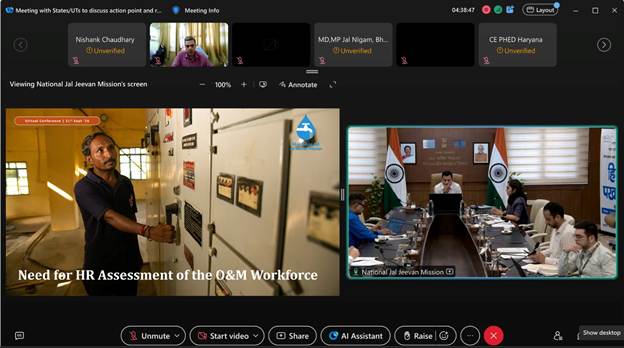
States and UTs were briefed on the two implementation pathways under the programme: a 510-hour Short-Term Training course for new entrants and a 120-hour Recognition of Prior Learning (RPL) pathway for existing operators, plumbers, electricians, pump attendants and other personnel engaged in rural water supply systems. States were encouraged to leverage both pathways and prioritise local youth to ensure the availability of skilled resources within rural areas while creating livelihood opportunities.
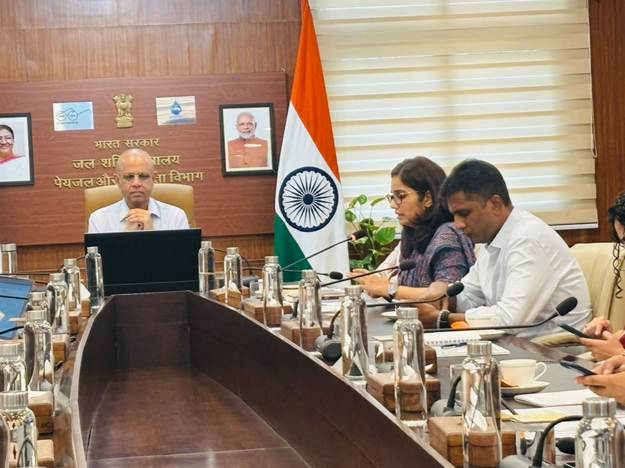
Representatives from NCVTE outlined the process for adoption of approved qualifications and informed States about opportunities to become recognised Awarding Bodies for training, assessment and certification. The Ministry of Skill Development and Entrepreneurship also highlighted opportunities available under PMKVY 4.0 and advised States to prepare district-based training plans through convergence with State Skill Development Missions, ITIs, Polytechnics and other Government training institutions.
The Department informed States and UTs that the expanding rural water sector is emerging as a significant source of local employment generation. Assessments indicate that more than 13 lakh personnel may be required in the coming years for operation and maintenance of rural water supply infrastructure, including technicians, operators, plumbers, electricians, pump mechanics, laboratory personnel, supervisors and water quality workers. States were advised to align skilling efforts with future workforce requirements so that investments in infrastructure also translate into sustainable livelihood opportunities for rural youth.
Smt. Swati Meena Naik, Joint Secretary, NJJM explained in detail about the rollout of Sujalam Shakti, a women-led initiative aimed at creating a trained village-level workforce for water quality surveillance, testing and basic disinfection. The initiative seeks to establish a community-based mechanism for regular monitoring of drinking water quality at the village level while strengthening women's participation in rural water governance.
She, informed participants that the programme is based on the NSQF Level-2 qualification titled “Fundamentals of Basic Water Quality Testing and Disinfection”. The initiative seeks to equip women with skills in representative water sampling, use of Field Test Kits (FTKs), basic chlorination and disinfection practices, sanitary inspections, source protection, record maintenance and digital reporting.
She informed that the first phase aims to train approximately 1.35-1.70 lakh women through convergence with State Rural Livelihood Missions, Panchayati Raj Institutions, Rural Self Employment Training Institutes (RSETIs) and other training networks. States were advised to prioritise women already associated with water quality testing activities under Jal Jeevan Mission, Self-Help Group members and other community representatives.
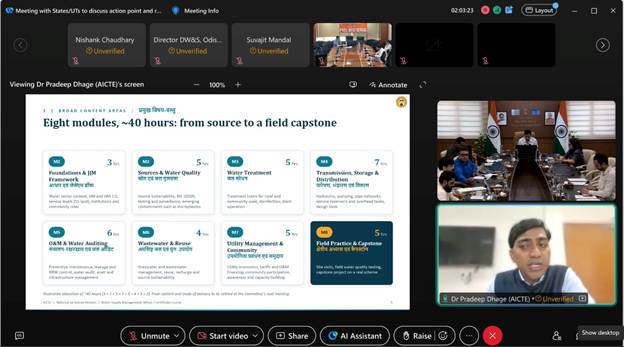
The Conference also discussed strengthening linkages between the rural water sector and technical education. In this regard, AICTE presented progress on the development of a dedicated elective course on Water Supply Management for diploma and engineering students, with a focus on practical exposure to rural water supply systems.
IIT Kanpur highlighted the importance of integrating emerging technologies into future water-sector curricula and training programmes. Deliberations focused on the growing role of IoT-enabled monitoring systems, telemetry, SCADA, GIS applications, predictive maintenance tools, machine learning and data-driven decision-support systems in the management of water infrastructure. Participants observed that future technical education and skilling programmes should increasingly incorporate such technologies to prepare the next generation of water-sector professionals.
States and UTs were advised to undertake district-wise assessment of human resource requirements based on actual infrastructure and operational needs, including treatment plants, pumping stations, transmission systems, reservoirs, distribution networks and water quality laboratories. Such assessments will help identify workforce gaps and guide targeted skilling interventions. Following actionable points with timeline was also informed to States/UTs
-
- States/SWSM are to take a decision on adoption of the existing Nal Jal Mitra (Jal Vitran Sanchalak) course, or development of a State-specific course, by 15th October 2026. On finalization, the proposal for the State to become an Awarding Body is to be submitted to NCVET accordingly.
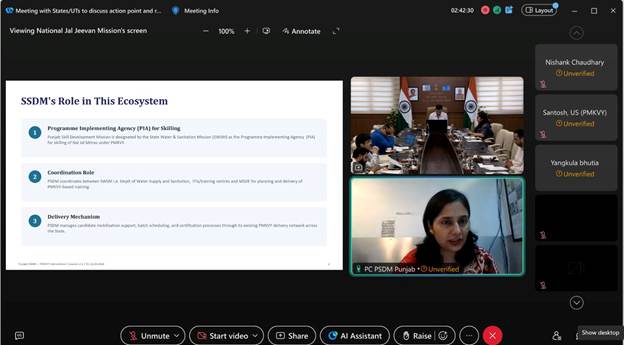
- SWSM may identify the SSDM, or another suitable body, as the Programme Implementing Agency (PIA) for STT and RPL under PMKVY. A meeting between SWSM and SSDM is to be convened before 5th October, at which the skilling target for the current financial year is to be finalized.
- SWSM is to identify the number of candidates to be trained, with nominations routed through the Gram Panchayats.
- SWSM to direct the DWSMs to identify ITIs with infrastructure as per PMKVY guidelines. DWSM shall be responsible for ground-level verification of the same. Any assistance which is needed to be provided by SSDM or identified PIA.
- States are to draft the HR policy mandated under the JJM 2.0 guidelines and CIRP, in coordination with the Department of Rural Development and Panchayati Raj.
- SWSM, along with DWSM, is to undertake a detailed HR assessment to identify O&M manpower gaps at the GP, block, and district levels.
- States are to identify Sujalam Shakti members and ensure their registration on the GP dashboard platform.
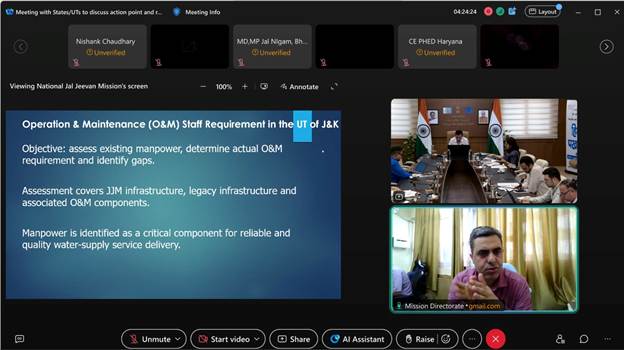
During the Conference, several States shared their experiences and good practices. Odisha presented its initiatives in training local mechanics, Nal Jal Mitras and women engaged in water quality surveillance. Telangana showcased its asset-based methodology for estimating manpower requirements, while Jammu & Kashmir shared its workforce planning approach suited to its unique geographical conditions. Madhya Pradesh presented its strategy for leveraging State Institute of Rural Development (SIRD), Extension Training Centres and Rural Self Employment Training Institutes (RSETIs) for implementation of Sujalam Shakti certification programmes. Haryana and Punjab highlighted efforts related to candidate identification, institutional convergence, certification and workforce deployment.
The Conference noted that development of a robust skilling ecosystem will not only strengthen operation and maintenance of rural water supply systems but also create sustainable livelihood opportunities in villages. A trained workforce of operators, plumbers, electricians, fitters, pump mechanics, water-quality personnel and other technical professionals will be critical for protecting investments made under Jal Jeevan Mission and ensuring long-term water security.
Reviewing the way forward, Shri Kamal Kishore Soan, Additional Secretary & Mission Director, NJJM, called upon States and UTs to strengthen coordination among concerned departments and institutions, undertake district-wise HR mapping, identify training partners, accelerate adoption of Nal Jal Mitra and Sujalam Shakti qualifications, and establish mechanisms for deployment, remuneration and performance monitoring of trained personnel.
Concluding the Conference, Shri Soan reiterated that Jal Jeevan Mission 2.0 marks a transition from infrastructure creation to sustainable service delivery, and that building a professional, certified and locally available workforce will be critical for ensuring reliable operation and maintenance of rural drinking water infrastructure and sustaining safe drinking water services for future generations. He urged States and UTs to take forward the skilling roadmap with urgency and commitment to support both rural water security and employment generation across the country.
****
PS/AK
(रिलीज़ आईडी: 2313201)
आगंतुक पटल : 138