Ministry of Science & Technology
Self-assembly of organic molecules opens a new path to green hydrogen production
प्रविष्टि तिथि:
09 SEP 2026 5:02PM by PIB Delhi
A simple yet powerful strategy of integrating naturally occurring amino acid with a light-absorbing organic molecule could improve solar driven hydrogen production using completely metal free organic materials.
Hydrogen is considered one of the most promising clean energy carriers because its combustion produces only water, making it an environmentally benign alternative to fossil fuels. One of the promising methods for producing green hydrogen is by using sunlight to split water into hydrogen and oxygen. However, most existing photocatalysts rely on inorganic semiconductors or precious metals, which are often expensive, difficult to manufacture, and raise concerns regarding long-term sustainability. Developing efficient metal-free organic photocatalysts has therefore remained a major scientific challenge.
A team of researchers from the Centre for Nano and Soft Matter Sciences (CeNS), Bengaluru, -an autonomous institute under Department of Science and Technology (DST), integrated a naturally occurring amino acid (aspartic acid) with a light-absorbing organic molecule, perylene diimide (PDI) and allowed the molecules to spontaneously organize themselves through supramolecular self-assembly.
They found that the enhanced performance arises from how the molecule organizes itself. The amino acid moiety promotes strong, extended hydrogen bonding, while the PDI chromophore drives π–π stacking and efficient light absorption.
Thus, the synergistic interplay between the two governs the molecular organization and, consequently, the functional properties of the material.
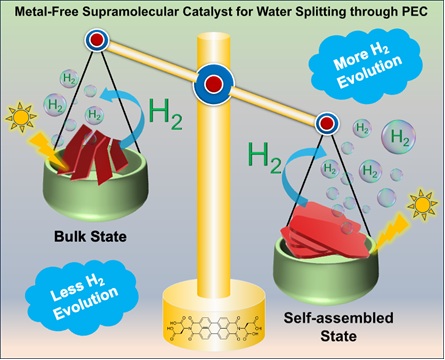
The researchers synthesised an aspartic acid-functionalized perylene diimide (PDI) molecule that spontaneously self-assembled in water into highly ordered two-dimensional nanosheets.
This subtle molecular reorganization dramatically broadened light absorption, enhanced charge separation, reduced energy losses, and increased the accessible surface area for catalytic reactions without altering the molecule's chemical composition. As a result, the self-assembled material generated nearly 18% higher photocurrent than its bulk counterpart during solar-driven water splitting.
Advanced electrochemical measurements together with density functional theory (DFT)
calculations further revealed that self-assembly promotes more efficient charge transport, while the amino acid increases the molecular dipole moment, facilitating effective separation of photo-generated charges that drive hydrogen evolution.
The study further demonstrates that naturally occurring amino acids can serve not only as molecular building blocks but also as powerful regulators of supramolecular organization and photocatalytic performance. This molecular design strategy offers a sustainable route to developing efficient, environmentally friendly, and metal-free photocatalysts for solar energy conversion.
The work led by Dr. Goutam Ghosh and Dr. Ashutosh K. Singh at the Centre for Nano and Soft Matter Sciences (CeNS), Bengaluru, together with Mr. Sourav Moyra, Mr. Kumar Shubham, and Ms. Athira Chandran M was published in the Journal of Materials Chemistry A, one of the Royal Society of Chemistry's leading journals.
Such materials could contribute to future technologies for green hydrogen production, artificial photosynthesis, solar fuel generation, and next-generation renewable energy devices, reducing dependence on costly and scarce metals.
Publication Link: https://doi.org/10.1039/d6ta04378j
****
NKR/FT/AA
(रिलीज़ आईडी: 2308334)
आगंतुक पटल : 332