Ministry of Tribal Affairs
National Conclave on Tribal Languages & Museums begins in Mysuru, Karnataka
Launch of Adi Vaani Platform along with iOS application, addition of five new languages
MoTA AI bot “Jago” Launched
Ministry of Tribal Affairs signs MoU with Central Institute of Indian Languages (CIIL)
प्रविष्टि तिथि:
24 AUG 2026 9:14PM by PIB Delhi
The Ministry of Tribal Affairs today began the three-day National Conclave on Tribal Languages & Museums in Mysuru, Karnataka. The Conclave brings together policymakers, linguists, researchers, technologists, and tribal community representatives to deliberate on the documentation and revitalisation of tribal languages and on strengthening tribal and Tribal Freedom Fighter Museums (TFFM) across the country.
The inaugural session was attended by Shri Durga Das Uikey, Hon'ble Union Minister of State, Ministry of Tribal Affairs; Sri Raghumurthy, Hon'ble Minister, Tribal Welfare Department, Government of Karnataka; Shri Yaduveer Krishnadatta Chamaraja Wadiyar, Hon'ble Member of Parliament, Mysuru Constituency; Shri Anant Prakash Pandey, Joint Secretary, Ministry of Tribal Affairs; Smt. Kanagavalli, IAS, Secretary, Tribal Welfare Department, Government of Karnataka; Prof. Basavaraja Kodagunti, Director, Central Institute of Indian Languages (CIIL), along with senior officials of the Central and State Governments. The proceedings began with the National Song, the National Anthem and the Naadageethe, followed by the lighting of the ceremonial lamp.
India is witnessing a transformative era in tribal development under the leadership of Hon’ble Prime Minister Shri Narendra Modi. The Government remains committed to preserving tribal languages, oral traditions and cultural heritage as a vital part of India’s civilisational identity. Many tribal languages and dialects survive primarily through oral tradition, making systematic documentation, technology-enabled revitalisation and the creation of dedicated spaces such as tribal and Tribal Freedom Fighter Museums an urgent national priority. It is one of the many steps in the journey towards Viksit Bharat@2047.
The Conclave is being organised by the Ministry of Tribal Affairs in collaboration with the Karnataka State Tribal Research Institute (KSTRI), Government of Karnataka, and the Central Institute of Indian Languages. Nearly 150+ participants across State took part in the National Conclave.
Karnataka Primers Released
In a special release ceremony, the Tribal Welfare Department, Government of Karnataka, together with KSTRI, released Karnataka Primers in tribal languages — the Primer of Jenukuruba for Class 1 (Kannada, Maths, EVS), along with Sannivesha, Pragiti Nota, Thattegalu flashcards.
MoU signed between MoTA & CIIL
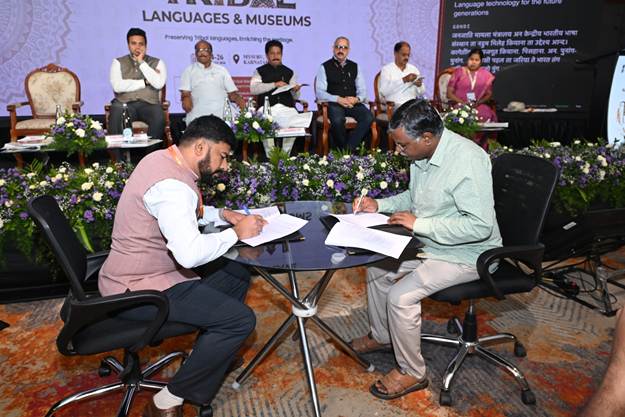
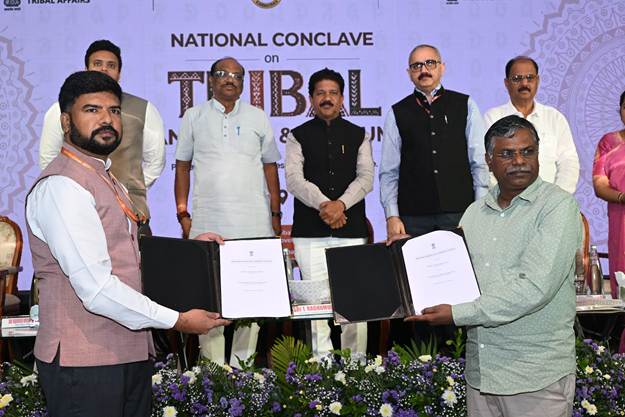
The Ministry of Tribal Affairs and CIIL signed a Memorandum of Understanding (MoU) on language documentation and corpus development, under which CIIL will support and share data with the Ministry on tribal languages.
Full-fledged Adi Vaani Platform, AI Bot Released
The session also saw the launch of “Jago”, the official AI conversational assistant of the Ministry of Tribal Affairs, along with its mascot. Jago is designed to make information on tribal welfare schemes, programmes, initiatives and repositories easier to find, understand and access, bringing together trusted information from the Ministry through one intelligent interface.
The major highlight of the Conclave was the launch of the upgraded Adi Vaani platform, with new features including its new iOS application, the addition of five new languages, and the launch of the Adi Vaani logo.
In her welcome address, Smt. Kanagavalli, IAS, Secretary, Tribal Welfare Department, Government of Karnataka, highlighted the urgent need for collective dialogue on tribal languages, stressing that the loss of a language also results in the loss of the culture and traditions associated with it.
Delivering the CIIL institutional address, Prof. Basavaraja Kodagunti, Director, Central Institute of Indian Languages, said that languages are living evidence of history and carry the knowledge and experiences of communities across generations. He highlighted the rich and ancient cultural heritage of tribal communities and stressed the need for field-level documentation, use of modern technology, and greater involvement of tribal youth in preserving tribal languages.
In his opening remarks, Shri Anant Prakash Pandey, Joint Secretary, Ministry of Tribal Affairs, said the preservation of tribal languages and heritage is an important component of the vision of Viksit Bharat@2047, and that development should be rooted in dignity, knowledge and community-led interventions.
Speaking on the occasion, Shri Yaduveer Krishnadatta Chamaraja Wadiyar, Member of Parliament, Mysuru Constituency, highlighted the contribution of tribal communities in preserving core Indic traditions through their languages and oral traditions. He further called for expanding the reach of the PM-JANMAN initiative to a larger number of Particularly Vulnerable Tribal Groups, and stressed the importance of mainstreaming tribal products through stronger market linkages.
Addressing the inaugural session, Shri Durga Das Uikey, Hon’ble Union Minister of State for Tribal Affairs, said the biggest objective is to bring tribal communities into the mainstream on an equal footing, and that various initiatives are being continuously undertaken towards this goal. He also highlighted the presence and contribution of tribal communities in historical narratives, including references to tribal communities.
The session also highlighted the importance of celebrating and documenting the historical legacy of tribal communities, including the legacy of Bhagwan Birsa Munda.
Technical Sessions
Following a presentation by Shri Ganesh Nagarajan , Deputy Secretary, MoTA setting the tone for the day’s deliberations, the afternoon featured three panel discussions.
The first panel, on Documentation, Endangerment & Community-Led Revitalisation, examined the current state of tribal language documentation and community-driven revival models. Panellists included Dr R. Karthick Narayanan, Executive Director, CoDin; Amalesh Gope, Assistant Professor, Tezpur University; Chaithra Puttaswamy, Associate Professor, Department of Humanities and Social Sciences, IIT Kanpur; and Dr Sujoy Sarkar, Lecturer-cum-Junior Research Officer, CIIL.
The second panel, on Technology Meets Tribal Languages, mapped available technical tools — including automatic speech recognition, text-to-speech, machine translation, corpus building, and keyboards and fonts — for tribal-language documentation, and discussed data protection, risk of misuse and safeguards for tribal linguistic knowledge, including questions around commercialisation of tribal-language data and content. The session included a live translation demonstration using audio recorded at the morning registration booth. Panellists included Dr Narayan Kumar Choudhary, CIIL Mysore; Prof. A.R.D. Prasad, Former Head, DRTC, ISI Bengaluru; Prof. Dileep A.D., IIT Dharwad; Dr Ritesh Kumar, CEO, UnRealTece; and Ranjani Prasad, Program Coordinator, Keystone Foundation.
The third panel, on Multilingual Education for Tribal Students: Pedagogy, Content & Outcomes, discussed tribal-language pedagogy and curriculum for tribal Schools, content-development gaps measured, availability of primers, dictionaries and teacher handbooks, and the link between tribal-language proficiency and livelihood outcomes. Panellists included Prof. Basavaraja Kodagunti, Director, CIIL; Prof. Minati Panda, JNU; Dr Ramanujam Meganathan, NCERT; and Arunabh Konwar, LLF.
Four Tribal Research Institutes — from Kerala, Odisha, Sikkim and Jharkhand — made presentations on their best practices in language preservation and ongoing projects.
The Conclave will continue on 25 August 2026 with a panel discussion on what tribal communities want, the adoption and signing of the Mysuru Declaration, and a series of sessions on Tribal Freedom Fighter Museums (TFFM).
******
RN/
(रिलीज़ आईडी: 2302927)
आगंतुक पटल : 214
इस विज्ञप्ति को इन भाषाओं में पढ़ें:
Kannada