Ministry of Science & Technology
Dr Jitendra Singh announces unanimous adoption of 'Chennai Declaration', reaffirming BRICS commitment to build effective, resilient and future- ready framework in science, technology and innovation
Chennai Consensus places people-centred, humanity-first approach at the heart of BRICS STI cooperation; places Global South, Young Innovators and Collaborative Research at Heart of BRICS STI Agenda
BRICS Strengthens Science Partnership through Research Infrastructure, Knowledge Sharing and Innovation
प्रविष्टि तिथि:
22 AUG 2026 4:44PM by PIB Delhi
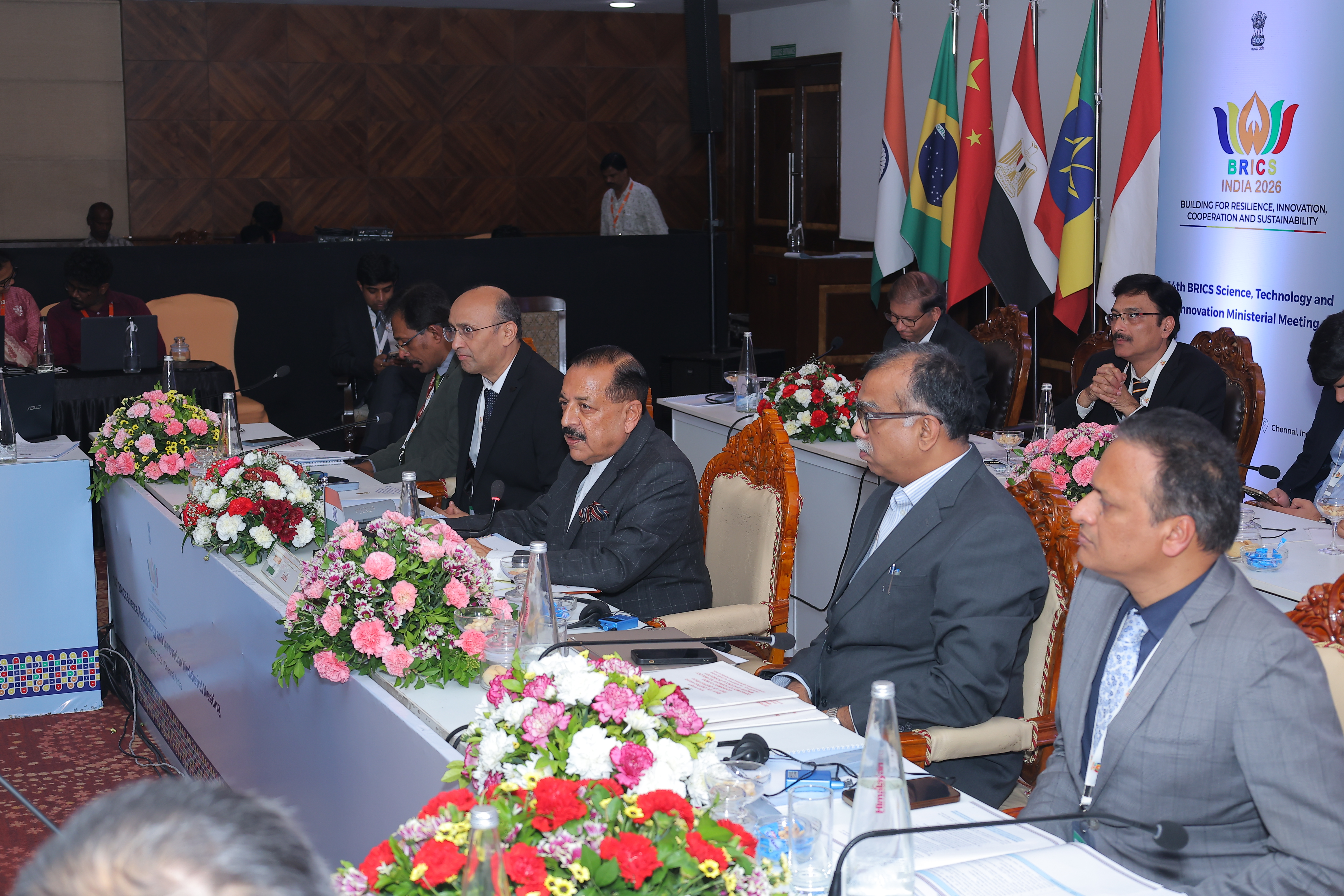
In the closing session of the 14th BRICS Science Ministerial Meet chaired by India, Union Minister of State (Independent Charge) for Science and Technology and Earth Sciences and MoS PMO, Personnel, Public Grievances, Pensions, Atomic Energy and Space, Dr Jitendra Singh announced the unanimous adoption of 'Chennai Declaration', reaffirming BRICS commitment to build effective, resilient and future- ready framework in science, technology and innovation.
The Chennai Consensus, adopted under India’s BRICS Chairship, places a people-centred and humanity-first approach at the heart of STI cooperation, with emphasis on sustainable development, resilient and high-quality growth, social inclusiveness and the use of innovation and technology to improve the welfare and quality of life of people across BRICS nations.
SX9Q.jpeg)
Delivering his closing remarks, Union Minister of State (Independent Charge) for Science and Technology and Earth Sciences and MoS PMO, Personnel, Public Grievances, Pensions, Atomic Energy and Space, Dr. Jitendra Singh, said the deliberations had reaffirmed the central role of Science, Technology and Innovation in building a more resilient, inclusive and sustainable future. He said the breadth of discussions, from Artificial Intelligence and High-Performance Computing to quantum technologies, advanced materials, biotechnology, health, climate and sustainability, reflects the shared opportunities and challenges that BRICS countries can address through collective action.
The Chennai Consensus records the growing maturity and depth of BRICS STI cooperation, with sustained collaborative activity across 14 thematic Working Groups, 11 editions of the BRICS Young Scientist Forum, nine editions of the Young Innovators Prize and nine BRICS STI Framework Programme calls, including research, innovation and flagship project calls. The Declaration describes this trajectory as reflecting growing strength, investment and continued engagement in the BRICS STI partnership.
PQUH.jpeg)
Dr. Jitendra Singh said India’s Chairship theme of “Building for Resilience, Innovation, Cooperation and Sustainability” must translate into concrete partnerships, stronger research networks, greater mobility of scientific talent, shared research infrastructure and more opportunities for young researchers and innovators. The Chennai Consensus also welcomes India’s efforts to review and streamline BRICS STI priorities and records the consultative work towards a more future-ready STI cooperation framework.
A major area of cooperation emerging from the Ministerial Meeting is shared research infrastructure and mega-science projects. The Chennai Consensus welcomes the outcomes of the BRICS Working Group on Research Infrastructures and Mega-science Projects, including the Action Plan and Terms of Reference for the Task Force, while also recording progress towards operationalising the BRICS Global Research Advanced Infrastructure Network (BRICS GRAIN). The framework envisages greater access to research facilities, common approaches to their use, researcher mobility and stronger collaboration around large-scale research infrastructure.
K6VB.jpeg)
The Action Plan provides a practical framework for greater access to research infrastructure, joint research, advanced technology development, researcher mobility and capacity building, including through the BRICS Global Research Advanced Infrastructure Network (BRICS GRAIN).
The Chennai Consensus also welcomes the BRICS Science and Research Repository as a structured platform for knowledge storage and sharing among BRICS countries. Its draft framework envisages a digital public good that can map scientific institutions, researchers, research outputs, datasets, infrastructure and collaboration opportunities, while promoting knowledge exchange, open science and greater visibility of BRICS research capabilities, subject to national regulations and data governance requirements.
The people and talent dimension of BRICS STI cooperation has also received strong emphasis. The Chennai Consensus encourages greater exchanges among young scientists and welcomes continued work under the BRICS Young Scientist Forum and BRICS Young Innovator Prize. It also recognises progress under the BRICS STI Entrepreneurship Partnership towards stronger engagement among incubators, accelerators and early-stage investors, greater mobility of young innovators and researchers, and enhanced access to relevant markets.
The Declaration further welcomes the BRICS Youth Startup Platform, while recognising the need to catalyse financing for early- and growth-stage startups and recording the consideration of a BRICS Startup Innovation Fund in the BRICS Industry Ministers’ Declaration, in coordination where appropriate with the STI track.
Dr. Jitendra Singh said the BRICS STI partnership must move beyond sustained dialogue towards demonstrable outcomes, with stronger mechanisms for joint projects, shared platforms, coordinated calls and open research infrastructure. He said that as BRICS expands and evolves, its STI cooperation must remain inclusive and responsive to the priorities of the Global South, with frontier technologies becoming accessible, affordable and responsible and directed towards improving people’s lives.
The Chennai Consensus carries this approach across a wide range of emerging and strategic areas, including High-Performance Computing and Artificial Intelligence, biotechnology and human health, materials science and nanotechnology, photonics, astronomy, geospatial technologies, renewable energy, ocean and polar science, natural-disaster management and social sciences and humanities. The Declaration also welcomes continued cooperation in quantum technologies and encourages practical engagement and joint research projects among scientists, academic institutions and innovation communities.
The Ministerial Meeting also endorsed the BRICS STI Calendar of Activities for 2026–2027, providing continuity to the Working Groups, Steering Committee, Senior Officials’ process, Young Scientist Forum, Young Innovator Prize and other thematic activities. The Chennai Consensus records the transition of the BRICS STI Ministerial process to the next Chairship, with the next Ministerial Meeting scheduled under China’s Chairship in 2027.
Dr. Jitendra Singh expressed appreciation to the BRICS Ministers, delegations, experts and colleagues for their contributions to the Ministerial Meeting and acknowledged the efforts of the Department of Science and Technology and partner institutions in making India’s BRICS STI Chairship meaningful and outcome-oriented. He said the spirit of Resilience, Innovation, Cooperation and Sustainability should continue to guide BRICS as a platform for scientific excellence, technological progress and shared prosperity.
The adoption of the Chennai Consensus marks a significant step in strengthening BRICS STI cooperation around shared research, scientific infrastructure, innovation ecosystems, talent mobility and collaborative responses to global challenges. Under India’s Chairship, the BRICS STI partnership has been positioned for a more connected, practical and future-ready phase of cooperation, with science, technology and innovation serving as instruments of resilience, sustainable development and shared progress across the Global South.
***
NKR/AK
(रिलीज़ आईडी: 2302339)
आगंतुक पटल : 1903