Ministry of Jal Shakti
DDWS Organises National Workshop on Multi-Stakeholder Consultation for Capacity Building under Jal Jeevan Mission 2.0
The National Workshop Brings Together Stakeholders to Shape Future Training Frameworks
प्रविष्टि तिथि:
20 AUG 2026 5:48PM by PIB Delhi
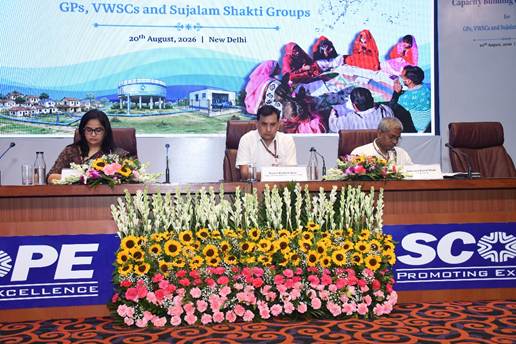
The Department of Drinking Water and Sanitation (DDWS), Ministry of Jal Shakti, organised a National Workshop on “Multi-Stakeholder Consultation on Capacity Building under Jal Jeevan Mission (JJM) 2.0 for GPs, VWSCs and Sujalam Shakti Groups”. The workshop brought together representatives from States/UTs, Rural WASH Partners, training institutions and other key stakeholders to collectively review and deliberate on the capacity-building modules developed for field level functionaries including Gram Panchayat representatives. The consultation focused on strengthening the content, pedagogy and field applicability of the modules, drawing upon diverse State/UT experiences and field realities, to support their finalisation and effective roll-out under JJM 2.0.
Setting the context, Shri Kamal Kishore Soan, Additional Secretary and Mission Director, National Jal Jeevan Mission, highlighted the enhanced focus on capacity building under JJM 2.0 to strengthen the long-term sustainability of rural drinking water services. Emphasising that sustainable service delivery extends beyond infrastructure creation, he underlined the need to empower Gram Panchayats and local stakeholders with the knowledge, skills and institutional support required to effectively manage village water supply systems. He stressed the importance of clearly defined roles, Jan Bhagidari and a robust technical support ecosystem to ensure regular, safe and reliable drinking water supply for rural households. Urging participants to develop simple, practical and application-oriented training modules, he observed that capacity-building efforts must be designed from the perspective of village-level stakeholders and enable them to translate learnings into day-to-day action. He expressed confidence that the collective experience and expertise of the participants would help shape a comprehensive and future-ready capacity-building framework under Jal Jeevan Mission 2.0.
Smt. Swati Meena Naik, Joint Secretary, provided an overview of the workshop objectives and expected outcomes and underscored the need for a robust capacity-building ecosystem to ensure sustainable and reliable rural drinking water services, noting that the long-term success of water supply systems depends not only on infrastructure but also on the capacities of local institutions and communities. She emphasised the importance of clearly defined roles and responsibilities across Gram Panchayats, community institutions and technical support agencies. Capacity building should focus on practical and application-oriented learning, enabling stakeholders to understand key aspects of service delivery, including source sustainability, water quality, operation and maintenance, financial management and community participation. Highlighting the importance of community ownership, she encouraged communities to become active partners in managing and sustaining local water resources.
Emphasising the vision of digital transformation under JJM 2.0, she highlighted the need for a connected digital ecosystem to support task tracking, monitoring and accountability. She noted that digital tools can strengthen service management and support informed decision-making at all levels. She reiterated that continuous capacity building, backed by technical handholding and institutional support, is critical for sustainable water service delivery at the village level.
Participants were subsequently briefed on the eight number of training and capacity-building modules developed by the National Jal Jeevan Mission. A major highlight of the workshop was the group-based consultation exercise, during which participants reviewed the modules, deliberated on their relevance, practicality, and scalability, and suggested improvements to enhance their effectiveness. The stakeholders worked collaboratively to identify emerging capacity-building needs and develop recommendations for strengthening training frameworks under JJM 2.0.
The workshop concluded with a shared commitment among stakeholders to further strengthen capacity-building mechanisms and develop a comprehensive, future-ready framework that supports the objectives of JJM 2.0. The insights and recommendations emerging from the consultation will contribute to refining training modules and enhancing implementation capacities across State/UTs.
******
PS/AK
(रिलीज़ आईडी: 2301608)
आगंतुक पटल : 853