Ministry of Social Justice & Empowerment
From Contractual Sanitation Work to Self-Employment: How Swachhta Udyami Yojana Supported Satish Kumar’s Journey Towards Economic Empowerment
प्रविष्टि तिथि:
17 AUG 2026 3:53PM by PIB Delhi
For sanitation workers engaged in contractual employment, limited income and lack of access to mechanized equipment can create significant barriers to improving their livelihoods. Timely financial assistance and access to mechanization can provide opportunities for sanitation workers to transition towards self-employment and achieve greater economic stability.
Demonstrating how financial support under the Swachhta Udyami Yojana (SUY) component of the NAMASTE scheme can support livelihood transformation, Shri Satish Kumar, a 54-year-old sanitation worker from Sahibabad, Ghaziabad, Uttar Pradesh, moved from contractual sanitation work to becoming a self-employed Sewer Suction Machine owner-operator.
Before receiving assistance under the scheme, Satish Kumar was working as a contract sanitation worker and earned approximately ₹13,000–₹15,000 per month. Despite his hard work and dedication, his income was insufficient to adequately meet his family’s household needs, build savings, and achieve long-term financial security.
Although he had completed higher school education, his employment opportunities remained limited. His financial constraints also prevented him from independently purchasing mechanized sanitation equipment. His dependence on contractual employment restricted his earning potential and made it difficult for him to improve his standard of living.
Satish Kumar aspired to own a vehicle and mechanized cleaning machine so that he could become self-employed, increase his income and provide a more secure future for his family. Achieving financial independence and establishing a stable source of livelihood were among his key aspirations.
Satish Kumar learned about the Swachhta Udyami Yojana (SUY) component of the NAMASTE scheme during an awareness camp organized by the Ghaziabad Municipal Corporation, that proved a turning point in his life. The camp provided information about financial assistance available to sanitation workers and their dependents for acquiring mechanized sanitation equipment.
After understanding the benefits of the scheme, he applied for assistance and received a loan of ₹5.91 lakh from Canara Bank, along with an upfront capital subsidy of ₹3.64 lakh from National Safai Karamcharis Finance and Development (NSKFDC). With this financial support, he successfully procured a Sewer Suction Machine. The total project cost was ₹9.55 lakh.
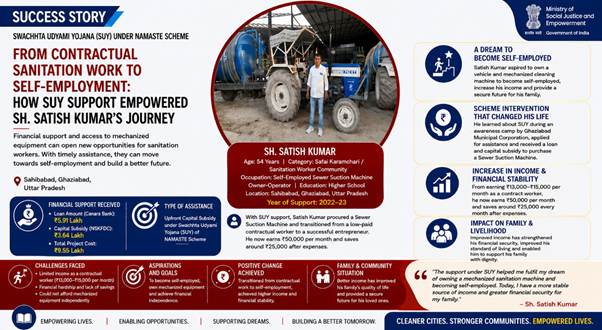
The assistance enabled Satish Kumar to transition from contractual employment to self-employment. Today, he operates his own Sewer Suction Machine and earns approximately ₹50,000 per month. After meeting expenses including EMI payments, fuel and maintenance, he is able to save around ₹25,000 per month.
The intervention has significantly improved his financial condition and strengthened his ability to support his family. The transition to self-employment has provided him with a more stable source of income while enabling him to pursue his long-standing aspiration of owning and operating his own sanitation service enterprise.
With his improved livelihood, Satish Kumar has achieved greater financial stability and an improved standard of living. His journey demonstrates how access to financial assistance and mechanized sanitation equipment can create opportunities for sanitation workers to move towards entrepreneurship and sustainable livelihoods.
Talking about the importance of being beneficiary of the Scheme, Satish Kumar said, “The support under SUY helped me fulfil my dream of owning a mechanized sanitation machine and becoming self-employed. Today, I have a more stable source of income and greater financial security for my family.”
Satish Kumar’s journey highlights how timely financial assistance under the Swachhta Udyami Yojana can help sanitation workers overcome economic constraints and transition towards self-employment. His journey reflects determination, entrepreneurship and the importance of access to mechanization and financial support for sustainable livelihoods.
*****
SS-38-TAR-KV-GA-RK
(रिलीज़ आईडी: 2300439)
आगंतुक पटल : 151