PIB Backgrounder
Building a Business-Ready India
Advancing Ease of Doing Business, Empowering Enterprises
प्रविष्टि तिथि:
13 AUG 2026 5:01PM by PIB Delhi
Enabling Enterprise-Led Growth
As India celebrates its 80th Independence Day, the nation continues to strengthen the foundations of a self-reliant, resilient and growing economy. The Government has undertaken reforms aimed at reducing compliance burdens, enhancing transparency, encouraging entrepreneurship and creating greater opportunities for enterprises of all sizes.
These efforts are advancing Ease of Doing Business through digital single-window systems, simplified incorporation processes, wider market access, improved access to finance and trust-based regulation.
Reforming India’s Business Environment
From digital single-window clearances to large-scale regulatory clean-ups, the focus of the reforms is on creating a predictable and facilitation-driven business environment.
- National Single Window System (NSWS): It is a single window digital platform which guides in identifying and applying for approvals according to the business requirements. The system integrates approvals across 32 Central ministries and 34 States. It provides access to over 686 central and 7,498 state approvals. Since its launch in 2021, NSWS has granted over 8.29 lakh approvals (November, 2025).
- Startup India (2016): The initiative aims to support entrepreneurs and build a robust startup ecosystem. It seeks to transform India into a nation of job creators rather than job seekers. DPIIT-recognised startups increased from 502 in 2016 to over 2.47 lakh as on 12 August 2026.
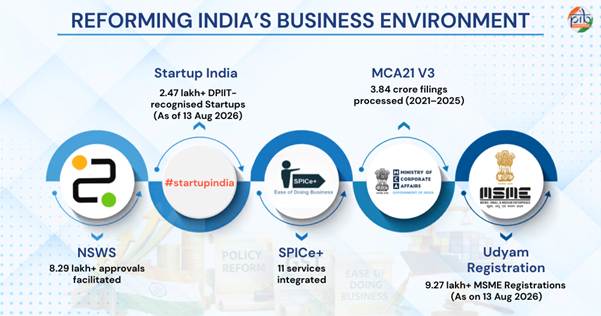
- SPICe+ Form (2020): This web-based form integrates 11 services from 3 Central Government ministries and departments. The form integrates 10 essential procedures including name reservation, incorporation, DIN allotment, PAN issuance, TAN issuance, EPFO registration, ESIC registration, Profession Tax registration, Bank account opening, and GSTIN allotment, and First-Time Registration of Shops and Establishment for all new companies getting incorporated in Delhi. It thereby, reduces procedural burden, saves time and lowers compliance costs for businesses.
- MCA21 V3: MCA21 Project, a forward-looking, AI-driven initiative significantly enhances transparency in India’s corporate landscape. The platform is used for end-to-end registry and incorporation related services of companies & limited liability partnerships (LLPs). Between 2021 and 2025, it processed 3.84 crore filings, with 3.33 crore approved through Straight Through Process.
- Udyam Registration (2020): It offers a free, paperless, and self-declaration-based system for MSMEs (Micro, Small and Medium Enterprises). MSME registrations on the Udyam Portal increased from 0.10 lakh in October 2020 to over 9.27 lakh by 13th August 2026.
- Business Reform Action Plan (BRAP) : Launched in 2015, BRAP promotes Ease of Doing Business by simplifying regulations and improving transparency across States and Union Territories (UTs). It covers reforms across single-window clearances, land, labour, inspections, taxation, environmental approvals and others.
Unlocking Finance for Enterprise Growth
Credit guarantees, digital lending and receivables financing are widening access to formal finance, particularly for MSMEs.
- Pradhan Mantri MUDRA Yojana (PMMY) : PMMY (2015) bridges the gap in financial accessibility, offering collateral-free loans up to ₹20 lakh to support non-corporate and non-farm income-generating activities. As on 27 March 2026, the scheme has sanctioned loans worth ₹40.07 lakh crore through 57.79 crore loans since inception.
- Credit Guarantee Scheme: Enables MSEs to access credit without collateral security or third-party guarantees, with support for credit facilities of up to ₹10 crore. As of March 2026, Credit Guarantee Fund Trust for Micro and Small Enterprises (CGTMSE) had approved cumulative coverage worth ₹13.67 lakh crore, benefiting 1.41 crore guarantees.
- Credit Assessment Model (CAM): Launched by Public Sector Banks in 2025, CAM uses digitally fetched and verifiable data for automated MSME loan appraisal. Between April and December 2025, over 3.96 lakh MSME applications worth ₹52,300 crore+ were sanctioned under the model.
- TReDS (Trade Receivables Discounting System): TReDS is an electronic platform that facilitates financing and discounting of trade receivables of MSMEs through multiple financiers. Union Budget 2026–27 proposed measures to strengthen TReDS, including a credit guarantee mechanism for invoice discounting and its use for Central Public Sector Enterprise transactions. The platform has grown from strength to strength, with invoice discounting increasing from ₹40,000 crore in 2021-22 to ₹3.47 lakh crore in 2025-26.
From Compliance to Trust-Based Governance
India’s regulatory reforms are moving beyond simply digitising processes towards reducing unnecessary requirements, decriminalising minor offences and creating greater certainty for businesses.
- Jan Vishwas (Amendment of Provisions) Act, 2026: Decriminalises 717 provisions and amends 784 provisions across 79 Central Acts, covering 23 Ministries. It strengthens trust-based governance by reducing criminal liability for minor and technical offences.
- Regulatory Compliance Burden: The initiative simplifies regulations and reduces unnecessary requirements to lower compliance costs and strengthen Ease of Doing Business. More than 47,000 compliances have been reduced, including 16,108 simplified, 22,287 digitised, 4,458 decriminalised, and 4,270 redundant compliances removed as of November 2025.
- GST 2.0: Introduced in 2017, GST replaced multiple indirect taxes with a unified national tax framework. Reforms announced in September 2025 further rationalised rates and moved towards a simplified two-rate structure, reducing compliance and transaction costs. Registered taxpayers increased from around 60 lakh in 2017 to over 1.68 crore as on 31st July 2026, reflecting deeper formalisation.
- Faceless Assessment Scheme: The scheme eliminates physical interface between the taxpayer and tax officers. Automated case selection, random allocation and a Central Cell for taxpayer communication reduce multiple visits and waiting time. The approach promotes standardised, objective and consistent tax assessments, making tax compliance more efficient and transparent.
Expanding Markets for Indian Businesses
India’s digital public infrastructure is opening new markets for enterprises. Investments in logistics and multimodal connectivity are helping businesses move goods faster and more efficiently.
- Government e-Marketplace (GeM) (2016): GeM digitises public procurement and expands market access for diverse businesses. As on 6th August 2026, GeM connects more than 1.37 lakh government buyer organisations with nearly 25 lakh sellers and service providers. It facilitated cumulative procurement worth over ₹20 lakh crore+. In 2025–26, more than 75 lakh orders were executed.
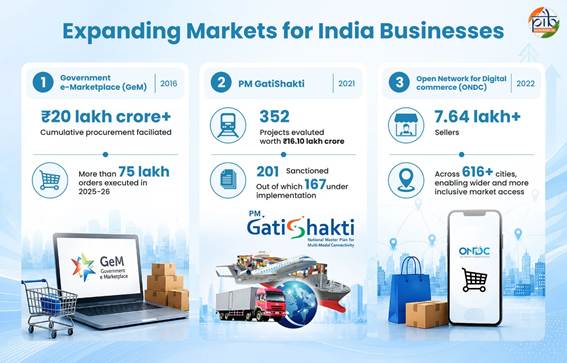
- PM GatiShakti (2021): It enables integrated infrastructure planning and multimodal connectivity through a unified digital platform. The platform brings together 58 Ministries/Departments and 36 States/UTs with 3,291 data layers. As of February 2026, the Network Planning Group evaluated 352 projects worth ₹16.10 lakh crore, with 201 sanctioned and out of which 167 projects are under implementation. The initiative helps businesses identify suitable locations, plan investments and access upfront multimodal connectivity and infrastructure, strengthening Ease of Doing Business.
- Open Network for Digital Commerce (2022): It promotes open digital commerce networks and reduces dependence on individual platforms. It has 7.64 lakh+ sellers across 616+ cities, supporting wider and more inclusive market access.
Strengthening India’s Global Business Footprint
India is strengthening its position in global markets by combining export promotion with better logistics, digital trade facilitation and stronger domestic production capabilities.
- Export Promotion Mission (2025): The mission is designed to enhance India’s export competitiveness, with a focused emphasis on MSMEs, first-time exporters, labour-intensive sectors, and exporters from interior and low-export-intensity regions. By bringing financial and non-financial support under one framework, the Mission reduces barriers to exporting and makes global market access easier for businesses.
- Trade Connect e-Platform: Provides exporters, including MSMEs, with trade information, market opportunities and access to global buyers. It has crossed 20 lakh registered users, with 40 lakh+ Certificates of Origin issued as of August 2026.
- ICEGATE (Indian Customs Electronic Gateway): ICEGATE enables electronic filing, duty payment, document amendments, query resolution and refund processing, making cross-border trade more efficient. Bills of Entry filings increased from over 1.43 lakhs in April 2020 to over 6.14 lakhs in June 2026, reflecting growth in digital customs processing and trade activity.
Creating an Enabling Enterprise Ecosystem
India’s Ease of Doing Business journey is evolving from simplifying individual processes to building a more responsive and enterprise-friendly ecosystem. With stronger digital infrastructure, wider access to markets and finance, and greater regulatory certainty, businesses are better positioned to seize opportunities, scale sustainably and compete globally.
References
Ministry of Commerce & Industry
https://www.pib.gov.in/PressReleaseIframePage.aspx?PRID=2090097®=3&lang=2
https://www.pib.gov.in/PressReleasePage.aspx?PRID=2154136®=3&lang=2
https://www.pib.gov.in/PressReleaseDetail.aspx?PRID=2204665®=1&lang=1
https://www.pib.gov.in/PressReleasePage.aspx?PRID=2253019®=3&lang=2
https://www.startupindia.gov.in/content/sih/en/about-startup-india-initiative.html
https://www.pib.gov.in/PressReleasePage.aspx?PRID=2201280®=3&lang=2
https://www.pib.gov.in/PressReleasePage.aspx?PRID=2168993®=3&lang=2
https://www.pib.gov.in/PressReleasePage.aspx?PRID=2244401®=3&lang=1
https://www.pib.gov.in/PressReleasePage.aspx?PRID=2246226®=3&lang=2
Ministry Of Finance
https://www.pib.gov.in/PressReleasePage.aspx?PRID=2216047®=3&lang=2
https://www.icegate.gov.in/services/statistics-reports
https://www.pib.gov.in/PressReleasePage.aspx?PRID=1643250®=3&lang=2
Ministry of Corporate Affairs
https://www.pib.gov.in/PressReleasePage.aspx?PRID=2099226®=3&lang=2
https://www.pib.gov.in/PressReleasePage.aspx?PRID=1656755®=3&lang=2
MSME
https://udyamregistration.gov.in/
PIB Archives
https://www.pib.gov.in/FactsheetDetails.aspx?id=150812&NoteId=150812&ModuleId=16®=48&lang=1
https://www.pib.gov.in/PressReleasePage.aspx?PRID=2236804®=3&lang=1
https://www.pib.gov.in/PressReleasePage.aspx?PRID=2269961®=48&lang=2
https://www.pib.gov.in/PressNoteDetails.aspx?NoteId=154772&ModuleId=3®=3&lang=2
https://static.pib.gov.in/WriteReadData/specificdocs/documents/2026/apr/doc202648842601.pdf
https://www.pib.gov.in/PressReleasePage.aspx?PRID=2236804®=3&lang=1
https://www.pib.gov.in/PressReleasePage.aspx?PRID=2232079®=3&lang=1
Click here to see Pdf
PIB Research
(रिलीज़ आईडी: 2298971)
आगंतुक पटल : 1814