Ministry of Communications
Union Minister for Communications Shri Jyotiraditya M. Scindia reviews progress of Bharat 6G Alliance, presents 5G Lab Excellence Awards
B6GA is working towards achieving Prime Minister Shri Narendra Modi’s Vision of Making India a Front-Line Contributor in Telecom Technology
Bharat 6G Alliance Must Benchmark Global Progress and Strengthen Collaboration among Working Groups: Shri Jyotiraditya M. Scindia
Government Reiterates Commitment to Making India a Global Leader in 6G Technologies
प्रविष्टि तिथि:
28 JUL 2026 7:51PM by PIB Delhi
The Union Minister of Communications and Development of North Eastern Region, Shri Jyotiraditya M. Scindia today reviewed the progress of the Bharat 6G Alliance (B6GA) at Vigyan Bhawan, New Delhi, along with Dr. Chandra Sekhar Pemmasani, Minister of State for Communications and Rural Development and Shri Amit Agrawal, Secretary (Telecom).
Prime Minister Shri Narendra Modi had released India’s 6G Vision “Bharat 6G Vision” document on March 22th, 2023 which envisages India to be a front-line contributor in design, development and deployment of 6G technology by 2030.
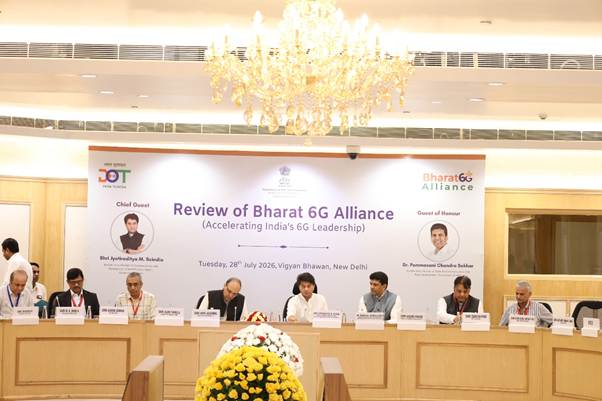
The meeting reviewed the progress and Action Taken by the Bharat 6G Alliance (B6GA) towards advancing India’s 6G ambitions. The Alliance functions through seven specialised Working Groups covering Spectrum; Device Technology & Manufacturing Ecosystem; Technology; Applications; Green & Sustainability; Outreach; and 6G Use Cases & Revenue Streams.
The members organisations of the alliance collectively hold more than 7,700 patent filings related to 5G and 6G technologies, including 4,400+ foreign filings, reflecting the growing strength of India’s research and innovation ecosystem. India’s participation in the 3GPP has also increased significantly, with the number of Indian participants rising from 717 in 2020 to 1,787 in 2025, while technical contributions increased from 196 to 2,943 during the same period.
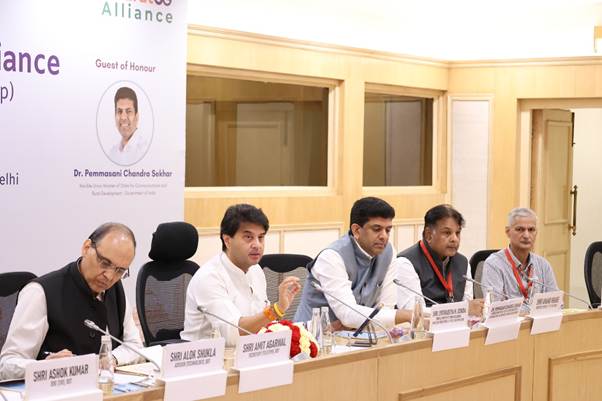
An update on 6G Technology Standardisation Efforts by the Telecom Standards Development Society, India (TSDSI) was also presented. The discussions highlighted the importance of India’s active and meaningful participation in global standardisation processes and the need to ensure that Indian innovations, technologies, use cases and requirements contribute to the development of globally relevant 6G standards.
Quarterly updates of the Bharat 6G Alliance Working Groups were presented during the meeting, covering six key areas of the 6G ecosystem—Technology; Applications & 6G Use Cases and Revenue Streams; Green and Sustainability; Spectrum; Devices Technology, Components, Sensors and Manufacturing Ecosystem; and Outreach. The deliberations focused on accelerating indigenous research and development, identifying emerging applications and use cases, strengthening spectrum strategies, promoting energy-efficient and sustainable technologies, developing domestic capabilities in devices, components, sensors and manufacturing, and expanding collaboration and outreach across the ecosystem.
The meeting emphasised the importance of building a robust end-to-end telecommunications ecosystem in India, with stronger linkages between research, innovation, standards, manufacturing and market deployment. The participants discussed the need for greater collaboration among Government, industry, academia, startups and research institutions to accelerate technology development, enable translation of research into deployable solutions and create globally competitive products and services.
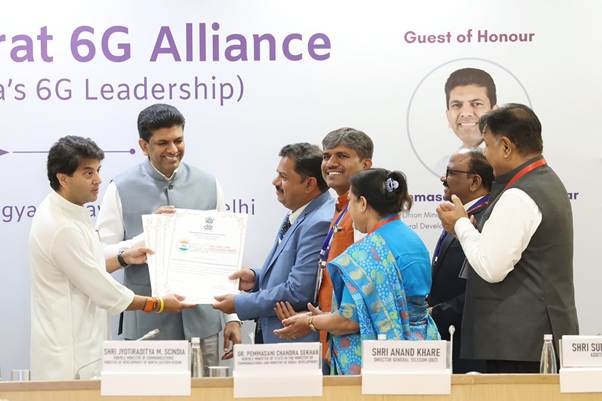
The 5G Labs Excellence Awards, based on cumulative performance during January–June 2026, recognised outstanding performance in utilisation, engagement, innovation and overall excellence in 5G/5G-Advanced technologies were also presented during the event. The awards acknowledge institutions and stakeholders for their contribution to experimentation, innovation, testing, skill development and the development of applications and use cases based on 5G and 5G-Advanced technologies. Based on cumulative performance during the period January–June 2026, four award categories were instituted, namely:
|
Award Category
|
Rank 1
|
Rank 2
|
Rank 3
|
|
5G Lab Excellence Award
|
IIITDM Kurnool
|
DKTE Textile & Engineering Institute, Maharashtra
|
IIT Roorkee
|
|
5G Lab Utilisation Excellence Award
|
IIITDM Kurnool
|
IIT Ropar
|
PEC Chandigarh
|
|
5G Lab Engagement Excellence Award
|
IIITDM Kurnool
|
IIT Roorkee
|
THDC Institute of Hydropower Engineering & Technology, Tehri
|
|
5G Lab Innovation Excellence Award
|
IIITDM Kurnool
|
DKTE Textile & Engineering Institute, Maharashtra
|
IIIT Delhi
|
IIITDM Kurnool secured the first position in all four categories, reflecting its outstanding overall performance among 5G Use Case Labs across the country.
An Open Discussion and Interaction with participants was held providing an opportunity for stakeholders to share their perspectives on emerging technologies, opportunities and challenges in the 6G ecosystem. The interaction covered key issues including technology development, standardisation, spectrum, sustainable communications, devices and manufacturing, applications and use cases, as well as mechanisms for strengthening collaboration among various stakeholders.
In the key remark, Shri Jyotiraditya M. Scindia, Union Minister of Communications and Development of North Eastern Region, reiterated the Government’s commitment to positioning India as a leading contributor to the global telecommunications ecosystem. He emphasised that India’s 6G journey must be anchored in indigenous research and innovation, strong standards participation, domestic manufacturing, sustainable technologies and global partnerships. Shri Scindia said, “There has been a tremendous amount of progress since the last meeting. I would like to congratulate the team on accomplishing set targets and look forward to achieving next set of objectives in a dynamic manner. We should see where all other international grouping are in their progress of achieving 6G and how we compare to them. We should also identify areas of intersections amongst the working groups and how there can be scope of collaborations amongst them.”
The Union Minister suggested to focus on identifying areas of intersection among the seven working groups to foster greater synergy and collaboration, while benchmarking the country’s progress against international 6G groupings to identify gaps, learn from global best practices and further improve its performance. He also noted the participants’ suggestions for greater support from the Ministry and Government, alongside the need to foster a robust ecosystem encompassing academia, research and development, and world-class testing infrastructure to strengthen India’s capabilities in 6G technology.
The Union Minister further emphasised the importance of creating a secure, resilient, sustainable and inclusive telecommunications ecosystem capable of supporting India’s digital aspirations and contributing to global technological advancement. He noted that the convergence of research, innovation, standards, manufacturing and applications will be critical to ensuring that India not only adopts next-generation technologies but also contributes significantly to their global development.
Delivering the Keynote Address, Dr. Chandra Sekhar Pemmasani, Minister of State for Communications and Rural Development, emphasised the importance of innovation, research and development and close collaboration between Government, industry, academia and research institutions in building a future-ready telecommunications ecosystem. He highlighted the need to accelerate indigenous technology development, nurture talent and create an enabling environment for startups and innovators to develop solutions for emerging communication technologies. Dr. Pemmasani said, “I am pleased to see the remarkable progress made by the Bharat 6G Alliance in bringing together industry, academia, startups and research institutions to shape India's 6G future. The collective efforts of its stakeholders and working groups have laid a strong foundation for innovation, indigenous technology development and global standardisation. As we move forward, it is essential to further deepen collaboration across all stakeholders, strengthen coordination among the working groups, and accelerate research, testing and standards development.”
The Bharat 6G Alliance Review Meeting reaffirmed the collective resolve to accelerate India’s 6G journey through coordinated efforts across technology, applications and use cases, sustainability, spectrum, devices and manufacturing, standardisation and outreach. The discussions and interactions provided further momentum to the vision of developing an indigenous, globally interoperable and future-ready telecommunications ecosystem, enabling India to emerge as a significant global hub for 6G innovation, technology, standards and deployment.
About Bharat 6G Alliance (B6GA)
The Bharat 6G Alliance is a multi-stakeholder collaborative platform bringing together academia, industry, startups and public institutions to build a world-class, future-ready 6G ecosystem in India. Focusing on R&D, innovation and standardisation, B6GA plays a pivotal role in advancing India’s vision of global leadership in next-generation communication technologies.
****
NJ/ARJ
(रिलीज़ आईडी: 2290730)
आगंतुक पटल : 1855