PIB Backgrounder
Start-up Village Entrepreneurship Programme
Catalysing Rural Economies through Grassroots Entrepreneurship
प्रविष्टि तिथि:
25 JUL 2026 10:12AM by PIB Delhi
The Start-up Village Entrepreneurship Programme supports non-farm enterprises through training, finance, mentoring, and community-led institutional support. By June 30, 2026, SVEP had supported 4.32 lakh rural enterprises across the country. The programme has strongly focused on social inclusion and equitable access to entrepreneurship opportunities. Around 86% of entrepreneurs belong to SC, ST, Minority, and OBC communities. Through SHGs, CRP-EPs, bank linkages, and convergence with schemes like Pradhan Mantri Mudra Yojana, SVEP has expanded its outreach. SVEP has emerged as an effective grassroots model for poverty reduction, local employment generation, and rural economic development.
Enterprise-Led Rural Transformation in India
India has the third-largest start-up ecosystem in the world. It has thrived with the support of favourable government policies and has proven highly beneficial for the economy's growth. However, most of the Indian start-up ecosystems are based in urban areas. Hence, the government has launched several initiatives to promote entrepreneurship and innovation in rural areas. One of the key initiatives is the Start-up Village Entrepreneurship Programme (SVEP).
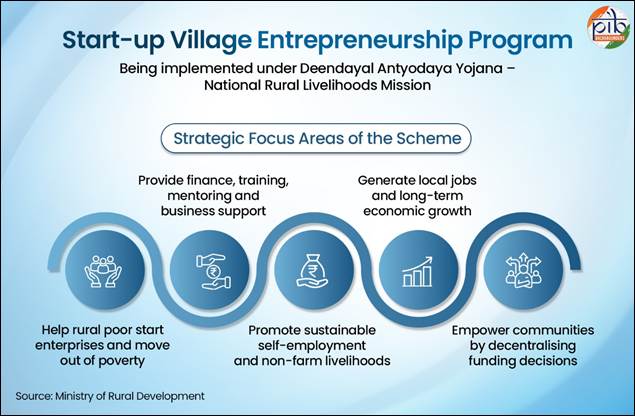
Launched in 2016, SVEP is a sub-scheme of the Deendayal Antyodaya Yojana – National Rural Livelihoods Mission (DAY-NRLM). The programme supports Self Help Groups (SHGs) and their family members in establishing small enterprises in the non-farm sector. It provides financial assistance, institutional support, business management training, soft skill development, and business development services. This promotes sustainable livelihoods and self-employment opportunities in rural areas.
SVEP also facilitates access to banking linkages and convergence with government schemes. The strategic focus has been on achieving long-term economic growth and wider social benefits. A key feature of SVEP has been community-based decision-making for funding and supporting enterprises locally.
Deendayal Antyodaya Yojana – National Rural Livelihoods Mission
The Deendayal Antyodaya Yojana–National Rural Livelihoods Mission (DAY-NRLM) is one of the world’s largest livelihood initiatives. It mobilizes rural poor households into Self-Help Groups (SHGs), predominantly women. The focus is on providing them with sustainable livelihoods, access to financial services, and skill development. As of mid-June 2026, more than 10.29 crore rural households have been mobilized into SHGs under DAY-NRLM.
Scaling Rural Entrepreneurship Across India
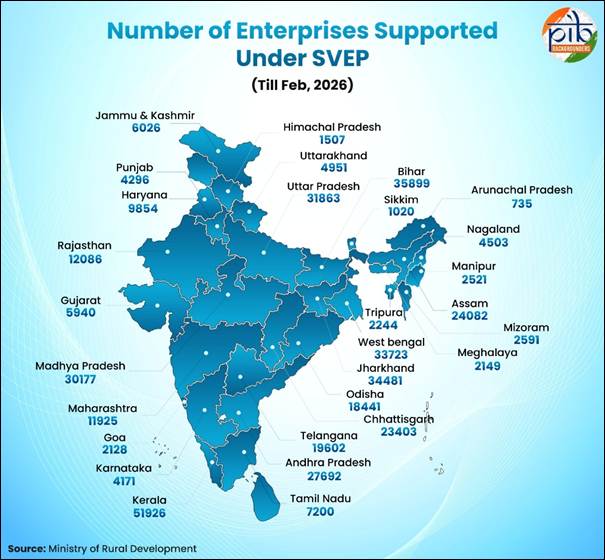
SVEP has adopted an all-inclusive approach, with a strong focus on supporting women, marginalized communities, and individuals with limited educational attainment. Since its inception till June 15, 2026, the programme has supported over 4.32 lakh rural enterprises. Assam, Bihar, Jharkhand, West Bengal and Madhya Pradesh have recorded the highest number of enterprises supported under the programme.
From SHG Member to Rural Business Leader
Ms. Bhagyashri Londhe from Jahanpur, Maharashtra, began her journey by joining an SHG in 2014. Participation in SHG and Village Organization (VOs) activities strengthened her leadership and business skills. She began her entrepreneurial journey by producing small-scale quantities of masala, papad, and pickles. A ₹45,000 Community Enterprise Fund loan under SVEP enabled her to scale up production by leveraging locally sourced raw materials. Her entrepreneurial efforts gained recognition at Mahalaxmi Saras 2019-20, where she earned ₹5 lakh in revenue within ten days.
Her aspirations to learn and grow enabled her to upgrade her business knowledge and skills. She completed her Class 10 education through an open university while managing her enterprise. Training under NRLM and Krishi Vigyan Kendra enhanced her business literacy and technical capabilities. Consequently, her enterprise started producing large volumes daily, generating regular income, and creating employment for rural women. Her journey demonstrates how entrepreneurship, continuous learning, and institutional support can transform aspiring women into successful business leaders.
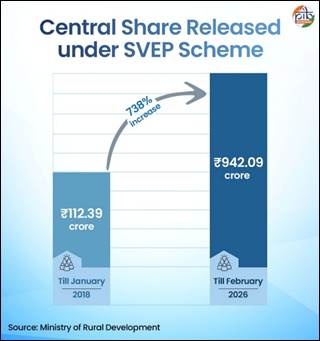
To support the continued expansion of SVEP, the government has released a cumulative central share of ₹942.09 crore up to February 2026. This is nearly 738% higher than the cumulative ₹112.39 crore released between the programme's launch in 2016 and January 2018.
Roadmap for Nurturing and Scaling Rural Enterprises
SVEP is implemented through the State Rural Livelihoods Missions (SRLMs), with a provision of ₹6.50 crore per block and an average investment of ₹27,083 per enterprise.
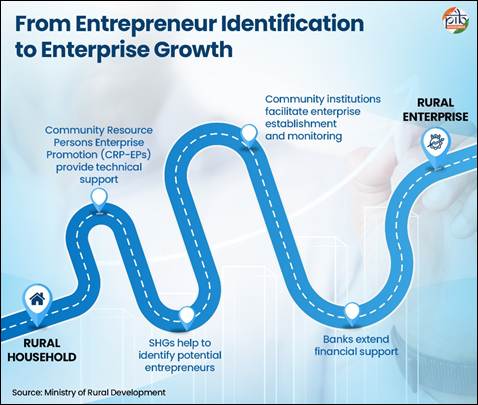
At the block level, Block Resource Centres–Enterprise Promotion (BRC-EPs) coordinate programme implementation. Trained Community Resource Persons–Enterprise Promotion (CRP-EPs) provide technical assistance to the Block Resource Centres on enterprise promotion. Banks extend financial support to eligible entrepreneurs. Self-Help Groups (SHGs) and their federations help identify potential entrepreneurs. Community institutions facilitate enterprise establishment and provide handholding support. They also manage loans through the Community Enterprise Fund (CEF). Community institutions also regularly monitor enterprise performance and growth. Digital tools support business planning, loan appraisal, and enterprise tracking. This integrated mechanism ensures effective implementation and enterprise development.
CRP-EPs are selected jointly by SRLMs and Project Implementing Agencies through testing, training, and certification. Preference is given to local residents with basic business and mathematical skills. At least 90% of CRP-EPs are selected from SHG households, with women constituting a minimum of 60% of the cadre. Each CRP-EP provides mentoring, training, and credit facilitation support to up to 50 enterprises.
From SHG Member to Best Performing CRP-EP
Ms. Poonam from Uttar Pradesh overcame social and financial barriers to become a successful CRP-EP. After joining a Self-Help Group, she was introduced to SVEP and completed a 54-day CRP-EP training programme. The training equipped her with skills in enterprise promotion and livelihood development. After completing her training, she began supporting nearly 40 enterprises by assisting with business planning, facilitating access to credit, establishing market linkages, and providing ongoing mentorship. Poonam credits SVEP for her financial independence and values the opportunity it has given her to help others establish and grow their businesses. Her journey reflects how community-based institutions and entrepreneurship support can strengthen rural livelihoods and advance women’s economic empowerment.
Entrepreneurs are identified by community institutions based on need, poverty status, and entrepreneurial potential. Beneficiaries receive training, mentoring, and financial support after enterprise viability assessment, with final loan approval provided by community-based organisations. The programme mandates that at least 60% of beneficiaries are women, while ensuring representation of persons with disabilities and SC/ST/minority communities.
SVEP is monitored at the State and Central levels through quarterly reviews and periodic assessments. Further, there is a centralized MIS system for tracking enterprise performance, fund utilisation, and programme progress.
Impact of SVEP on Rural Livelihoods and Entrepreneurship
The Quality Council of India (QCI) conducted a mid-term evaluation of the SVEP for the Ministry of Rural Development, with major field assessments undertaken in 2019. The review assessed the programme's impact on rural enterprises, livelihoods, and social inclusion.
The findings indicate positive outcomes in income generation, enterprise development, and empowerment of vulnerable communities:
- 99% of SVEP-supported enterprises were profitable.
- SVEP enterprises contributed 57% of total household income.
- Average monthly enterprise revenue was about ₹39,000.
- Manufacturing enterprises recorded the highest average revenue at ₹47,800 per month.
- 96% of entrepreneurs reported increased savings.
- 75% of enterprises were owned or managed by women.
SVEP helped entrepreneurs earn incomes above their initial aspirations. Improved access to finance enabled entrepreneurs to establish and grow enterprises. Continuous mentoring strengthened enterprise management and sustainability.
Moreover, SVEP encouraged women and disadvantaged communities to become first-generation entrepreneurs. Beneficiaries reported improved confidence and livelihood security. Many households experienced better education, nutrition, health, and sanitation outcomes. Entrepreneurs gained stronger business management and financial skills. Increased savings and reinvestment supported long-term enterprise growth. The programme also enhanced the social standing of beneficiaries within their communities.
From Welfare to Enterprise-Led Development
SVEP has demonstrated that rural entrepreneurship can act as a powerful driver of inclusive economic growth when supported by strong community institutions. By empowering women, SC/ST communities, and first-generation entrepreneurs, the programme has transformed local aspirations into sustainable enterprises. This further leads to higher incomes, increased savings, and improved household well-being. More importantly, it has shown that entrepreneurial talent exists in every village and can flourish when provided with the right ecosystem. As India advances towards becoming a global start-up hub, programmes such as SVEP are laying the foundation for a vibrant rural start-up ecosystem. It is generating employment, strengthen local economies, and unlock new opportunities for millions of rural families. In conclusion, this is contributing to the vision of a self-reliant and developed India.
References
Ministry of Rural Development
https://svep.nrlm.gov.in/landing
https://svep.nrlm.gov.in/pdf/Final_Mid_Term_Report.pdf
https://nrlm.gov.in/dashboardForOuter.do?methodName=dashboard
https://lakhpatididi.gov.in/wp-content/uploads/2024/02/SVEP_updated_Master_Circular.pdf
https://sansad.in/getFile/loksabhaquestions/annex/13/AU2824.pdf?source=pqals
https://www.pib.gov.in/PressReleaseIframePage.aspx?PRID=1651525®=48&lang=2
https://sansad.in/getFile/loksabhaquestions/annex/187/AU3940_Wamd8p.pdf?source=pqals
Ministry of Commerce
https://www.ibef.org/blogs/svep-start-up-village-entrepreneurship-programme
Government of Nagaland
https://nsrlm.nagaland.gov.in/wp-content/uploads/2020/07/guidelines-CRP-EP.pdf
PIB Backgrounders
https://www.pib.gov.in/PressReleasePage.aspx?PRID=2195990®=3&lang=1
https://www.pib.gov.in/PressReleasePage.aspx?PRID=2267960®=3&lang=1
https://www.pib.gov.in/FeaturesDeatils.aspx?NoteId=156719&ModuleId=2®=3&lang=1
Click to See PDF
***
PIB Research
(रिलीज़ आईडी: 2289268)
आगंतुक पटल : 4792