Ministry of Science & Technology
CSIR-Central Road Research Institute (CSIR-CRRI) today commenced its year-long Platinum Jubilee Celebrations with the launch of a nationwide first-phase implementation of advanced indigenous road infrastructure technologies across 16 towns or locations across the country.
Union Minister Dr. Jitendra Singh calls for wider industry partnerships to take indigenous road technologies from laboratories to highways
Dr. Jitendra Singh Launches MSS+ Smart Mix Pro Plant, Calls for Stronger Industry Partnerships to Scale Up Indigenous Road Technologies
CSIR-CRRI Showcases Next-Generation Road Technologies, Strengthens Industry Partnerships for Wider Deployment
प्रविष्टि तिथि:
16 JUL 2026 6:12PM by PIB Delhi
The CSIR-Central Road Research Institute (CSIR-CRRI) today commenced its year-long Platinum Jubilee Celebrations (July 16, 2026 – July 16, 2027) with the launch of a nationwide first-phase implementation of advanced indigenous road infrastructure technologies across 16 towns or locations in the country. The initiative marks a significant step towards demonstrating and scaling up innovative, sustainable road construction and maintenance technologies developed by CSIR-CRRI through strategic collaborations with industry and implementing agencies.
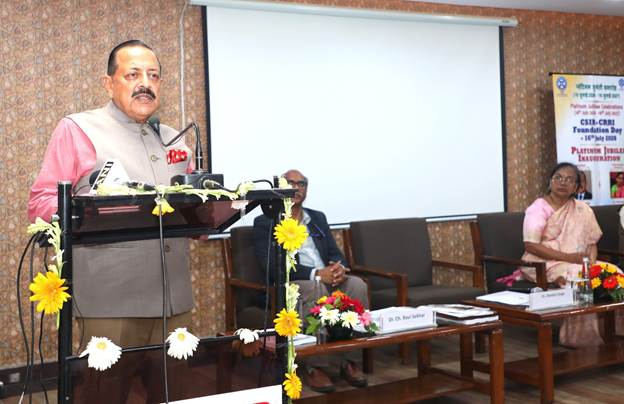
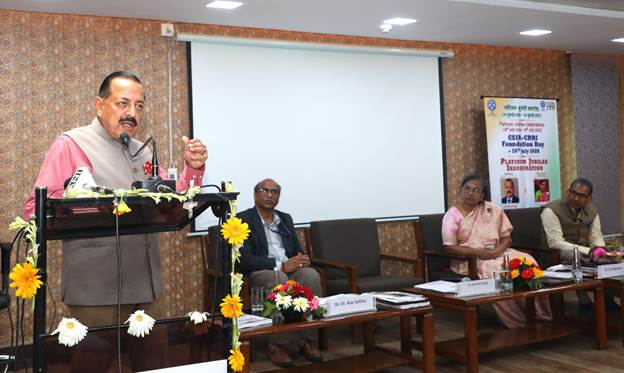
The celebrations were inaugurated by Union Minister of State (Independent Charge) for Science & Technology and Earth Sciences; Minister of State in the Prime Minister's Office, Personnel, Public Grievances and Pensions, Department of Atomic Energy and Department of Space, Dr. Jitendra Singh, who called for stronger collaboration between scientific institutions, industry and State governments to ensure that home-grown technologies are implemented on a much larger scale across the country.
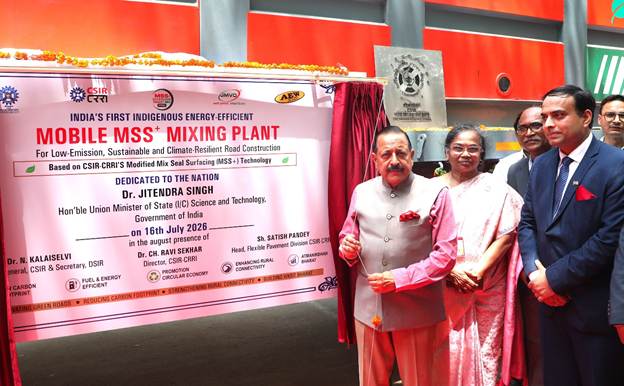
Before inaugurating the celebrations, Dr. Jitendra Singh visited the technology exhibition and interacted with scientists, researchers and industry representatives. He reviewed a range of indigenous technologies developed by CSIR-CRRI in road engineering, pavement technologies, intelligent transportation systems, road safety and sustainable construction materials. The Minister also launched the Automatic Modified Mix Seal Surfacing (MSS+) Smart Mix Pro Mixing Plant, designed for the large-scale implementation of CSIR-CRRI's indigenous Modified Mix Seal Surfacing (MSS+) technology. He inaugurated the AI-enabled Network Survey Vehicle (NSV) for comprehensive road infrastructure assessment and dedicated the PATCH-FILL pothole repair technology, reinforcing the Institute's efforts towards smarter, safer and environmentally sustainable road infrastructure.
The programme was attended by Dr. (Mrs.) N. Kalaiselvi, Director General, CSIR & Secretary, DSIR; Dr. Ch. Ravi Sekhar, Director, CSIR-CRRI; former Directors of the Institute; senior scientists, academicians, industry leaders, policymakers, engineers, representatives of Central and State Government organisations and technology partners.
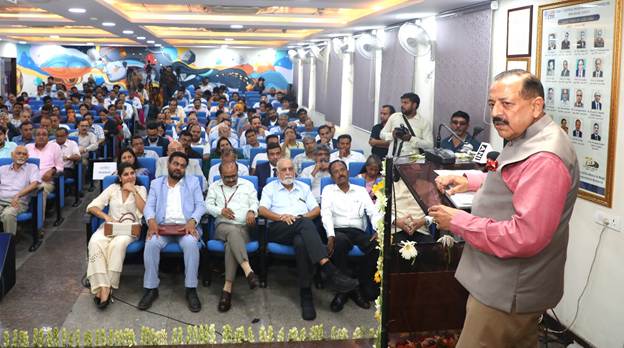
Addressing the gathering, Dr. Jitendra Singh said that India's unprecedented infrastructure expansion under the leadership of Prime Minister Shri Narendra Modi has created a significant opportunity for scientific institutions to contribute cutting-edge technologies for roads, bridges and transportation systems. Referring to the country's expanding network of highways, airports, railways and urban infrastructure, he said research institutions must continuously deliver innovative, cost-effective and sustainable solutions capable of meeting India's growing infrastructure requirements.
The Minister said scientific research achieves its true purpose only when technologies move beyond laboratories and reach the field. He called for industry partners to be associated with technology development from the very beginning so that innovations evolve according to practical requirements and are commercialised faster. He also stressed greater convergence among scientific institutions working in related sectors and said wider outreach to stakeholders is essential for translating research into economic and societal impact.
Dr. Jitendra Singh said indigenous technologies such as Steel Slag Roads, Modified Mix Seal Surfacing (MSS+), Bio-Binder, EcoFix, RejuPave and other sustainable pavement technologies demonstrate how scientific innovation can simultaneously strengthen infrastructure, promote environmental sustainability and support the national missions of Waste to Wealth, Circular Economy and Atmanirbhar Bharat. He said technologies that convert industrial waste into durable infrastructure represent the future of sustainable development.
Emphasising the need to accelerate implementation, the Minister said successful technologies must be propagated more extensively among States and implementing agencies. He suggested structured interactions with State Road Secretaries and Chief Engineers to facilitate wider adoption of proven indigenous technologies across the country and encouraged CSIR-CRRI to organise regular industry interactions so that scientific innovations continue to respond to field requirements while generating greater commercial value.
A major highlight of the event was the commercialisation of several indigenous technologies developed by the Institute. LUMETRA, an advanced indigenous glare measurement technology, was licensed to Accurate Optics, Haryana. Technology Transfer Agreements for the MSS+ Smart Mix Pro technology were signed with JMVD Industries Private Limited, Uttar Pradesh, and Ashok Road Equipment Manufacturers (India) Private Limited, Telangana. Bio-Binder, developed for producing bio-bitumen from lignocellulosic biomass, was transferred to GWC Asphalt, Assam, and Goyat Biorefinery LLP, Haryana, while PAVE-SEAL, an air-cleaning nano-photocatalytic pavement sealing technology, was transferred to Bitumix India LLP, Assam.
The Institute also signed a Memorandum of Understanding (MoU) with CMSPL and NICMAR, besides Memoranda of Agreement (MoA) with HanuAI, TechFAB and Terra Climate, further strengthening collaboration between research institutions and industry for technology development, commercialisation and deployment.
To commemorate the Institute's 75-year journey of scientific excellence, Dr. Jitendra Singh unveiled the CSIR-CRRI Platinum Jubilee Logo and released the Platinum Jubilee Planner (July 2026–July 2027) and the CSIR-CRRI Annual Report 2025–26. The Minister also felicitated recipients of the Asia Book of Records, recognising the Institute's contributions to research, innovation and technology development.
Speaking on the occasion, Dr. Jitendra Singh said CSIR-CRRI has evolved into India's premier institution dedicated to roads, bridges, pavement engineering and transportation technologies, contributing significantly to the country's infrastructure development over the past seven decades. He noted that with India's National Highway network expanding from about 91,000 kilometres in 2014 to nearly 1.47 lakh kilometres today, alongside rapid growth in airports, railways and urban infrastructure, the role of institutions such as CSIR-CRRI has become even more critical in delivering indigenous, sustainable and globally competitive technologies.
The Minister said the next phase of growth must focus on scaling up proven technologies rather than limiting them to pilot projects. Referring to the successful implementation of steel slag roads in several States, he said such technologies have demonstrated their effectiveness and should now be adopted more widely across the country. He called for greater awareness among State governments and implementing agencies so that innovative solutions developed by Indian scientists become an integral part of infrastructure projects nationwide.
Dr. Jitendra Singh also emphasised that India's research ecosystem should work in close partnership with industry from the inception of every technology. Such collaboration, he said, would enable research institutions to develop solutions that are market-driven, commercially viable and readily deployable while reducing the time taken for technologies to move from laboratories to public use. He added that regular engagement with industry and implementing agencies would further strengthen technology commercialisation and create greater economic value from publicly funded research.
Referring to the Institute's work on sustainable construction materials, the Minister said innovations based on steel slag, waste plastic, bio-based binders and other industrial by-products are helping transform waste into valuable national assets while reducing environmental impact. Such technologies, he said, represent the true spirit of Atmanirbhar Bharat and the Government's commitment to promoting sustainable and resource-efficient infrastructure.
In her address, Dr. (Mrs.) N. Kalaiselvi, Director General, CSIR and Secretary, DSIR, said that CSIR-CRRI technologies are already being implemented on more than 1,200 kilometres of roads across the country, including nearly 280 kilometres of Steel Slag Roads, while the Institute's MSS+ technology has also witnessed large-scale adoption in multiple States. She expressed confidence that the Institute's long-term goal is to see one-third of India's road network adopting CSIR-CRRI technologies, supported by stronger partnerships with industry and wider implementation by States.
The Platinum Jubilee celebrations also reaffirmed CSIR-CRRI's commitment to strengthening collaboration among government, academia and industry to develop safe, sustainable, climate-resilient and technology-driven transportation infrastructure. Through continued innovation, technology commercialisation and stakeholder partnerships, the Institute aims to play an increasingly important role in supporting India's journey towards Viksit Bharat 2047.
*****
NKR/AK
(रिलीज़ आईडी: 2285435)
आगंतुक पटल : 238