Ministry of Personnel, Public Grievances & Pensions
'Whole of Government' approach calls for convergence of diverse individual and institutional capacities: Dr Jitendra Singh
Capacity Building Goes Beyond Individual Competence, Calls for Convergence of Institutional Capabilities as well: Dr. Jitendra Singh
Union Minister Dr. Jitendra Singh Launches Third Batch of DAKSH Leadership Programme for Senior PSE Executives
DAKSH Leadership Programme to Build Future-Ready Leadership Pool for India's Public Sector Enterprises: Dr. Jitendra Singh
प्रविष्टि तिथि:
03 JUL 2026 4:44PM by PIB Delhi
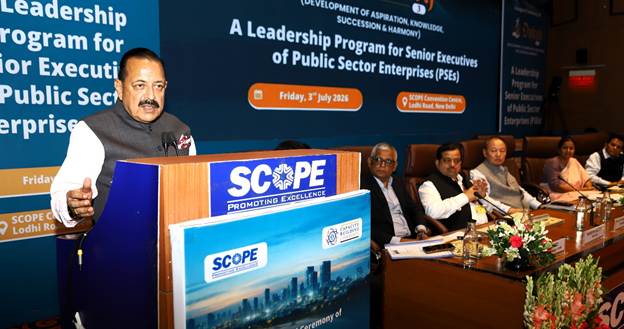
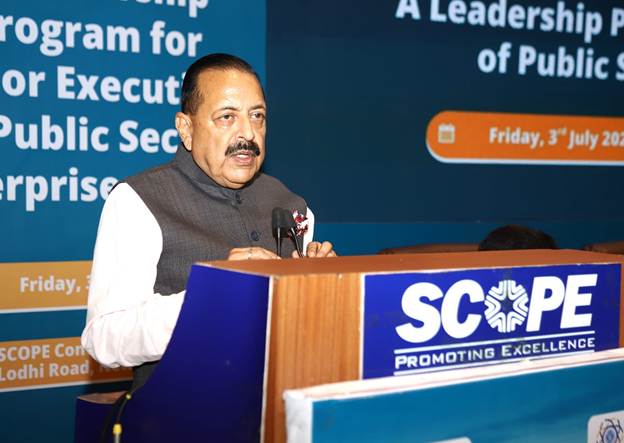
Union Minister of State (Independent Charge) for Science & Technology, Earth Sciences and Minister of State in the Prime Minister's Office, Personnel, Public Grievances & Pensions, Department of Atomic Energy and Department of Space, Dr. Jitendra Singh today said that India's "Whole of Government" approach calls for convergence of diverse individual and institutional capacities, where institutions and professionals contribute their respective strengths and expertise towards common national goals.
The Minister said, capacity building is no longer confined to enhancing individual competencies but must also create synergy across institutions to prepare governance systems capable of meeting the aspirations of Viksit Bharat by 2047.
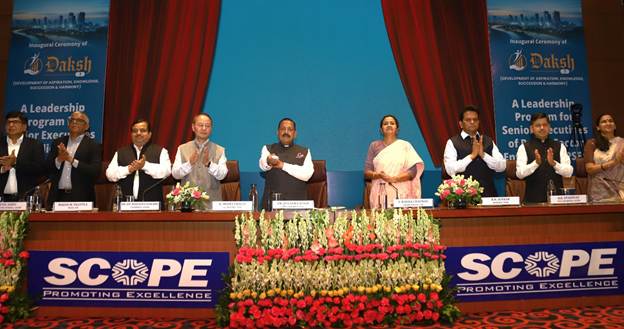
Dr. Jitendra Singh was inaugurating the third batch of DAKSH (Development of Aspiration, Knowledge, Succession and Harmony), a year-long leadership development programme for senior executives of Central Public Sector Enterprises (CPSEs), organised jointly by the Capacity Building Commission (CBC) and the Standing Conference of Public Enterprises (SCOPE) at the SCOPE Convention Centre, New Delhi. The programme is being conducted in collaboration with the Indian School of Business (ISB) to prepare senior executives for future Board-level responsibilities through structured leadership development and capacity building.
The inaugural ceremony was attended by Secretary, Department of Public Enterprises, K. Moses Chalai; Chairperson, Capacity Building Commission, S. Radha Chauhan; Member (Administration), Capacity Building Commission, Alka Mittal; Chairman, SCOPE and CMD, NBCC, K.P. Mahadevaswamy; Dean, Indian School of Business, Shri Madan Pillutla; Director General, SCOPE, Atul Sobti; Vice Chairman, SCOPE and CMD, Goa Shipyard Limited, Shri Brajesh Kumar Upadhyay, along with senior government officials, CPSE leadership and participants of the DAKSH programme.
Congratulating the organisers and participants, Dr. Jitendra Singh said the participation of executives from some of the country's leading public sector enterprises reflects the growing credibility of the programme. He also appreciated the increasing representation of women officers in the current batch, describing it as a positive reflection of India's changing leadership landscape.
The Minister said the Capacity Building Commission has emerged as one of the most significant governance reforms introduced under Prime Minister Narendra Modi's vision. Recalling its evolution, he said the Commission initially represented an entirely new institutional experiment in governance but has since established itself as an important pillar of capacity development across government.
Dr. Jitendra Singh said the Government's governance philosophy has evolved from a Whole-of-Government approach towards a broader Whole-of-Government and Whole-of-Nation framework. Such an approach, he said, becomes meaningful only when diverse institutions contribute their respective capabilities and expertise instead of functioning in isolation. He added that the Capacity Building Commission is uniquely positioned to strengthen both individual competencies and institutional convergence by bringing together different categories of public functionaries on common learning platforms.
Describing DAKSH as a natural extension of this evolving capacity-building ecosystem, Dr. Jitendra Singh said the programme is preparing the next generation of leadership for India's public sector enterprises. He noted with satisfaction that several participants from earlier batches have already moved to Board-level positions, demonstrating the programme's contribution to strengthening governance structures within CPSEs.
The Minister said the distinction between the public and private sectors is steadily narrowing as governance and development increasingly require collaborative approaches. He suggested that leadership programmes should expose senior public sector executives to greater interaction with the private sector, global best practices and emerging management models so that they are better equipped for the demands of a rapidly changing economy.
Emphasising the pace of technological transformation, Dr. Jitendra Singh said continuous learning has become indispensable for leadership in the modern era. Knowledge acquired today quickly becomes outdated, he observed, making adaptability and lifelong learning the defining characteristics of successful leaders. He suggested that leadership programmes should increasingly be customised around the evolving needs of senior executives instead of following uniform training models.
Calling for greater participant ownership in leadership development, the Minister advocated structured and anonymous feedback mechanisms to continuously refine programmes such as DAKSH. He also suggested making learning more interactive through dialogue-based sessions rather than one-way lectures, enabling participants to contribute from their own professional experiences while enriching classroom discussions.
Dr. Jitendra Singh further recommended stronger collaboration with premier academic institutions and domain-specific centres of excellence so that leadership programmes can be tailored to the specialised requirements of different public sector enterprises. Such partnerships, he said, would ensure that sector-specific knowledge complements broader leadership capabilities.
Expressing confidence in the future of the initiative, the Minister said programmes like DAKSH will play an important role in creating a leadership pipeline capable of steering India's public enterprises through the coming decades. He said that when India celebrates 100 years of Independence in 2047, institutions like the Capacity Building Commission and SCOPE will take pride in having contributed meaningfully to the journey towards Viksit Bharat.
Chairperson, Capacity Building Commission, S. Radha Chauhan said leadership development today extends beyond enhancing individual capabilities to strengthening organisational and institutional capacities capable of adapting to rapidly evolving technologies and governance models. She said the Commission is integrating future-oriented themes such as Artificial Intelligence, emerging technologies and institutional adaptability into its capacity-building framework while systematically documenting participant feedback to continuously improve leadership programmes.
Member (Administration), Capacity Building Commission, Smt. Alka Mittal said DAKSH represents a strategic national investment in India's future leadership pipeline. She said the year-long programme has been designed to prepare senior CPSE executives for Board-level responsibilities through behavioural science, leadership research and strategic thinking, enabling them to lead organisations with resilience, ethical clarity, innovation and national purpose.
*****
NKR/AK/AV
(रिलीज़ आईडी: 2280759)
आगंतुक पटल : 1164