Ministry of Jal Shakti
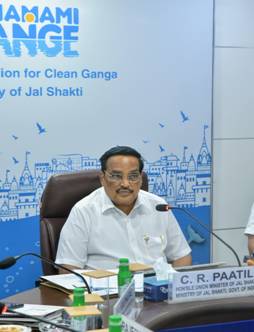
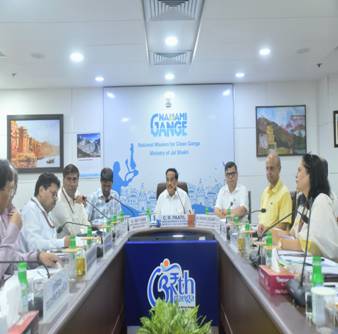
Jal Shakti Minister Shri C.R. Paatil chairs 19th Meeting of Empowered Task Force on Ganga Rejuvenation
Reviews progress under Namami Gange; emphasizes accelerated project implementation, treated wastewater reuse, groundwater management and institutional coordination
प्रविष्टि तिथि:
02 JUL 2026 7:38PM by PIB Delhi
Strengthening the Government's commitment towards holistic river rejuvenation, the 19th Meeting of the Empowered Task Force (ETF) on River Ganga was held on 2 July 2026 under the chairmanship of the Union Minister for Jal Shakti, Shri C.R. Paatil. The meeting reviewed the progress of the Namami Gange Programme and deliberated on key interventions aimed at accelerating river rejuvenation through improved infrastructure, scientific water management, policy reforms and enhanced coordination among stakeholders.
|
|
|
|
|
|
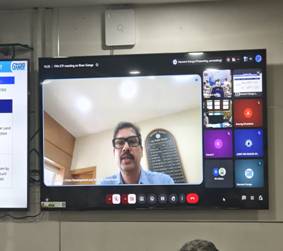
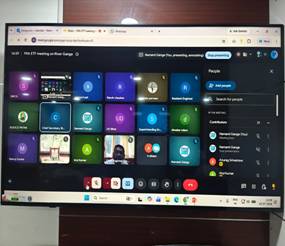
The meeting was also joined by MoS Jal Shakti, Shri Raj Bhushan Chaudhary and it brought together key stakeholders from various ministries and state governments, including Secretary, Department of Water Resources, Shri V.L. Kantha Rao; Secretary, Department of Drinking Water & Sanitation, Shri Ashok K.K Meena; Director General of the National Mission for Clean Ganga (NMCG) Shri Rajeev Kumar Mital; JS&FA Department of Water Resources Shri Gaurav Masaldan; Shri Nalin Srivastava (Deputy Director General, NMCG); Shri Brijendra Swaroop, Executive Director (Projects), Shri Anup Kumar Srivastava (Executive Director, Technical); Shri Bhaskar Dasgupta (Executive Director, Finance); Ms. Aishwarya Singh Joint Secretary (DDWS), Sh. Anurag Srivastava, ACS UP, Ms Nandini Ghosh (Project Director, West Bengal SPMG); Sh. Suraj Project Director (Jharkhand); along with senior officers of NMCG and participating states. Meeting was attended by representatives of Ministry of Power, Ministry of Housing and Urban Affairs, Ministry of Home Affairs of Government of India.
Expressing satisfaction over the progress achieved, the Minister appreciated the continued pace of implementation under the Namami Gange Programme. He was informed that 524 projects have been sanctioned so far at an estimated cost of ₹43,031 crore, of which 363 projects have been completed. Under sewerage infrastructure, 218 projects have been sanctioned with a treatment capacity of 6,610 MLD and a sewer network of 5,233 km, while 145 sewerage projects have already been completed, creating and rehabilitating 4,263 MLD of treatment capacity along with over 4,611 km of sewerage network. The programme has recorded an expenditure of over ₹21,550 crore, reflecting sustained progress in project execution across Ganga Basin States.
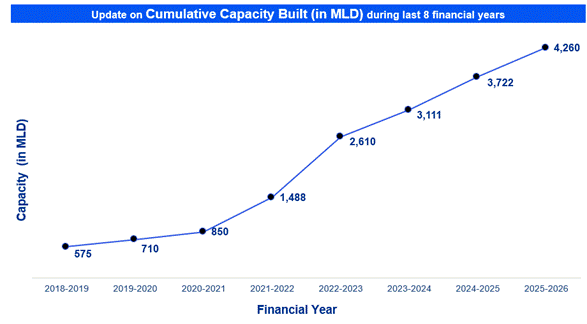
The meeting also reviewed the progress of project implementation under Namami Gange during FY 2025–26. It was noted that the programme added 538 MLD of sewage treatment capacity during the financial year, taking the cumulative sewage treatment capacity created to around 4,260 MLD. The Minister appreciated the consistent improvement in implementation and directed States to maintain the momentum for timely completion of all ongoing projects.
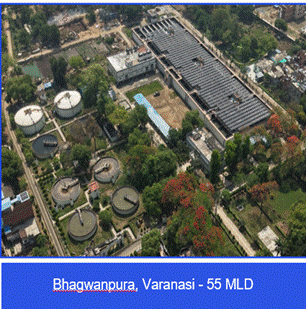
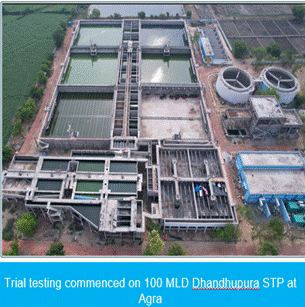
The meeting reviewed major activities undertaken by NMCG since the 18th ETF meeting. The Minister appreciated the commencement of trial testing of the 100 MLD Dhandhupura Sewage Treatment Plant at Agra, which will significantly reduce untreated wastewater entering River Yamuna after commissioning. He also lauded the commissioning of the 55 MLD Bhagwanpura STP at Varanasi, inaugurated by Prime Minister Shri Narendra Modi, which has substantially strengthened sewage treatment in the city while incorporating a 750 kW solar power plant to meet a significant share of the plant's operational energy requirements.
|
|
|
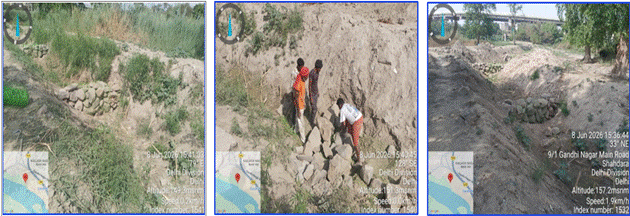
Highlighting the growing role of Nature-based Solutions (NbS) in urban river management, the meeting reviewed progress of the Constructed Wetland System being developed for in-situ remediation of the Shastri Park and Kailash Nagar drains in Delhi. The Minister appreciated the ecological restoration measures including desilting, embankment formation, aquatic plantation and stone pitching, and directed officials to ensure timely completion so that these interventions serve as replicable models for sustainable wastewater management.
The meeting also reviewed NMCG's extensive public outreach initiatives. The Minister appreciated the successful observance of World Environment Day 2026, during which large-scale awareness campaigns, plantation drives, cleanliness activities and community engagement programmes were organised across around 125 Ganga districts, further strengthening people's participation in river conservation.
The Minister appreciated several biodiversity conservation and ecosystem restoration initiatives undertaken under the Namami Gange Programme. These included the river ranching programme organised by ICAR-CIFRI to restore native fish biodiversity in the Ganga, the successful community-led rejuvenation of the Baya River in Bihar, and the rescue of a stranded Gangetic Dolphin using India's first Dolphin Ambulance, an initiative that received national recognition during Prime Minister's Mann Ki Baat programme. The meeting also noted with satisfaction that the number of Ramsar wetlands within the Ganga Basin has increased to 35, further strengthening conservation of wetlands and aquatic biodiversity across the basin.
Emphasis was laid on strengthening scientific river basin management through integrated planning of surface water and groundwater systems. The meeting reviewed progress on the development of a Standard Operating Procedure for engineered groundwater recharge along the Ganga Main Stem and the identification of priority districts for groundwater interventions by the Central Ground Water Board (CGWB). The Minister emphasized the need for coordinated implementation of groundwater recharge measures to enhance long-term water security across the basin.
A major focus of the meeting remained the Safe Reuse of Treated Wastewater (SRTW). The Minister reviewed the completion of City-Level Reuse Action Plans (CLRAPs) for Agra, Prayagraj and Varanasi, which identify opportunities for utilizing treated wastewater across sectors such as thermal power, railways, urban landscaping and irrigation. Stressing that reuse must be guided by quality and safety, Shri C.R. Paatil directed that treated wastewater intended for irrigation and other applications should strictly conform to the prescribed quality standards and undergo regular monitoring to safeguard public health and agricultural productivity. He further directed the concerned Urban Local Bodies and State Departments to expedite implementation of the identified reuse projects while strengthening institutional mechanisms for quality assurance and sustainable urban water management.
The Minister further reviewed progress on Action Taken Reports relating to environmental flow monitoring, sewerage infrastructure, land acquisition, DPR preparation, safe reuse of treated wastewater, aerial drainage mapping, groundwater recharge interventions, sand mining management, and implementation of City Sanitation Action Plans. He directed all implementing agencies and State Governments to expedite pending activities and ensure timely compliance with the decisions of the Empowered Task Force.
Concluding the meeting, Shri C.R. Paatil reiterated that the rejuvenation of River Ganga is a shared national responsibility requiring sustained collaboration among Central Ministries, State Governments, Urban Local Bodies, scientific institutions and local communities. He emphasized that strengthening sewage infrastructure, promoting reuse of treated wastewater, conserving wetlands and biodiversity, adopting Nature-based Solutions, and integrating groundwater management with river conservation will collectively accelerate the vision of a Aviral & Nirmal Ganga, while ensuring long-term water security and ecological resilience across the Ganga Basin.
****
ND/HM
(रिलीज़ आईडी: 2280512)
आगंतुक पटल : 1483