Ministry of Health and Family Welfare
Union Health Ministry Convenes Regional Workshop to Strengthen Strategies for a Leprosy-Free India
India Has Made Remarkable Progress Against Leprosy, But Intensified Efforts Are Needed in Endemic Areas”: Smt. Aradhana Patnaik
Periodic Case Detection Campaigns and Expanded SDR Coverage Vital to Breaking Leprosy Transmission: AS & MD
Regional Workshop Concludes with State-Specific Roadmaps for Achieving a Leprosy-Free India
प्रविष्टि तिथि:
12 JUN 2026 5:06PM by PIB Delhi
In a significant step towards realizing the vision of a Leprosy-Free India, the Ministry of Health and Family Welfare, Government of India, organized a two-day Regional Workshop on Review of Programme Performance and Focused Strategic Action for Achieving Zero Transmission of Leprosy in Nava Raipur, Chhattisgarh.
Addressing the gathering, Smt. Aradhana Patnaik highlighted India's remarkable achievements in reducing the burden of leprosy and recalled that the country had attained elimination as a public health problem at the national level in 2005. She noted, however, that transmission persists in several endemic districts and hotspot areas, necessitating intensified and targeted interventions to interrupt transmission completely.
Underscoring the importance of early diagnosis and prompt treatment, she emphasized the need for periodic Leprosy Case Detection Campaigns in endemic areas. She also called for strengthening contact tracing and expanding the coverage of Post-Exposure Prophylaxis (PEP) through Single-Dose Rifampicin (SDR) among eligible healthy contacts of index cases, particularly in vulnerable and hard-to-reach populations. Encouraging states to increase contact screening and PEP coverage, she noted that these interventions are critical for reducing disease transmission and preventing new infections.
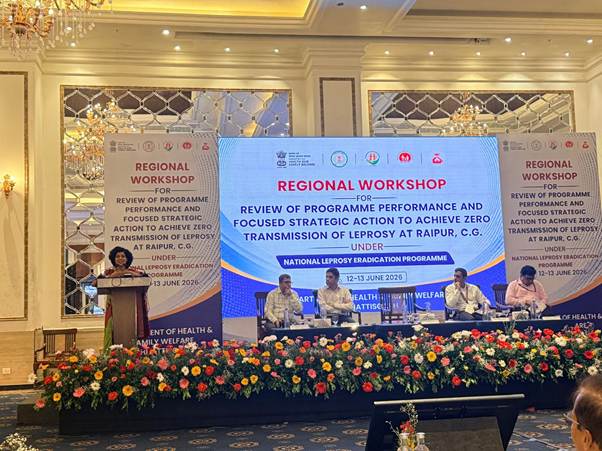
Ms. Patnaik emphasized that while substantial progress has been achieved, the challenge now lies in sustaining gains and accelerating action in the remaining endemic pockets. Stressing accountability, timely decision-making, and effective programme implementation, she urged states to regularly review progress, identify implementation bottlenecks, and undertake corrective measures. She highlighted the importance of capacity building, Information, Education and Communication (IEC) activities, and convergence under the National Health Mission framework to strengthen programme implementation.
She further advocated leveraging Community-Based Assessment Checklists (CBAC), Rashtriya Bal Swasthya Karyakram (RBSK), and Rashtriya Kishor Swasthya Karyakram (RKSK) platforms for enhanced screening and early detection of leprosy. She also guided State and District Leprosy Officers on the effective utilization of flexi-pool resources available under the National Health Mission and called upon all participating states to maintain momentum towards achieving zero transmission.
Highlighting the epidemiological landscape, Ms. Patnaik informed participants that five high-priority states—Maharashtra, Chhattisgarh, Jharkhand, Odisha, and Madhya Pradesh—together account for nearly 50 percent of India's leprosy burden. She noted that these states also have a substantial number of districts reporting prevalence rates above one case per 10,000 population, including 23 districts in Chhattisgarh, 21 in Jharkhand, 18 each in Maharashtra and Odisha, and 10 districts in Madhya Pradesh.
She further observed that while most States and Union Territories have achieved leprosy elimination status, Chhattisgarh, Jharkhand, Odisha, Maharashtra, and Chandigarh are yet to achieve the elimination target at the sub-national level. She emphasized that achieving zero transmission would require stronger inter-state collaboration, evidence-based planning, intensified surveillance, sharing of best practices, and sustained efforts to eliminate stigma and discrimination associated with the disease.
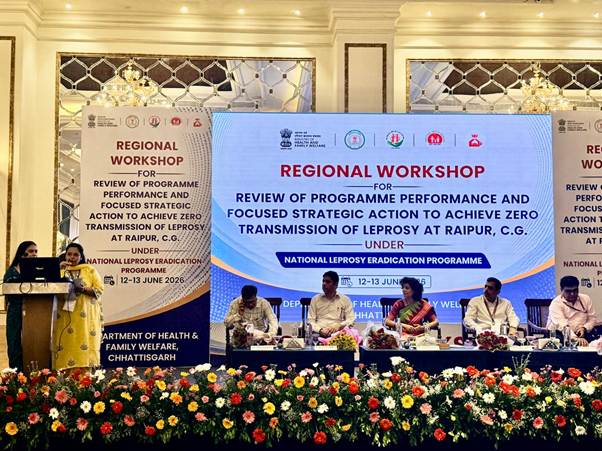
Speaking at the Occasion, Dr. Sunil V. Gitte, Deputy Director General (Leprosy), informed participants that 91,783 new leprosy cases were detected in India during 2025–26, with a prevalence rate of 0.56 per 10,000 population. Of the newly detected cases, 4.18 percent were children and 2.12 percent presented with Grade-2 Disability at the time of diagnosis.
Highlighting ongoing efforts in disability prevention and rehabilitation, Dr. Gitte informed participants that 1,591 reconstructive surgeries had been performed for persons affected by leprosy. In addition, more than 1.03 lakh Micro Cellular Rubber (MCR) footwear and over 1.25 lakh self-care kits had been distributed to support disability prevention and improve quality of life. He emphasized that active case detection, intensified contact surveillance, post-exposure prophylaxis, timely treatment, disability prevention, rehabilitation services, and community awareness remain critical pillars of the National Leprosy Eradication Programme (NLEP). He also presented focused strategies for districts reporting prevalence rates above one per 10,000 population, higher proportions of child cases, and increased Grade-2 Disability among newly detected patients.
During the workshop, participating states presented detailed reviews of programme performance, including trends in new case detection, treatment completion, contact tracing and follow-up, disability prevention and medical rehabilitation services, and IEC initiatives. States also showcased innovative practices and successful field models that have contributed to improved case detection, enhanced treatment adherence, stronger community engagement, and reduction in disability among affected persons.
Interactive technical sessions witnessed extensive deliberations among senior officials from the Government of India, representatives of participating states, WHO experts, technical institutions, and development partners. Discussions focused on district-specific challenges and practical solutions for improving programme outcomes through evidence-based microplanning, strengthened surveillance, enhanced community participation, stigma reduction, social and behaviour change communication, and improved treatment compliance.
The workshop concluded with the formulation of state-specific action plans and a renewed commitment from participating states to intensify interventions in high-endemic districts. Participants expressed confidence that coordinated efforts by the Government of India, state governments, technical institutions, development partners, and communities would significantly accelerate progress towards achieving the shared vision of a leprosy-free, disability-free, and transmission-free India.
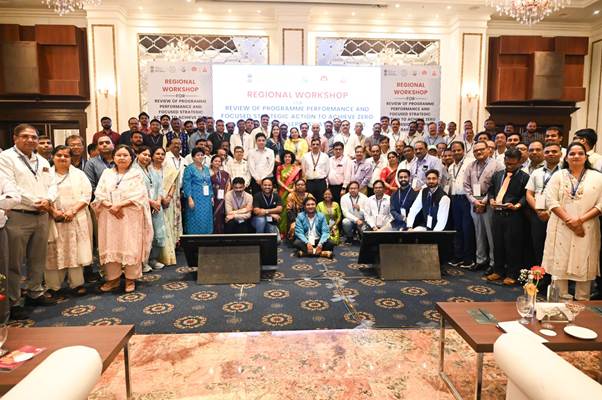
The workshop was chaired by Smt. Aradhana Patnaik, Additional Secretary and Mission Director (National Health Mission), Ministry of Health and Family Welfare, Government of India. It was attended by Shri Amit Kataria, Secretary, Health and Family Welfare Department, Government of Chhattisgarh; Shri Sanjeev Kumar Jha, Commissioner-cum-Director, Health Services and Mission Director, National Health Mission, Chhattisgarh; Shri Nikhil Gajraj, Joint Secretary, Ministry of Health and Family Welfare, Government of India; Dr. Sunil V. Gitte, Deputy Director General (Leprosy); along with Mission Directors, State Leprosy Officers, Regional Directors, and senior programme officials from participating states.
The workshop brought together nearly 200 participants, including State and District Leprosy Officers, senior officials of the Ministry of Health and Family Welfare, public health experts, representatives of the World Health Organization (WHO), Directors of Central and Regional Leprosy Training and Research Institutes, programme managers, technical experts, and development partners including the International Federation of Anti-Leprosy Associations (ILEP) and the Sasakawa-India Leprosy Foundation (SILF). Representatives from five high-priority states—Chhattisgarh, Maharashtra, Madhya Pradesh, Jharkhand, and Odisha—participated in the deliberations and shared experiences from the field.
*****
SR
HFW/ 2 Day Regional Workshop on Leprosy /12 June 2026/1
(रिलीज़ आईडी: 2272194)
आगंतुक पटल : 1752